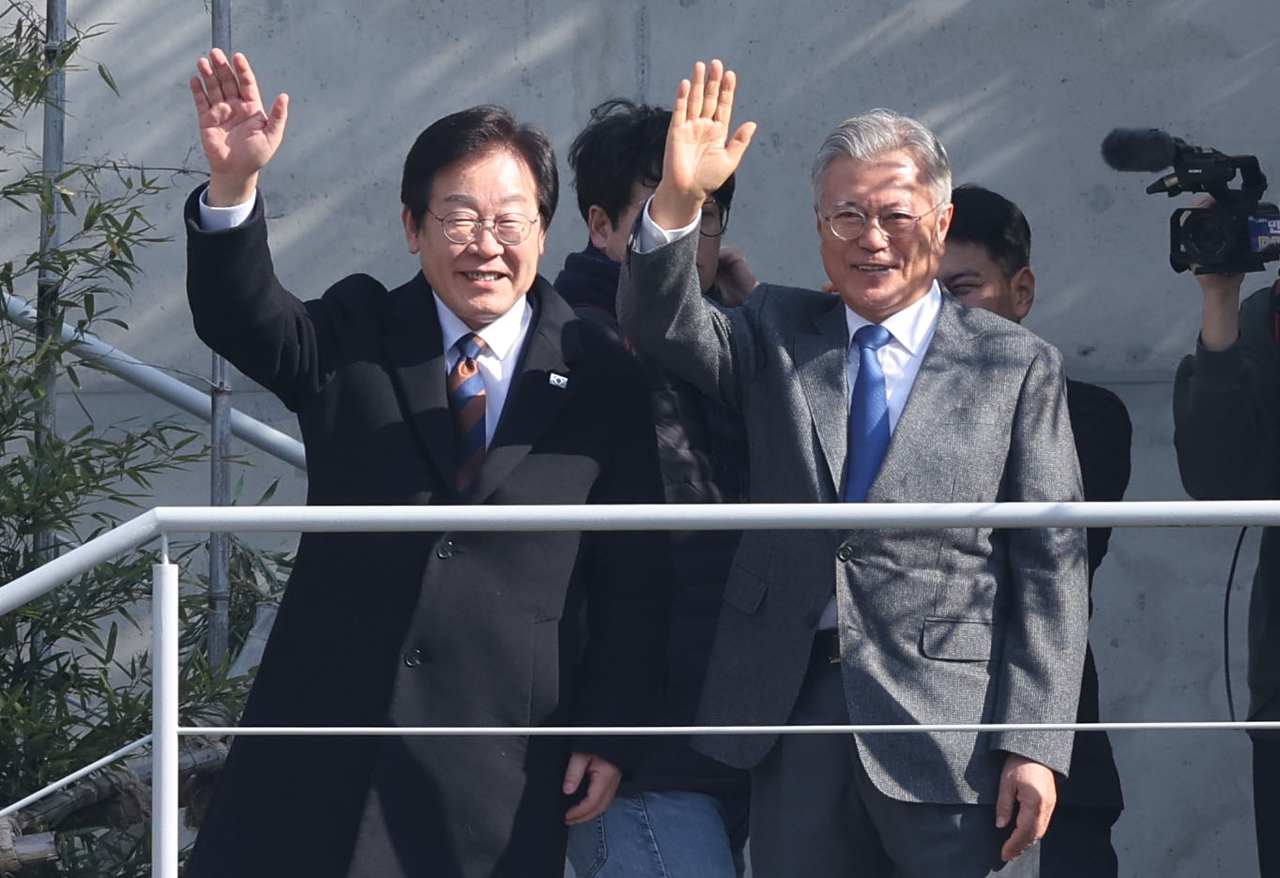
The leader of the main opposition Democratic Party of Korea, Rep. Lee Jae-myung, expressed his commitment to guiding the party during a meeting with former President Moon Jae-in on Thursday, amid signs of internal division as pro-Moon figures slammed the opposition leader for his dominance in the party.
On Thursday afternoon, Lee visited Moon’s residence in Pyeongsan Village, Yangsan, South Gyeongsang Province, marking his first visit in four months since being re-elected party leader in September.
According to Rep. Jo Seoung-lae, spokesperson for the Democratic Party, Moon expressed his support for Lee’s role as party leader, urging him to lead the party with unity amid the significant headwinds the nation is expected to face in the new year.
“(Moon) told Lee that both he and the Democratic Party appear to be taking steps toward unity and expressed his hope that they will continue on this path,” Jo told reporters after Moon and Lee’s meeting. “In particular, Moon emphasized the need for an inclusive and conciliatory approach to navigate the party through the current extreme political climate.” Further details of their discussion were not disclosed as of press time.
The opposition party leader's meeting with Moon came amid growing criticism from key figures within the main opposition party, particularly those affiliated with Moon, over the party’s heavy reliance on its party leader.
On Wednesday morning, Kim Kyoung-soo, a former governor of South Gyeongsang Province who is considered a close ally of Moon, publicly urged the party to break away from its current structure, which he described as overly centered on Lee’s leadership.
“The Democratic Party must abandon the painful labels of one-man system and privatized party,” Kim wrote in a Facebook post. “We must start changing the party’s political culture now. ... The only way forward is to build a broader, more inclusive Democratic Party,” he added.
Kim also called on Lee to issue a sincere apology to those who distanced themselves from the party following the last presidential election.
“Many people have turned away in disgrace after the 2022 presidential election, the local elections and the general election process,” he continued. “These are people who are willing to return and support us if only the minimal conditions for unity are met. We must sincerely apologize and make it possible for them to come back.”
During the candidate selection process after Lee became the party leader, some key figures close to Moon were sidelined or left the party, while allies of Lee secured key nominations. The result was a Democratic Party dominated by Lee’s supporters, less under the influence of Moon's supporters.
Kim, considered a close confidant of Moon, lost his seat as governor of South Gyeongsang Province in 2021 after being convicted of involvement in an online opinion manipulation scandal, with the top court verdict barring him from holding public office until April 2028.
His eligibility for the presidential election has been restored after a presidential pardon in August. Speculation has since grown that he could challenge Lee’s dominance within the party and emerge as a potential contender in the next presidential race.
Meanwhile, another pillar of criticism against Lee is tied to the recent decline in public support for the opposition party.
According to a survey by Korea Research International, the Democratic Party’s approval rating stood at 44 percent, only slightly above that of the ruling People Power Party, which garnered 41 percent support. This marks a 4 percentage point decline for the Democratic Party compared to early January, while the ruling party saw a 12 percentage point increase. Other pollsters have reported similar trends, reflecting the Democratic Party’s struggle to maintain public support.
Kim Dong-yeon, the former economy minister under Moon and now governor of Gyeonggi Province, also voiced concerns, saying the party’s crisis stems from a loss of credibility.
“The Democratic Party must ask itself whether it is truly capable of overcoming this crisis and proving itself as a party capable of governance,” Kim said in a press briefing on Friday. “The party is facing a trust crisis, and public support is slipping away. As a member of the Democratic Party, I sincerely apologize to the people.”
Former presidential Chief of Staff Im Jong-seok echoed similar sentiments, stating that the party’s current leadership style is stifling internal democracy.
“The Democratic Party today is failing to gain the public’s trust because it disregards dialogue and compromise while fixating solely on Lee Jae-myung,” Im wrote on his Facebook account on Jan. 21.
Lee now faces growing legal troubles that cast a shadow over his political future.
The appellate court overseeing his election law violation case has scheduled a sentencing hearing for Feb. 26, with a verdict expected as early as March.
Lee was previously sentenced to one year in prison with a two-year suspended sentence in November. If the appeals court upholds this ruling, he risks losing his eligibility to run in the next presidential election.
flylikekite@heraldcorp.com