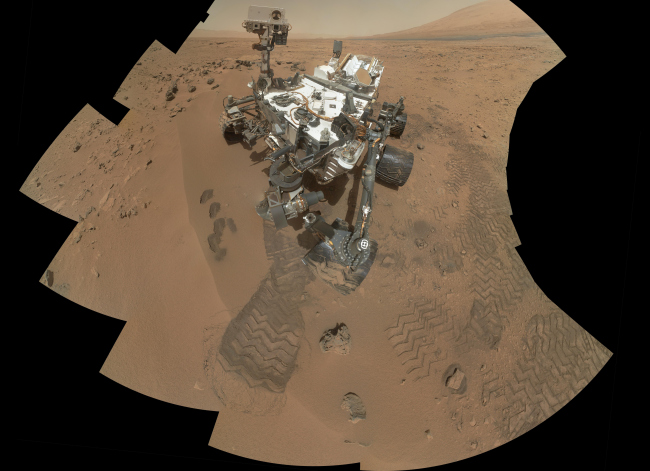
This image released by NASA shows the work site of its Curiosity rover on Mars. (AP-Yonhap News)
The Mars rover Curiosity has offered a tantalizing sign that there might have once been life on the Red Planet, but scientists said it was too soon to make much of the first soil analyses.
NASA’s Sample Analysis at Mars instruments have been sending back information as it hunts for compounds such as methane, as well as hydrogen, oxygen and nitrogen, that are the building blocks of life.
Researchers detected simple organic compounds in the soil scooped up from a crusted dune. But they cautioned that the traces of carbon could have come from meteorites or even particles the instruments picked up before launch from Earth.
“It’s not unexpected necessarily,” said Mahaffy of NASA’s Goddard Space Flight Center, who is in charge of the chemistry experiments. “It’s been exposed to the harsh Martian environment.”
The latest findings were presented Monday at a meeting of the American Geophysical Union in San Francisco. The mission managed by the NASA Jet Propulsion Laboratory is trying to determine whether conditions on Mars could have been favorable for microbes when the planet was warmer and wetter.
The Internet was abuzz over the possibility of life on Mars in relation to the latest findings. Days before the science gathering, the space agency sought to contain expectations and issued a statement insisting there’d be no big news.
The rover, which in August touched down on the floor of a 150-km impact crater near the Martian equator, has already turned up evidence that its landing site was once covered in water.
(From news reports)
koreaherald@heraldcorp.com











