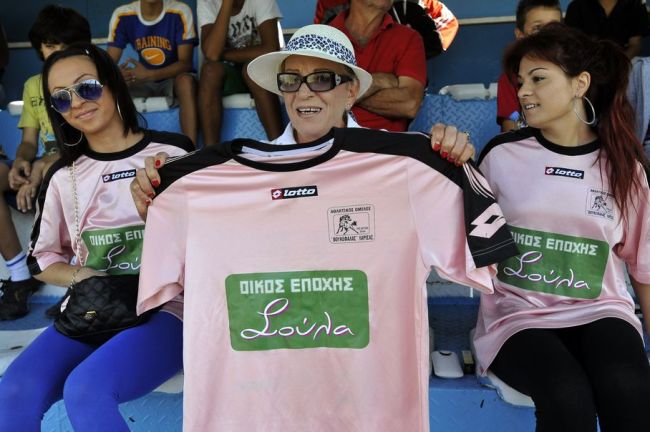
Brothel owner Soula Alevridou, centre, the benefactor of the Voukefalas amateur soccer team, holds up their new jersey for photographers, during a local championship match, in the city of Larissa, central Greece. (AP)
The world‘s oldest profession is giving a whole new meaning to love of the game.
Players on a cash-strapped Greek soccer team now wear pink practice jerseys with the logos “Villa Erotica” and “Soula’s House of History,” two bordellos it recruited as sponsors after drastic government spending cuts left the country‘s sports clubs facing ruin.
Other teams have also turned to unconventional financing. One has a deal with a local funeral home and others have wooed kebab shops, a jam factory and producers of Greece’s trademark feta cheese.
But the amateur Voukefalas club — whose players include pizza delivery guys, students, waiters and a bartender — has raised eyebrows with its flamboyant sponsorship choice.
“Unfortunately, amateur football has been abandoned by almost everyone,” said Yiannis Batziolas, the club‘s youthful chairman, who runs a travel agency and is the team’s backup goalkeeper. “It‘s a question of survival.”
Prostitution is legal in Greece, where brothels operate under strict guidelines. Though garish neon signs advertising their services are tolerated, the soccer sponsorship has ruffled some feathers in the sports-mad city of Larissa. League organizers have banned the pink jerseys during games, saying the deal violates “the sporting ideal” and is inappropriate for underage fans.
Batziolas acknowledges the sponsorship took his team by surprise. “They didn’t believe it in the beginning,” he said. “But when they saw the shirts printed, they thought it was funny.”
Near-bankrupt Greece is struggling to meet creditors‘ relentless demands to slash spending and keep the euro as its currency. As Greece heads toward a sixth year of recession, drastic budget cuts have hammered many ordinary people: Retirees have been left to cover their own medical expenses, children have lost school bus services, and sports teams have scrambled to find sponsors as businesses close under the burden of emergency taxes.
Brothel owner Soula Alevridou, the team’s new benefactor, has already paid more than 1,000 euros ($1,312) for players to wear her jerseys. The team is appealing the game ban, but that doesn‘t worry the 67-year-old Alevridou, who says she’s only in it because she loves soccer.
“It‘s not the kind of business that needs promotion,” she said, dressed all in white and flanked by two young women in dark leggings at a recent game. “It’s a word-of-mouth kind of thing.”
Her businesses, plushly decorated pastel-colored bungalows where 14 women are employed, have weathered the country‘s financial disaster far better than most, and she readily acknowledges her success.
“If we don’t help our scientists and athletes, where will we be?” she asked. “Greece has educated people, cultured people and good athletes. It‘s better to help them than take our money to Switzerland.”
Alevridou watched in disappointment as her team lost its fourth straight game, 1-0, despite her promise to players of “a special time” at her businesses if they won.
“There’s a lot still missing. We have no midfield,” said Alevridou, a slightly built woman with a husky voice. “Many of our boys have jobs that keep them working at night. And if we have a game the following morning, they can‘t have a real presence on the pitch. ... They need more help.”
They aren’t the only team suffering. Greece‘s Amateur Athletics Federation suspended all its activities for several weeks earlier this year to protest funding cuts. And even the major soccer clubs sent most of their star players abroad this summer in the face of financial trouble and poor attendance, with fans no longer able to afford tickets.
Government cuts have hurt most of the teams in the amateur league in Larissa — the majestically named Olympus, Hercules, Fearless and Sagittarius clubs, as well as Voukefalas, named after Alexander the Great’s horse.
The impact of the crisis on sports is a major local concern. The town of 200,000 fielded the only professional club to ever break big-city domination of the league, winning the national championship in 1988. In 2007, Larissa FC also rebounded from bankruptcy for victory in the prestigious Greek Cup.
Voukefalas says it needs about 10,000 euros ($13,120) a year to meet expenses, and Alevridou has promised more cash.
“Here is where it all begins, with amateur sport. It‘s where the talent is bred,” she noted. “I am a Greek woman, and I love my country.”
She watched quietly, holding a cigarette and wearing a straw fedora with a leopard print band, as her team struggled.
“The team will get better,” she said. “I’m certain of it.” (AP)
<관련 한글 기사>
매춘女들 의지, 위기의 축구팀을 구하다
재정 파탄위기에 놓인 그리스의 축구 팀을 한 윤락업소가 구제해 화제다.
그리스 라리사 지역을 기반으로 한 아마추어 축구클럽인 부케팔로스(Voukefalas)는 14명의 직원을 고용하고 있는 윤락업소의 사장 솔라 알레브리두를 새로운 구단주로 맞았다.
그리스의 경제 사정이 갈수록 열악해 짐에 따라 정부는 그리스 내 스포츠 클럽에 대한 지원을 대폭 삭감했다. 이러한 조치에 항의하기 위해 그리스아마추어체육연합은 수 주간 모든 활동을 중단했다. 심지어 일부 메이저급 축구 클럽들 조차 이번 여름 이적시장에서 심각한 경영난에 봉착해 주전 선수들을 다른 팀으로 떠나 보내야 했다.
부케팔로스의 사장이자 백업 골키퍼인 이아니스 바트지올라스는 이와 같은 스폰서 선택은 생존과 직결된 문제라고 밝혔다. 실제로 부케팔로스 외에 다른 아마추어 스포츠 팀들도 장례업체, 케밥 레스토랑, 치즈 공장 등 이색적인 기업을 스폰서로 받아들이는 사례가 늘고 있다.
그리스 축구리그 주최측에서는 이 팀이 스폰서십으로 새로 채용한 핑크색 유니폼이 ‘스포츠 정신에 위배’되며 미성년자 팬들에게 악영향을 미칠 수 있다는 이유로 경기에 입고 나오는 것을 금지했다.
부카펠로스는 연간 구단의 비용을 충당하기 위해 1만 유로가 필요하며 그 전액을 포함한 이상의 금액을 알레브리두가 지원하기로 한 것.
67세의 윤락업체 여사장인 알레브리두는 “그리스에는 여러 훌륭한 운동선수들이 많다. 나는 내 돈을 은행에 넣어두는 것보다 그들을 지원하는 것이 좋을 것이라고 생각했을 뿐”이라고 말했다. (코리아헤럴드)
koreaherald@heraldcorp.com











