Moon scores his seventh consecutive primary victory in South Gyeongsang
Anxiety is growing within the main opposition Democratic United Party as its presidential primaries are failing to attract attention of even its own members.
For the DUP, it is crucial that the party’s nominee heightens his public credential ahead of competition with liberal rival professor Ahn Cheol-soo or eventually conservative foe Rep. Park Geun-hye of the ruling Saenuri Party.
As of the seventh round of voting in South Gyeongsang on Tuesday, the average in-party voting rate was a mere 53 percent, according to officials.
The figure was lower than the average turnout in the party’s chairmanship race.
At the core of this voting unpopularity is the unbeatable dominance of Rep. Moon Jae-in, who has continued to win primaries since the first regional vote in Jeju on Aug. 25.
Controversy over the legitimacy of its voting system, which gives sizable weight to mobile votes by citizens, also contributed to indifference among the public.
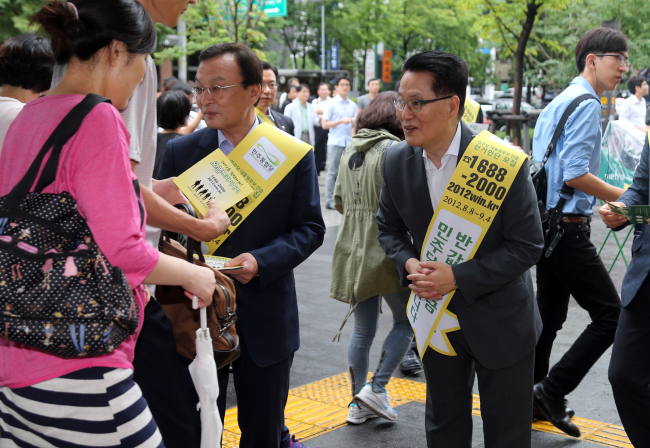
Democratic United Party Chairman Rep. Lee Hae-chan and floor leader Rep. Park Jie-won hand out leaflets promoting the party’s half-tuition policy and calling for citizens’ participation in its presidential primary on the street in Seoul. Despite such efforts, its presidential race is failing to get public attention. (Yonhap News)
On Tuesday, Rep. Moon secured his seventh consecutive primary victory in South Gyeongsang Province, the political turf of former local governor, Kim Doo-kwan.
Moon won 45.1 percent of the total valid votes, followed by Kim’s 43.9 percent.
Last week, the former presidential chief-of-staff emerged victorious even in North Jeolla Province, where former party chief Sohn Hak-kyu was hoping to gain an edge.
Though he has yet to face heated races such as the one in South Jeolla Province this Thursday, few refute that Moon will have an easy victory and grab the party candidacy.
He may, however, have to join a final run-off election if he fails to achieve more than 50 percent of valid votes.
It is this predictability which has led to the indifference of the in-party voters and the public, observers said.
The DUP earlier pledged to hold an exciting race in contrast to the Saenuri primary in which Rep. Park won a sweeping victory by raking up over 84 percent of the votes.
Moon, however, refuted that his consecutive victories were not an obstacle to the party’s presidential plan.
“Heated competition may be one of the factors of a successful primary but is not as important as the content,” he said through a statement.
Some also pointed at the party’s factional disputes, as observed in the mobile voting feud in the early stage of the primary.
After the first regional vote in Jeju, the three underdog candidates claimed that the mobile voting system was lopsided in Moon’s favor and even signaled they would step down from the primary if necessary.
Though they decided to continue their race, the trio ― Sohn, Kim Doo-kwan and Rep. Chung Sye-kyun ― blamed Moon as well as the party leadership for failing to prevent such controversies.
Some also accused party chief Rep. Lee Hae-chan and floor leader Rep. Park Jie-won of colluding with the Moon camp.
“The three-way alliance of Moon, Lee, and Park is the main reason for the lowered participation rate in the primary,” said Kim Doo-kwan in a radio interview on Tuesday.
Reflecting the discontent within the party, the South Gyeongsang primary on Tuesday was disturbed by abusive words and physical scuffles of some party members.
“We feel a sense of crisis as the public turns its back on the DUP primary while the conservative camp continues its political offensives,” said Rep. Kang Gi-jung, member of the Supreme Council, on Monday.
“The leadership is responsible for failing to find the solutions to the given situations.”
koreaherald@heraldcorp.com











