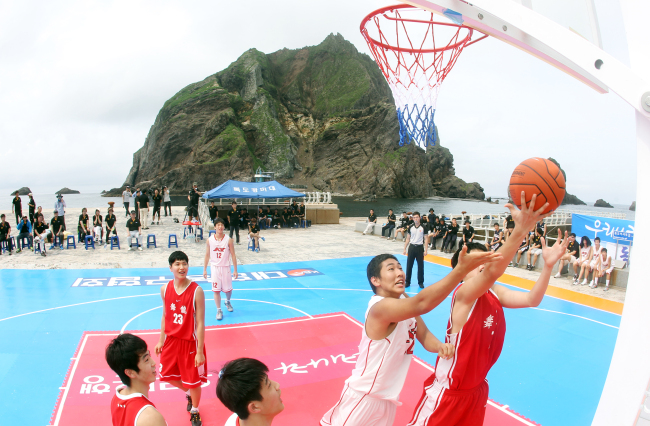
High school basketball players participate in a match held at Dokdo on Saturday. Organized by the Korea Basketball Association, the event, the second of its kind, is to highlight Korea’s sovereignty over its easternmost islets. (Yonhap News)
Seoul to deliver to Tokyo document rebutting offer to take case to ICJ
As Korea and Japan’s spat over Dokdo continues, some worry that both would lose more than gain given the intractable nature of the issue.
The rekindled row over the islets in the East Sea has apparently dampened the mood for bilateral cooperation in security, economy and other areas of mutual concern in the region and beyond.
The two countries’ war of words has also worsened domestic public opinion of each other, forging a retaliatory mood.
The row is expected to escalate this week as Seoul plans to deliver a diplomatic document rebutting Japan’s proposal to bring the Dokdo case to the international court.
In the document, Seoul is expected to reiterate that Dokdo is not the subject of a dispute, and that it is legally, historically and geographically Korea’s territory.
A biannual defense drill for Dokdo is also scheduled for next month.
All these developments have apparently unnerved the U.S., the key ally of the two Asian neighbors whose cooperation is believed to be of great strategic value for America amid its deepened engagement in the region.
“It’s obviously not comfortable for us when they have a dispute between them,” State Department spokeswoman Victoria Nuland said at a press briefing last week, apparently expressing displeasure over the spat.
“So our message to each of them is the same: Work this out; work it out peacefully; work it out through consultations.”
The spat was reignited when Korean President Lee Myung-bak made an unprecedented visit to Dokdo on Aug. 10 ― five days before the country’s Liberation Day. Diplomatic tension with Tokyo sharply escalated after Lee called for Emperor Akihito to apologize for Japan’s colonial atrocities.
Ahead of possible snap elections in October or November, Japanese Prime Minister Yoshihiko Noda has taken a tough stance over the issue, saying that Japan, a maritime state, would sternly deal with territorial issues. He called Korea’s control of the islets “illegal,” reiterating that the case should be brought before the International Court of Justice.
In light of the diplomatic row with Korea, Japan, also mired in territorial disputes with China and Russia, appears to be increasingly isolated in the region.
As if to reflect its waning economic clout, Tokyo’s warning of the possibility that it would scale back a bilateral currency swap deal with Seoul did not seem to have much impact on the market, analysts here said.
Experts argue that the recent moves by Japan have laid bare its failure to depart from its colonial past and sincerely address calls for an apology by the victims of its wartime atrocities.
“The spat, in part, shows the level of sincerity in Japan’s repentance of its past. For that, Koreans are disappointed and Seoul cannot help but respond sensitively to the issue,” said Nam Chang-hee, political science professor at Inha University.
“Washington could also express discontent over Japan’s failure to appropriately recognize its past, though it remains neutral over Dokdo now. After all, it is a crucial issue for Japan, which could get estranged not only from Korea and China, but also from the U.S.”
Nam added that Japan appears to be responding somewhat emotionally to this territorial case in consideration of the overall social angst stemming from its two decades of economic malaise, recent earthquakes and the rise of other regional powers such as China.
Amid the sparring, the loss for Korea is that the islets have received international media attention as a disputed area, observers said.
It has also made it difficult for the two countries to work together for the resolution of historical issues including the urgent one involving Korean women forced into sexual slavery during World War II.
Some experts have even raised concerns that the bilateral spat would embolden the political right in Japan and even make those friendly toward Korea turn back to join the growing conservative tide.
“Both nations need each other for greater causes. For this, they should pursue win-win cooperation. However, they now appear to be caught in a tense, zero-sum game, which is highly undesirable for the long-term interests of the two nations,” said Chun In-young, professor emeritus at Seoul National University.
By Song Sang-ho (sshluck@heraldm.com)
koreaherald@heraldcorp.com











