Close to the foot of Mt. Nam in downtown Seoul, an inconspicuous sign marks a school. It has no playground, a requirement for any official school. Students do not wear uniforms, and some look like they belong at a university rather than this high school.
“Math is really tough, but English isn’t easy, either,” says Kang Min. He is 26 years old and enrolled at Yeomyung just six months ago. He is among 70 students attending the school opened just for North Korean defectors like himself. Kang is one of the older students at Yeomyung. The youngest just turned 16.
Yeomyung was opened in 2004 by members of churches and advocacy groups for North Korean defectors as an alternative school for young people who braved dangerous journeys out of their home country and settled in the South. It was not until 2010 that it was formally recognized as a school, becoming the first and only such academic institution to be accredited.
For the students and the teachers, education sometimes takes a back seat to emotional healing. The students speak of their haunting experiences before safely arriving in South Korea ― hunger, sexual abuse, forced labor, torture, and brushes with death hiding from hunters who want to send them back to North Korea where they face execution or a lifetime at concentration camps. Some are unable to cope with their past and leave school after a short while.
“The kids tell you about the smell of blood of those executed in state organized public executions,” said Cho Myung-sook, the school’s vice principal. “We are not a missionary school, but to be able to cope with this, you need to have strong beliefs.”
According to Cho, 30 percent of the students suffer from severe psychological problems that require long-term medication.
Volunteers come to the school three times a week to give psychological counseling.
Most of the students see themselves as very lucky to attend Yeomyung. In regular South Korean schools, North Korean defector kids are often bullied because they do not understand what comes as second nature to their peers. The age difference often sets them far apart. “When a 26-year old does not know even the most basic English vocabulary, he becomes an outsider very quickly ― or worse ― starts to mingle with the wrong people,” Cho said.
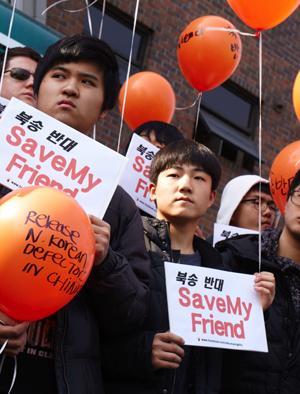
Students at Yeomyung helped organize the “Save My Friend,” a campaign to stop China from repatriating North Korean defectors. (Yonhap News)
Getting along in the new environment in South Korea is also often difficult. “We are not divided by cultural differences; it is more a developmental difference,” said Kang. “I do not just mean economically, but also morally. In North Korea people need to lie and cheat to survive.”
Ok Taek-yeon (name changed), 26, says he learned about manners and civilized behavior only after having come to Yeomyung. He found out about the school just after arriving in the South through a volunteer aiding North Korean defectors.
South Korea is not as rich and full of glitzy “bling bling” as he imagined watching K-pop dramas and movies in China, said Ok.
“But life here is good.” He strongly refuted criticism that Yeomyung separates defector students from South Koreans. “I have many South Korean friends. In case I do not understand something, I just ask. Period,” he said.
Until it became an authorized alternative school, Yeomyung had to file countless pleas and complaints with the government. In the end, South Korea’s education law had to be changed. Until 2010, schools had to own the school building and have a sports field, neither of which Yeomyung has. Even with the accreditation, Cho and fellow activists do not receive any financial support from the state and run the school on donations and volunteers only. While private organizations and churches help, the school still lacks even basic necessities. The only room big enough to host physical workout sessions is also used as the auditorium, cafeteria and music room.
“We changed the small lounge to counseling rooms for our psychologists. Professional expertise and support is much more helpful for the students than a lounge,” explained Cho.
The vice-principal knows what it is like to feel helpless. More than 20 years ago while in college, a call by an illegal Pakistani migrant worker changed her life’s path. The worker apparently had misdialed, but he pleaded with Cho to help a colleague who was injured at work. She decided to help, and ever since, she has been an activist for migrant workers. After years of lobbying for the underprivileged, she also successfully pushed changes in South Korea’s labor laws to improve the rights of migrant workers.
Then, in 1997, she was called to help North Korean defectors.
While on a honeymoon in China, she came in contact with North Korean defectors for the first time. The newlywed sold her wedding ring to help pay for their way to South Korea. As she tried to cross the border out of China, she was caught and incarcerated by Chinese authorities. It was her South Korean passport that saved her.
Cho is satisfied with the direction the school is taking. She does not want to just teach math and English. The goal is to help the students adjust to South Korean society in a practical way.
Field trips are therefore an integral part of the school’s work.
Education at Yeomyung also focuses on enabling the children to take responsibility and encouraging them to contribute to the society. The ongoing “SaveMyFriend” campaign in front of the Chinese Embassy in Seoul, an effort to rescue fellow North Korean defectors in danger of being repatriated by Chinese authorities, was launched by the students at Yeomyung school.
On a daily basis, however, Cho and her colleagues have to deal with absolute basics. “In the beginning, many of our students believe basketball is about keeping the ball as long as possible, so no one else gets it. You can imagine what such a game looks like,” Cho said.
(Yonhap News)
koreaherald@heraldcorp.com











