PYEONGCHANG, Gangwon Province ― The head of PyeongChang 2018 Olympics organizing committee denied the possibility of changing its downhill skiing course despite demands from civic groups.
“We have already made a plan, and we have no option,” Kim Jin-sun, president of the PyeongChang 2018 Organizing Committee said Thursday.
To meet Olympic standards, a men’s downhill course must cover between 800 meters and 1,000 meters of vertical drop. Women’s courses must drop between 500 meters and 800 meters.
PyeongChang proposed during its bid to the International Olympic Committee to build a downhill course on the slope of Mount Gariwang, some 15 kilometers south of PyeongChang.
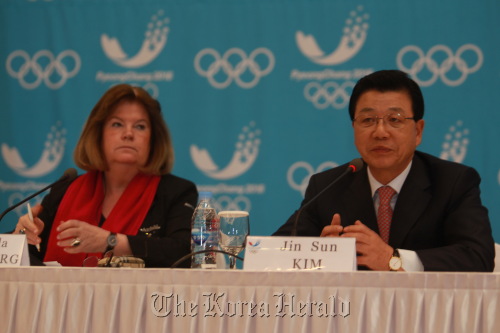
Kim Jin-sun (right), president of the PyeongChang 2018 Organizing Committee and Gunilla Lindberg, head of the IOC Coordination Commission, attend a news conference in PyeongChang on Thursday. (PyeongChang 2018 Organizing Committee)
But local environmental groups are currently protesting the venue’s location since some 2,400 hectares of forest on the mountain was designated in 2008 as a nature reserve.
“There are no mountains near PyeongChang that meet the conditions for international alpine skiing venues,” Kim said Thursday during a news conference following a meeting with the IOC Coordination Commission.
But Kim noted that the local organizer would work closely together with civic groups to minimize the environmental impact of the downhill course.
A special environmental advisory group will now work together with the local committee in planning and constructing the downhill course, according to the committee.
Meanwhile, IOC Executive Board member Gunilla Lindberg, who is also the head of the IOC Coordination Commission, said she was pleased with PyeongChang’s progress.
“Our visit this week is a start of a long and exciting journey,” Lindberg said Thursday following a three-day inspection in PyeongChang.
“We were pleased by the high quality of presentations that were delivered by a very capable team.”
She added: “They have a good grasp of what is expected of them. They have taken full advantage of the bid process.”
During their three-day visit, the 11-member IOC delegation, led by Lindberg of Sweden, held meetings with local authorities and delegates of the local organizing committee, including Kim, Choi Moon-soon, governor of Gangwon Province, and Korean Olympic Committee President Park Yong-sung.
The IOC delegation also checked on PyeongChang’s proposed venues in Alpensia Resort, also in Gangneung, a 30-minute drive from PyeongChang.
It was the first visit by the IOC officials since the establishment of the organizing committee at the end of last year.
“This is the start of a six-year-long journey. Of course there is a lot of work to be done, but I’m sure the good team and the good concept will bring a successful planning,” Lindberg added.
The next meeting between the IOC delegation and the local organizer is scheduled for February 2013.
By Oh Kyu-wook (596story@heraldm.com)
koreaherald@heraldcorp.com











