KEROBOKAN, Indonesia (AFP) ― In 1876 French poet Arthur Rimbaud joined the Dutch colonial army, sailed to the Indonesian island of Java and then deserted and fled into the jungle. No one knows what happened next.
More than 130 years later, an American author followed in the Frenchman’s footsteps to try and solve the mystery.
“It’s like a Sherlock Holmes story,” said Jamie James, alluding to the detective work needed to trace where the enigmatic Rimbaud, who was born in 1854 and died just before turning 37, wandered to.
Nearly 200 letters by the tortured poet, who described his process of attaining visionary insights as “a long, involved and logical derangement of all the senses,” map out all ― or nearly all ― of his travels in Africa and the Middle East.
But little detail has escaped Java island about what transpired in Indonesia, then a Dutch colony.
“It remains one of the most elusive enigmas among the many that constitute his tumultuous life and is often overlooked outside Rimbaud circles,” James wrote in “Rimbaud in Java: The Lost Voyage,” published last year.
“He never wrote anything about Java because he was a fugitive. He could have been arrested” by the Dutch for desertion, said the Texan, who has livedin Indonesia since 1999 and has been a Rimbaud enthusiast since childhood.
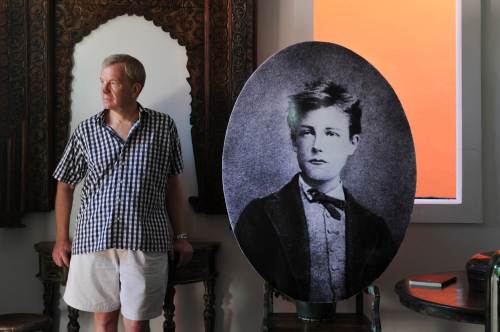
U.S. author Jamie James stands beside a portrait of famous French poet Arthur Rimbaud in his shop in Kerobokan, Indonesia, on Nov. 14. (AFP-Yonhap News)
The only fact known about Rimbaud’s eastern sojourn is that he embarked on June 10, 1876, at age 21, for the Dutch East Indies, or modern-day Indonesia.
In a typically whimsical decision Rimbaud, who wrote the anti-militarist “The Sleeper in the Valley,” embarked on the journey after signing up for six years in the Dutch colonial army.
“It was the call of money and the Orient,” said James, adding that 300 florins were paid to all recruits, a small fortune at the time.
Rimbaud, he said, grabbed the opportunity to finally reach the East, which had attracted him so much.
On July 22 he and hundreds of other recruits arrived in Jakarta, or what was then called Batavia, to join their garrison at Salatiga, a village in central Java perched on the foothills of Merlabu, a dormant volcano.
In Java “The man with the wind at his heels” ― as fellow poet and friend Paul Verlaine once described Rimbaud’s wanderlust ― had never been this far from home.
Author of “The Drunken Boat,” and a big fan of alcohol, Rimbaud must have been overjoyed that gin was not only permitted but encouraged by the Dutch as a way of instilling bravery in soldiers.
But he remained only two weeks at the garrison. On Aug. 15 he deserted, leaving his possessions to be sold for the benefit of the local orphanage.
He reappeared only on Dec. 31, 1876, when he returned to his mother in Charleville-Mezieres in northern France.
Between the dates of his disappearance and reappearance lie four-and-half months of mystery, which have raised all manner of speculation.
Paterne Berrichon, who had never met the poet but became his self-proclaimed biographer after marrying Rimbaud’s sister, affirmed that his late brother-in-law had hidden in the jungle, where orangutans had taught him to survive ― despite the fact orangutans disappeared from Java two centuries ago.
koreaherald@heraldcorp.com











