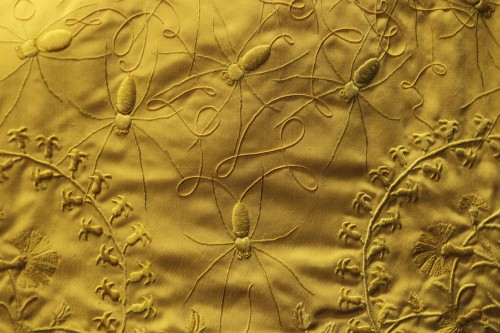
<YONHAP PHOTO-1317> Details are seen of a spider silk cape, designed by Simon Peers and Nicholas Godley, on display at the Victoria and Albert Museum in London, Tuesday, Jan. 24, 2012. The cape is woven and embroidered in Madagascar and is made from the silk of more than a million female Golden Orb Weaver spiders collected in the highlands of Madagascar. The hand-woven textile is naturally golden in colour and took over four years to create. (AP Photo/Sang Tan)/2012-01-24 22:52:32/ <저작권자 ⓒ 1980-2012 ㈜연합뉴스. 무단 전재 재배포 금지.>
Details of a spider silk cape designed by Simon Peers and Nicholas Godley are seen on display at the Victoria and Albert Museum in London, Tuesday.
AP-Yonhap News
Details are seen of a spider silk cape, designed by Simon Peers and Nicholas Godley, on display at the Victoria and Albert Museum in London, Tuesday, Jan. 24, 2012. The cape is woven and embroidered in Madagascar and is made from the silk of more than a million female Golden Orb Weaver spiders collected in the highlands of Madagascar. The hand-woven textile is naturally golden in colour and took over four years to create. (AP Photo/Sang Tan)/2012-01-24 22:52:32/ <저작권자 ⓒ 1980-2012 ㈜연합뉴스. 무단 전재 재배포 금지.> Details of a spider silk cape designed by Simon Peers and Nicholas Godley are seen on display at the Victoria and Albert Museum in London, Tuesday. AP-Yonhap News

Details of a spider silk cape designed by Simon Peers and Nicholas Godley are seen on display at the Victoria and Albert Museum in London, Tuesday. (AP-Yonhap News)

LONDON (AFP) ― An astonishing golden outfit made from the silk of spiders goes on display at London’s Victoria and Albert Museum on Wednesday, the largest example of the material in the world.

The four-meter-long hand-woven textile, a natural vivid gold colour, was made from the silk of more than one million female Golden Orb spiders collected in the highlands of Madagascar by 80 people over five years.

It was made by Englishman Simon Peers and American Nicholas Godley, both of whom have lived and worked in Madagascar for many years, and inspired by 19th century illustrations detailing the largely forgotten art.

The last known spider silk textile was created for the Paris Exposition Universelle in 1900, but no examples remain.

The spiders are collected each morning and harnessed in special contraptions which allow handlers to extract their silk, 24 spiders at a time.

At the end of the day, the spiders are returned to the wild.

The process is extremely laborious ― on average, 23,000 spiders are needed to create about 28 grams of silk, according to the V&A.

The textile is on show at the museum from Jan. 25 to June 5.


koreaherald@heraldcorp.com










