Preliminary candidate registration for the April general elections began Tuesday, the National Election Commission said, partially kicking off the crucial polls that could impact the 2012 presidential race.
It is the first time in 20 years that South Korea will elect a new parliament and a new president in the same year. Parliamentary elections are held every four years and the presidential votes occur every five years.
The registration runs through March 21, while full-fledged official campaigns are allowed for two weeks before the April 11 elections, the NEC said.
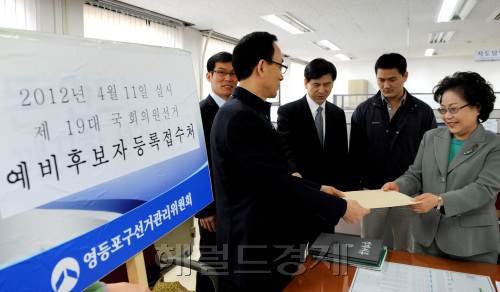
Lee Gyeong-sook (right), chair of the Yeongdeungpo B constituency committee of the main opposition Democratic Party, submits her preliminary candidate registration papers for the April 11 general elections to the district election management committee in Seoul on Tuesday. (Yang Dong-chul/The Korea Herald)
Pre-registered candidates can open offices and partially conduct campaigns through e-mails, text messages and phone calls, and distribute election pledges to their electoral districts on a limited basis, it noted.
Political analysts say the results of the upcoming elections could serve as a gauge of public sentiment for the presidential race, which comes eight months later.
Voters have shown strong disenchantment with the highly divisive political establishments that have been plagued with partisan conflicts and corruption. President Lee Myung-bak has also seen his approval ratings falling in recent months due in part to growing voter discontent over slipping living standards and a widening income gap between the rich and poor.
The ruling Grand National Party holds 169 seats in the 299-member unicameral parliament, while the main opposition Democratic Party controls 67 seats.
(Yonhap News)
koreaherald@heraldcorp.com











