The world of official development assistance is changing from superficial input to focusing on output and the strength of the medium used to deliver aid, countries and institutions agreed in Busan on Thursday.
As former British Prime Minister Tony Blair stated earlier in the week, the capacity of developing countries needs to be strengthened along with the link with institutions in order for effective sustainable development outcomes.
At the Fourth High Level Forum on Aid Effectiveness, which ended its three-day run on Thursday, countries including the U.S., U.K. and Korea and institutions like the World Bank have endorsed the New Consensus on More Effective Institutions for Development.
Drawing on lessons learned from the two previous meetings in Paris in 2005 and Accra, Ghana in 2008, it supports the strengthening of institutions and policies for effective delivery.
“It is no longer good enough to cite the number of textbooks purchased or the number of farmers trained as a result,” said Rajiv Shah, administrator of the U.S. Agency for International Development.
“We have to show the effect of those textbooks on literacy or the effect of those trainings on crop yields.”
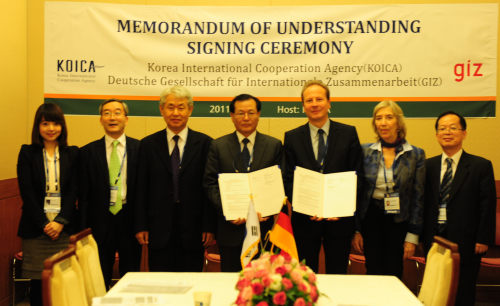
Korea International Cooperation Agency President Park Dae-won (center) poses with Christoph Beier (third from right), managing director of Deutsche Gesellschaft fur Internationale Zusammenarbeit, and other officials after agreeing to cooperate on official development assistance, in Busan on Thursday. (KOICA)
In order to see those results, the New Consensus states that core state functions and independent oversight institutions must be strengthened to boost the effectiveness of financial resources, among others.
“We are convinced that, if the unfinished aid effectiveness agenda is to be fully implemented, effective institutions and policies, especially partner countries, are a prerequisite,” said Tirivangani Mutazu of BetterAid.
The Organization for Economic Cooperation and Development Secretary-General Angel Gurria stressed that the new motto of its organization will be “better institutions for better policies for better lives,” when talking about development.
Another prominent subject has been the inclusion of the private sector in the discussion of development.
As the number of players within the official development assistance community expands, the relationships and network add an immense level of complexity, an issue that the efficiency of businesses can address.
Clare Melford, chief executive officer at the International Business Leaders Forum, said it is “quite bewildering” to see the complexity between the number of organizations and the different government processes.
“To get the most out of the business community, what the development sector really needs to do is move quickly from dialogues and process to action,” she said.
“Business is brilliant at making things smaller, faster and easier to use, which for the development community means giving us a one-stop shop to enable us to interact and to bring the skills that we can bring to development challenges.”
And in terms of the amount of resources being invested between the public and private sector, all delegates here including U.S. Secretary of State Hillary Clinton acknowledged that the private sector wins.
“The private sector is now widely recognized as a key part of sustainable development,” said Ben Knapen, Secretary of State for Development Co-operation of the Netherlands.
And the private sector is also seen as critical to capacity development as it establishes new enterprises, creates jobs, provides goods and services, generates income and profits and contributes to public revenues.
According to a joint statement by representatives from both the public and private sectors, there are five important principles when dealing with cooperation between the two, including sustainability, transparency, collective action and accountability for results.
By Robert Lee (robert@heraldm.com)
koreaherald@heraldcorp.com











