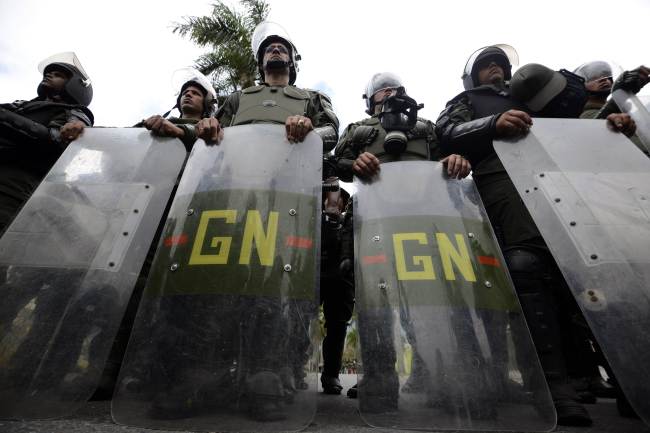
CARACAS (AFP) ― Student protesters marched toward the Cuban Embassy on Tuesday in yet another day of antigovernment demonstrations in Caracas as the United States announced the tit-for-tat expulsions of three Venezuelan diplomats.
The U.S. action, which answered Venezuela’s expulsions of three American diplomats a week ago, came a day after President Nicolas Maduro said his government would name a new ambassador to Washington.
The State Department said the Venezuelans would have 48 hours to leave and that Caracas needed to “show seriousness” in order for the relationship between the two countries to move forward.
Separately, Panama called for an “urgent” foreign ministers’ meeting of the Organization of American States to seek a solution to the Venezuelan crisis “through dialogue.”
Caracas appeared to be slowly returning to normal after a night of sporadic clashes, although in some middle class neighborhoods streets were still partially blocked by barriers of rubble and garbage.
Tuesday morning, small groups of youths made their way toward the Cuban Embassy, another potential flashpoint and a target of opposition ire.
“Venezuelans who don’t protest, don’t get out of this. Join us,” read a banner set amid a small group of students.
But by midday just dozens of people had joined the march, suggesting an easing up of pressure on the eve of a national dialogue convened Wednesday by Maduro.
Maduro invited “all social, political, union and religious groups” to take part in the “national peace conference,” although he provided few details.
The Venezuelan president, the late Hugo Chavez’s handpicked successor, also said he would ask the National Assembly to form a Truth Commission to look into the protests, which he claims are an attempt to “justify foreign intervention in Venezuela.”
Maduro, who sees the protests as a coup d’etat in the making, last week kicked out three U.S. diplomats who he said had met with student protest leaders.
But he said his government would name a new ambassador to the United States on Tuesday.
Maduro said he was naming a new ambassador because “Americans think we are killing each other” and he wants to improve dialogue with the U.S.
The two countries have not exchanged ambassadors since 2010, reflecting the bad blood that has prevailed between the two trade partners since Chavez came to power in 1999.
State Department spokeswoman Jen Psaki said Washington had seen reports about Maduro’s intention.
“But Venezuela also needs to show seriousness for us to be able to move forward. And recent actions, including expelling three of our diplomats, continue to make that difficult.”
Even as he seemed to extend an olive branch, Maduro lashed out at comments by White House spokesman Jay Carney, who on Monday urged him to concentrate on dialogue with the opposition and free detained demonstrators immediately.
“Are you the Venezuelan Supreme Court? Does the United States wield judicial power in Venezuela to decide who is guilty and who should go free?” Maduro exclaimed.
He spoke on a day that saw some of the worst protests against his government since the protests began in the western state of Tachira on Feb. 4.
In the latest reported death, a student who was on a rooftop terrace fell backwards to his death on the street as police were breaking up the crowd.
With 45 people still under arrest after marches largely inspired by the country’s dire shortages of basic goods and longstanding problems with inflation, the potential for escalation remained visible.
In a rare public split within Maduro’s ranks, a ruling party governor called for the release of all jailed protesters.
Jose Gregorio Vielma Mora, the governor of the western state of Tachira where the student-led protests began, also criticized the government’s use of the military, calling the response “a grave error” and “unacceptable excess.”
koreaherald@heraldcorp.com











