For more than 70 years, Fred Starrh’s family was among the most prominent cotton growers in California’s San Joaquin Valley. Then shifting global markets and rising water prices told him that wouldn’t work anymore.
So he replaced most of the cotton plants on his farm near Shafter, 200 km northwest of Los Angeles, and planted almonds, which make more money per acre and are increasingly popular with consumers in Asia.
“You can’t pay $1,000 an acre-foot to grow cotton,” said Starrh, 85, crouching to inspect a drip irrigator gently gurgling under an almond tree.
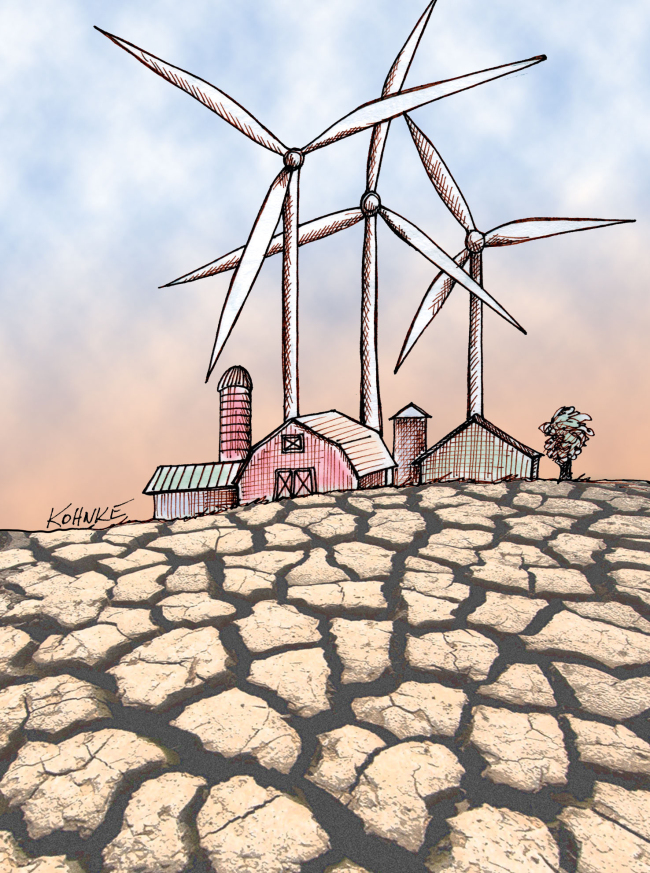
Such crop switching is one sign of a sweeping transformation going on in California ― the nation’s biggest agricultural state by value ― driven by a three-year drought that climate scientists say is a glimpse of a drier future. The result will affect everything from the price of milk in China to the source of cherries eaten by Americans. It has already inflamed competition for water between farmers and homeowners.
Growers have adapted to the record-low rainfall by installing high-technology irrigation systems, watering with treated municipal wastewater and even recycling waste from the processing of pomegranates to feed dairy cows. Some are taking land out of production altogether, bulldozing withered orange trees and leaving hundreds of thousands of acres unplanted.
“There will be some definite changes, probably structural changes, to the entire industry” as drought persists, said American Farm Bureau Federation president Bob Stallman. “Farmers have made changes. They’ve shifted. This is what farmers do.”
In the long term, California will probably move away from commodity crops produced in bulk elsewhere to high-value products that make more money for the water used, said Richard Howitt, a farm economist at the University of California at Davis. The state still has advantages in almonds, pistachios and wine grapes, and its location means it will always be well-situated to export what can be profitably grown.
That may mean less farmland in production as growers abandon corn and cotton because of the high cost of water. Corn acreage in California has dropped 34 percent from last year, and wheat is down 53 percent, according to the USDA.
Cotton planting, Starrh’s one-time mainstay, has fallen 60 percent over the decade, while almonds are up by more than half. (Bloomberg)
koreaherald@heraldcorp.com











