Ex-president dismisses U.N. sanctions, pulling party from new cabinet
SANAA (AFP) ― Yemen’s former President Ali Abdullah Saleh dismissed U.N. sanctions against him and senior Huthi rebel chiefs, pulling his party Saturday from a new cabinet and plunging the country into deeper chaos.
Also Saturday, al-Qaida claimed it had killed dozens of Shiite rebels and tried to assassinate the U.S. ambassador, as the rebels also rejected a new government announced on Friday.
A day after the U.S.-proposed U.N. measures including a visa ban and asset freeze were adopted, Saleh told members of his General People’s Congress the measures are “rejected.”
The new cabinet was formed shortly before the U.N. Security Council slapped sanctions against the influential former president and two rebel commanders for threatening peace.
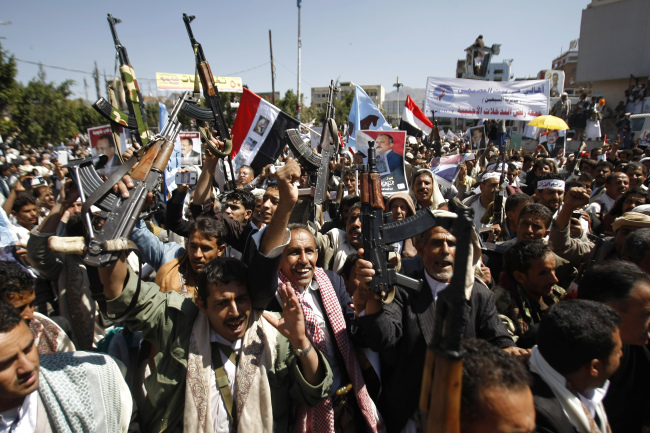
Earlier, in apparent retaliation, Saleh’s GPC also sacked from its leadership President Abdrabuh Mansur Hadi, after accusations he had solicited the sanctions.
The GPC also said it had not been consulted about the long-awaited cabinet, and urged party nominees to turn down their assigned ministries.
Saleh said he was willing to give up the immunity he was granted after stepping down in February 2012 following nationwide protests, and to face Yemeni justice.
“Find any (corruption) files, refer them to justice and lift the immunity. I will be there to appear in court,” he told the GPC.
The GPC said the U.N. decision to penalize Saleh for allegedly obstructing the political process is “strange,” insisting that the former strongman “stepped down peacefully” for the sake of a political compromise.
The Huthi rebels also rejected the new government that was welcomed by Washington, instead demanding a reshuffle to dismiss ministers they consider unqualified or corrupt.
Yemen has been dogged by instability since an Arab Spring-inspired uprising forced Saleh from power, with the rebels and al-Qaida seeking to fill the power vacuum.
Al-Qaida claimed twin attacks early Saturday that it said killed “dozens” of Huthis in the central region of Rada, where the Sunni Muslim jihadists have halted a rapid territorial advance by their Shiite rivals.
The turmoil has raised fears that the Arabian Peninsula nation, which neighbors oil-flush Saudi Arabia and lies on the key shipping route from the Suez Canal to the Gulf, may become a failed state.
Al-Qaida also said it had tried to kill U.S. ambassador Matthew Tueller, but the two bombs were detected “minutes before their detonation.”
The devices were planted Thursday outside Hadi’s residence, the media arm of al-Qaida’s Yemen branch said on Twitter.
There was no official confirmation of the failed plot.
Washington, which sees Hadi as a key ally in the fight against al-Qaida, earlier welcomed the new 36-member cabinet.
“This multi-party cabinet must represent the strength of Yemeni unity over individual and partisan interests that may seek to derail the goals of a nation,” U.S. National Security Council spokeswoman Bernadette Meehan said.
It was formed as part of a U.N.-brokered peace deal under which the Huthis are supposed to withdraw from Sanaa, which they seized on Sept. 21.
Though the rebels, also known as Ansarullah, are not directly represented, six of the new ministers are considered close to the insurgents.
Despite this, the rebels said Saturday the new government “is in violation of the peace agreement ... and a clear obstruction to the political process in favor of private and narrow interests.”
They said the cabinet should be reshuffled to “remove those not meeting the criteria” of the Sept. 21 peace deal.
Such criteria, they said, include “qualifications, integrity and neutrality.”
On Nov. 1, the main parties signed an agreement brokered by U.N. envoy to Yemen Jamal Benomar for the formation of a government of technocrats.
Rebel representatives and their rivals, the Sunni Al-Islah (Reform) Islamic party, mandated Hadi to form a government and committed to support it.
Benomar has warned in an interview that without the rapid formation of a government, tensions between Shiites and Sunnis were likely to increase, sinking the country deeper into crisis.
Al-Qaida said Saturday it had launched two attacks against Huthi posts in Rada.
“Dozens of Huthis were killed and wounded,” it said.
On Friday, the U.N. Security Council slapped sanctions on Saleh and two allied Shiite rebel commanders for threatening peace in the impoverished country.
The Huthis are widely thought to be backed by Saleh.
Washington said Saleh “was behind the attempts to cause chaos throughout Yemen” by using the Huthis to weaken the government and “create enough instability to stage a coup.”
koreaherald@heraldcorp.com











