Prime Minister Chung Hong-won on Thursday reiterated the need to reform the deficit-laden public servants’ pension system and urged government employees to refrain from collective action.
“The government hopes to address the fundamental problems of the state employees’ pension by increasing (public sector workers’) contributions and pushing back the eligible age,” Chung said in a national address.
“I urge the public servants to understand that this is an ‘unavoidable choice’ and to cooperate.”
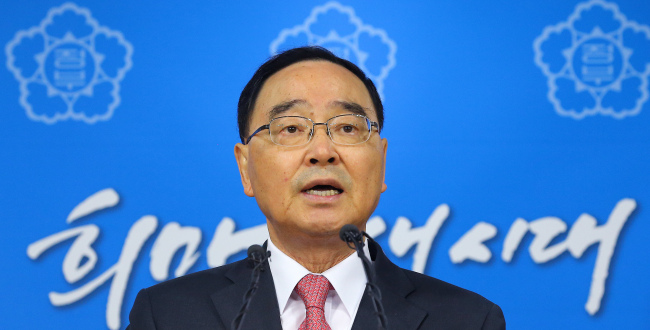
Chung raised the possibility that the system could run out of funds, saying the deficit would snowball to 200 trillion won ($184 billion) over the next 20 years if changes were not made.
Listing the discrepancies between it and the National Pension for ordinary citizens, Chung said that the state employees’ pension plan needed to be fair and that changes were inevitable.
The average monthly payout from the government employee pension is 2.19 million won, while the figure for the National Pension stands at 840,000 won.
The age of initiation is 60 in the public sector pension system, while the majority of Koreans begin receiving payouts at 65.
In a bid to allay the discontent of public workers, Chung said the government would not demand “one-sided sacrifices” and there would be changes in place to improve their working conditions.
“Civil servants must refrain from collective action,” he said. “As public officials, who are the cornerstones of Korea’s development, they should express their views rationally and logically rather than showing off their collective clout.”
The address drew mixed reactions from the major parties, with the main opposition New Politics Alliance for Democracy saying that it appeared to be a declaration that the government would forge ahead without negotiating with civil servants.
“It is very worrying as major social discord could arise if the public sector pension is not reformed through negotiation,” NPAD spokesman Kim Sung-soo said.
“The government must remember the lesson learned from the railway strike: that dialogue and communication is the solution.”
As the government pushed the reform plans forward, it was revealed that, in the revision it proposed last month, the ruling Saenuri Party had deleted the clause of the Public Official Pension Act that makes the state responsible for subsidizing the system.
In the proposed revision, the part of Article 69 that states “the State or the local government shall bear the relevant deficiencies (hereinafter referred to as ‘supplementary money’), as prescribed by Presidential Decree” has been removed.
The proposed revision includes a clause that states that a legal reserve should be accumulated from the premiums paid by incumbent civil servants, government payments and, if necessary, additional subsidies.
koreaherald@heraldcorp.com











