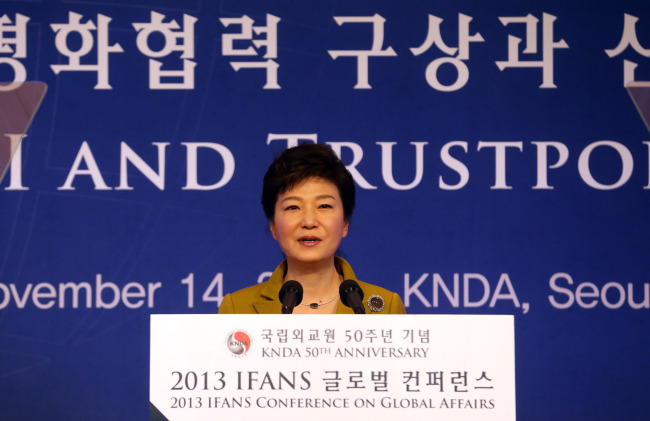
President Park Geun-hye on Thursday proposed publishing a history textbook with Northeast Asian neighbors to reduce the differences in historical perceptions and create a peaceful and cooperative environment similar to that of Europe.
“As Germany and France, and Germany and Poland did, we can build up practices of cooperation and dialogue by publishing a joint history textbook of Northeast Asia,” Park said in a speech at the ceremony marking the 50th anniversary of the Korea National Diplomatic Academy.
“I believe that for peace and cooperation of Northeast Asia, the countries within the area must first share a vision for the future of the region,” Park said.
Park’s remarks came as historical and territorial rows among Korea, Japan and China continue to escalate.
Japan remains adamant against Korea’s calls for it to address past atrocities committed during its colonial rule, including the sexual enslavement of Korean women for its troops during World War II.
Japan also continues its claim over Korea’s Dokdo islets in the East Sea. Similar territorial rows between China and Japan have further ratcheted up tension in the region, leading to cancellations or delays of diplomatic exchanges such as the annual three-way cooperation summit and first summit talks.
Park has also yet to hold summit talks with Japanese Prime Minister Shinzo Abe, saying it is not yet time for such a summit.
“Turning Northeast Asia into a common market like that of the European Union will bring immense opportunities for us,” Park said in her speech. “But despite such incredible potential, the political and security reality of Northeast Asia is obstructing, rather than supporting, the integration of the region.”
Park’s latest proposal for reconciliation and cooperation in Northeast Asia is considered the third part of her diplomatic vision following her trust-building process for North Korea, and Eurasia initiative to connect the economic blocs of Asia and Europe.
While adopting a “principles-based” approach to North Korea, Park aims to create regional integration for stability. For this, Park deems resolution of history among the three major players a priority, sources explained.
“Right at this moment, the threat of a military collision remains, and North Korea continues its nuclear development, triggering tension on the Korean Peninsula that has remained divided for nearly 70 years,” Park said.
Describing the situation as an “Asian paradox,” where diplomatic tension increases despite increasing economical interdependency, Park reiterated that trust was the answer to overcoming the situation.
Park stressed her regional initiative would involve first dealing with softer issues such as nuclear energy safety, climate change, natural disasters, cyber cooperation and prevention of money laundering to accumulate dialogue and cooperation, before expanding the scope to more sensitive issues.
She added that conflict and confrontation in the region must be solved in a peaceful manner and any possibility of a military clash must be prevented.
Park furthered her proposal saying that the peace in the region would lead to new economic cooperation between Eurasia and the Pacific region.
Despite Park’s aspirations, a slew of historical debates linger at home as well, with ongoing controversy over a new history textbook, as well as Park’s choice for the new chief of the national history textbook screening body, who is allegedly less critical of Japan’s colonialism and eulogistic of former dictators.
By Lee Joo-hee ()
koreaherald@heraldcorp.com











