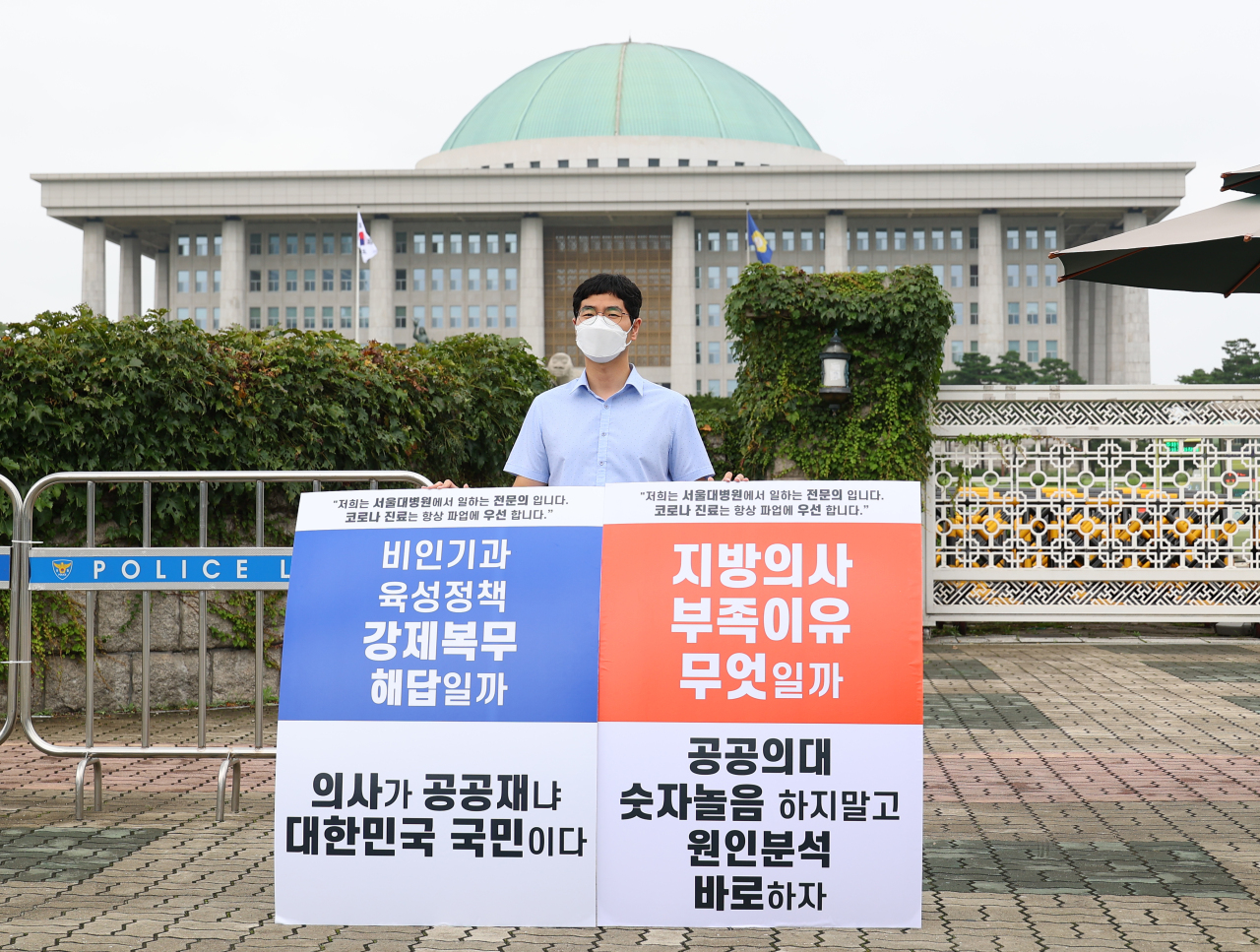
Prime Minister Chung Sye-kyun on Sunday pressed striking trainee doctors to come to the negotiating table as he lashed out at them for turning a blind eye to patients.
Chung expressed "deep regret" over their decision to continue the indefinite strike and urged the Korean Intern and Resident Association to scrap their strike.
His comments came hours after the association's emergency task force voted in favor of the walkout in the second round of voting that ended earlier in the day. The first round was voted down due to lack of quorum.
Thousands of trainee doctors working at the country's general hospitals began the strike on Aug. 21 to protest the government's medical reform scheme.
The collective action could further stretch medical staff at a time when South Korea is struggling to contain the spread of the coronavirus.
On Sunday, South Korea reported 299 new COVID-19 cases, including 283 local infections, raising the total caseload to 19,699, according to the Korea Centers for Disease Control and Prevention. Two more patients died, raising the death toll to 323.
The association's emergency task force decided to continue the indefinite strike, despite the government's order to return to work.
On Saturday, South Korea's health authorities issued back-to-work orders to 278 striking doctors, warning of possible prison terms.
Those who do not follow the government order without a legitimate reason could have their licenses revoked and even face imprisonment of less than three years or a fine of less than 30 million won ($25,000).
"The government has no choice but to react in line with the law and principle to protect the lives and security of people," Chung said.
Adding to woes is a separate strike planned by the Korean Medical Association (KMA), which represents some 130,000 doctors across the country.
The KMA ended its three-day walkout last Friday, but it also said it will launch an indefinite strike on Sept. 7 unless the government withdraws its new policies, including a plan to increase the number of medical students.
Separately, the Korean Medical Student Association said 93.3 percent of 3,036 people who applied for the Korean Medical License Examination set for September and October canceled their applications in protest of the government's medical reform scheme.
As part of the country's medical workforce reform plan, the health ministry is planning to expand admission quotas at medical schools by 4,000 over the next 10 years, starting in 2022, and to open a new public medical school, as it seeks to broaden the reach of health care services.
This will increase the number of students admitted annually to medical schools to 3,458 in the 2022-2031 period from the current 3,058, according to the plan. (Yonhap)










