Committee chairman vows ‘nook and cranny’ approach for genuine regional growth
Without tangible development in rural areas, no country can become an advanced nation no matter how great the economic growth is, said Lee Won-jong, chairman of the Presidential Committee on Regional Development.
“When you take a look at the farming or fishing communities in advanced nations such as the U.S., Britain, Japan or Switzerland, their living infrastructure is well managed, and the residents’ economic base is sturdy,” Lee said in an interview with The Korea Herald last Wednesday that coincided with the committee’s 100th day running.
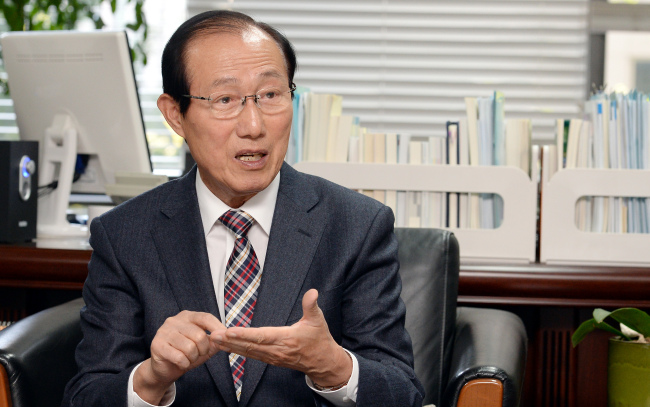
“In Korea, a good example is the water supply. Whereas over 90 percent have water supply in metropolitan areas, the supply is less than 60 percent in smaller towns, not to mention that rural areas have increasing sources of pollution than in the old days,” he said.
That is where the purpose of the committee comes in ― to get rid of the negative factors in the living infrastructure of rural areas, and provide higher-quality services for the residents there.
The task will be time-consuming, unglamorous and low-key for a long time, but the committee aims to deviate from past government policies that tended to be extravagantly designed such as by relocating state or public organizations to less developed areas, he said.
“Our regional development policy may be void of a large-scale vision or any corporeal outcome at the moment. But as we are planting the seed, in time, when people start to actually feel the improvement, they will know,” the veteran administrator said.
Lee, 71, who has devoted 44 years of his career to administering cities and provinces, was tapped to head the committee by President Park Geun-hye in June.
Lee, after stepping down from the Seoul mayoral post after the collapse of Seongsu Bridge in 1994, was later elected to governor of North Chungcheong Province in 1998 and served for eight years. Cheong Wa Dae had explained Lee’s appointment is based on his successful experience in creating the foundation for the technopolis of bio-health science in Osong that had until then been trapped in pre-modern industries.
For the otherwise ignorable task to gain steady emphasis and importance, the committee has been given an unusually high say in drawing up the budget with cooperation from relevant ministries such as the Ministry of Strategy and Finance. Some 10 trillion won ($9.4 billion) of the budget has been set aside to start going in effect in 2015 in relation to various projects that the committee manages or is involved in. They will range from replacing the worn-out slate roofs of rural residences to alleviating environment pollution.
The committee will also have the right to present views on regional projects to the central ministries, review the progress and have the Finance Ministry refer to the committee when drawing up the special budget for municipalities, through revising the Special Act on Balanced National Development. The government announced the revised bill in September.
The committee, most imminently, will draw up guidelines to remove inconveniences and reduce gaps among regions in the services of jobs, education and culture by the end of this month.
Through the “nook-and-cranny approach,” Lee said it would help alleviate conflicts between regions.
“Conflicts have both positive and adverse effects. Not all conflicts are bad as the proper function of conflict has contributed to the development of human history,” Lee said, adding that he never considered himself a politician but always an administrator.
The most important aspect would be for the policy to be affordable for the central and municipal governments at a level conceded by the majority of the people and the political parties.
He cited former Lee Myun-bak administration’s controversial four-river restoration project as having been problematic in how the scheme was forced upon the country rather than proceeding in steps such as by test-driving it at one of the rivers with the worst pollution.
It would also be crucial for the central government to involve municipalities in drawing up each policy, he said.
“The biggest characteristic of our operation is to secure the region with autonomy. Since each region has long been domesticated by the central government, they continue to rely heavily on the state budget despite being self-governed,” he said. “Each region must also grow to change their perception that they can make their own depiction to be responsible of them.”
Another noteworthy approach is the “regional cooperation zone,” which aims to go beyond geographic distance or boundaries to promote joint industries.
For instance, South Jeolla Province, South Gyeongsang Province and Busan would work together on offshore plants, while North Chungcheong and Gangwon provinces would collaborate on biotechnology.
After the launch, the committee toured different regions nine times to collect various voices. They included activating agricultural industry from North Jeolla Province, better hiring of regional college graduates from Daegu and exclusive subsidies for neglected regions from Gangwon.
In order to foster unique and exclusive industries and attract wider investment, the committee is also eying more foreign investors. The committee cited the government’s measure since April to establish small free economic zones in provincial cities for foreign-invested land exceeding 80,000 square meters, one-fourth the land required for an existing FEZ.
Recalling a French city called Lille on the outskirts of Paris as an example of a smaller town that fostered a great tourism industry by taking full advantage of the intersecting transportation and geographic characteristic, Lee said it was important for each region to take charge and approach with vision instead of tailgating the successful projects of others.
“The tourism sites and products that are more or less similar to each other city will not be enough. Creating what is indigenous for each region is what characterizing is, and where autonomy is needed,” Lee said.
By Lee Joo-hee ()
koreaherald@heraldcorp.com











