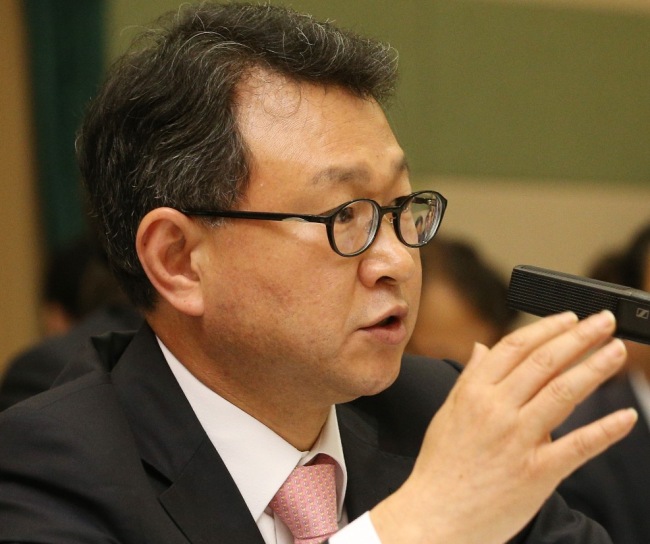
A high-ranking audit official said Tuesday former President Lee Myung-bak was in part responsible for the problems associated with the Four-River Renovation Project.
He said that Lee was partly behind it being conducted as a preparatory step for his “Grand Canal,” which allegedly led to budget waste, corruption and price fixing by contractors.
“I think that former President Lee Myung-bak has a share of responsibility,” Board of Audit and Inspection Secretary General Kim Young-ho said in response to an opposition lawmaker’s question during a parliamentary audit.
He also said the agency once looked into whether it would refer Lee to the prosecution in connection with the corruption-riddled project. But the BAI concluded that Lee should not be subject to criminal investigation.
The Grand Canal was Lee’s key election pledge. It was scaled down into the Four-River Reclamation Project in the faced of widespread opposition.
The state auditor said in July that the previous government pushed the 22 trillion won ($20 billion) river project with the intention of ultimately building a cross-country canal network,
It added that, privately, Lee had not given up on the canal project and that the “hidden” long-term plan caused a number of serious problems, such as bid-rigging, increased costs and poor water quality management.
During the parliamentary session, the ruling Saenuri Party and main opposition Democratic Party lawmakers denounced the state audit agency for making inconsistent reports on the project.
“There is criticism that the three audits conducted by the BAI are ‘political audits,’” Rep. Lee Ju-young of the Saenuri Party said in a statement, adding that the BAI’s conclusion lack credibility.
The DP for its part honed in on the BAI’s conclusion, terming the project a “fraud against the people.”
In the second day of a parliamentary audit of the administration, more allegations of election interference by government agencies were made, threatening to bog down the parliament yet again.
According to reports, three civilians working at the Ministry of National Defense’s cyber command posted about 300 election-related messages, including that Rep. Moon Jae-in was unqualified to become president, on Twitter and blogs.
Following the report, the Defense Ministry announced that it would investigate the allegations, while emphasizing that the military operates under the principle of political neutrality.
The DP, however, appears to be preparing to throw its weight behind the allegations.
“This is the truth behind why the Saenuri Party has been hampering the investigation into the National Intelligence Service,” DP floor leader Rep. Jun Byung-hun said.
“The fact that the NIS’ election interference was only the tip of the iceberg has been revealed.”
In addition to the cyber command, it was revealed on Monday that the Ministry of Patriots and Veterans Affairs had produced booklets that implied that progressive politicians including former presidents Kim Dae-jung and Roh Moo-hyun were pro-North Korea.
While developments that took place during the previous administration took center stage, the Park Geun-hye administration’s economic democratization and welfare policies also drew heavy fire from the opposition.
The DP pressed concerned officials accusing the government of abandoning the related plans, honing in on the recently modified plans for the basic pension system.
Although the president had pledged to provide 200,000 won ($187) monthly pension for all seniors, the plans were scaled back due to fiscal issues.
koreaherald@heraldcorp.com











