ASEAN supports her peninsular, regional peace initiatives
President Park Geun-hye focused on promoting freer trade and strengthening economic and diplomatic ties with Southeast Asia during her eight-day trip to Indonesia and Brunei.
Park returned to Seoul on Sunday after attending the Asia-Pacific Economic Cooperation summit, forums with 10 Southeast Asian nations and other regional partners, and a summit with Indonesian President Susilo Bambang Yudhoyono.
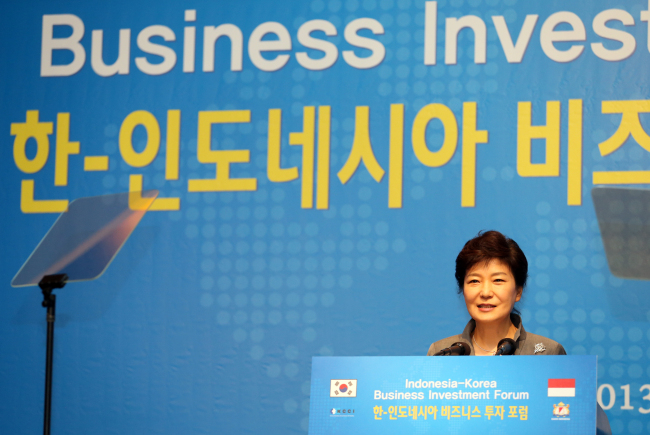
During the APEC summit in Bali, Park stressed trade liberalization as the “most effective, least expensive policy” to help revitalize the sluggish global economy, while calling for joint efforts to fight protectionism and shore up a multilateral trading system.
Amid her push for free trade, APEC leaders adopted a joint declaration underscoring their support for the success of a ministerial-level meeting of the World Trade Organization to be held in Bali in December.
At the gathering, participants are to push for progress over deadlocked negotiations on the Doha Development Agenda, a WTO initiative aimed at reducing trade barriers across the world.
On the sidelines of multilateral forums, Park also pushed to spur joint efforts for progress on bilateral free trade negotiations with Canada, Australia, Peru, China and Indonesia.
Her drive culminated on Saturday in her agreeing with the Indonesian president in Jakarta to conclude their negotiations over a comprehensive economic partnership agreement by the end of the year.
Apart from the free trade campaign, Park pushed her sales diplomacy campaign and sought to cement strategic ties with the 10-member Association of Southeast Asian Nations.
In recent years, South Korea has intensified efforts to strengthen economic ties with ASEAN ― South Korea’s largest investment destination, second-largest trade partner and second largest market for the country’s construction industry.
ASEAN states are also of great strategic importance as they stretch across the Indian and Pacific oceans, where crucial trading and energy supply routes pass, including the vulnerable and congested Strait of Malacca.
During her bilateral summit with ASEAN in Brunei, the two sides agreed to set up a bilateral security dialogue and a Korea-ASEAN business council, which Seoul officials say underscores their evolving partnership in a wider range of issues.
Park also gained ASEAN’s support for Seoul’s policy toward North Korea, which is to build trust with Pyongyang while maintaining robust deterrence.
Adopted at the end of the Korea-ASEAN summit, its chairman’s statement encouraged Pyongyang to comply with all international agreements against its nuclear development and expressed support for all efforts to achieve a “complete, verifiable and irreversible denuclearization” of the peninsula in a peaceful manner.
ASEAN also supported Park’s initiative to help resolve what she calls the “Asia paradox,” which refers to the region’s deepening economic interdependence and escalating territorial rows and historical animosities.
Park’s initiative seeks to build trust first in non-political areas such as climate change and then on tougher issues such as security, and ultimately forge multilateral confidence for peace.
To help ASEAN to bridge their internal development gaps, Park also pledged efforts to help build physical connectivity among ASEAN states through Seoul’s active engagement in the construction of infrastructure based on its development experience.
Her so-called “sales diplomacy” campaign gained much traction during her summit with Indonesian President Susilo Bambang Yudhoyono.
Apart from their pledge to complete CEPA negotiations this year, the two countries also signed a series of agreements on cooperation in the defense industry, infrastructure construction and research on resource development.
By Song Sang-ho ()
koreaherald@heraldcorp.com











