Leaders agree to hold security dialogue and launch business council
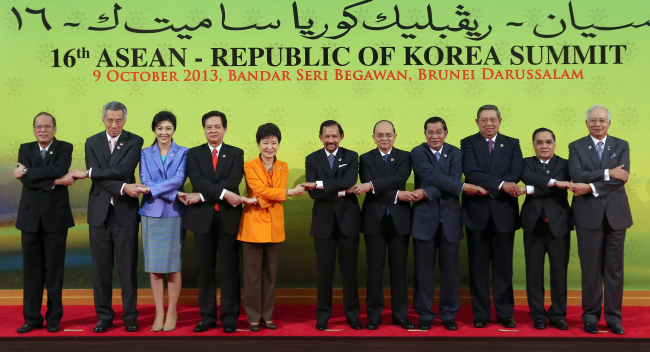
BANDAR SERI BEGAWAN ― President Park Geun-hye on Wednesday stepped up her diplomatic push to deepen economic and security cooperation with the 10-member Association of Southeast Asian Nations.
During their summit, Park and ASEAN leaders agreed to set up a bilateral assistant ministerial-level security dialogue and hold its inaugural gathering next year as part of efforts to enhance their cooperation on a wider range of regional and global issues.
In the economic realm, the two sides agreed to hold a Korea-ASEAN business council to further strengthen their economic and trade ties.
They hope to convene its first session when Seoul hosts a special Korea-ASEAN summit in December next year to mark the 25th anniversary of the start of bilateral dialogue. South Korea believes the council could help its small- and medium-sized firms advance into ASEAN.
The two sides also agreed to seek to upgrade their free trade agreement to enhance the level of trade liberalization. The bilateral FTA took effect in 2009 and two-way trade volume reached $131 billion last year.
During the talks, Park also pledged to help ASEAN reduce their internal development gaps ― a major hurdle to ASEAN’s push for economic integration ― through sharing Korea’s development experience and know-how.
In the social and cultural sectors, Park offered to increase the number of South Korea’s cultural and educational centers in the ASEAN region and strengthen cooperation in cyberspace college education.
“During the summit, Park sent a strong message that Korea is a partner with ASEAN to share trust and happiness, which is the centerpiece of her statecraft philosophy,” a Cheong Wa Dae official told reporters, declining to be named.
He explained that Seoul’s cooperation with ASEAN has proceeded in consideration of the three pillars of ASEAN‘s integration ― peace through cooperation in politics and security, prosperity through economic cooperation and common development through socio-cultural cooperation.
In recent years, South Korea has intensified efforts to build deeper, wider economic ties with ASEAN. ASEAN is South Korea’s second-largest trade partner, largest investment destination and second largest market for the country’s construction industry.
Southeast Asian states are also of great strategic importance as they stretch across the Indian and Pacific Oceans where the world’s most crucial trading and energy supply routes pass including the vulnerable and congested Strait of Malacca.
Seoul and ASEAN established the Korea-ASEAN Center in Seoul in 2009, concluded a free trade agreement later that year and elevated their relations to a strategic partnership in 2010. Seoul also set up a diplomatic mission wholly dedicated to its relations with ASEAN.
Amid intensifying Sino-U.S. rivalry, the strategic importance of ASEAN has increased.
Washington has been refocusing its strategic attention on Southeast Asian countries, some of which are called “swing players,” balancing the interests of the U.S. and China without taking the side of either in order to maximize their own national interests.
On the sideline of the ASEAN summit, Park held bilateral talks with the leaders of Brunei, Singapore and Myanmar, during which she called for support for South Korean firms’ participation in their major infrastructure and resource development projects.
During a summit with Brunei’s Sultan Haji Hassanal Bolkiah in the morning, Park asked for his interest and cooperation for Korean companies to join the country’s multibillion-dollar bridge construction plans.
Brunei has large-scale projects set to build three bridges connecting the mainland with the remote district of Temburong; the island of Pulau Muara Besar; and the floating village of Kampong Ayer. These projects are worth $3.36 billion in total.
Also during the talks, Park expressed hopes that the two countries could strengthen cooperation in agricultural and maritime industries based on their efforts to seek related memorandums of understanding.
Park also touched on the countries’ evolving trade relations. Bilateral trade volume has jumped 13 times since they opened diplomatic ties in 1984. Last year, the trade volume reached $2.1 billion, compared with $160 million recorded in 1984.
Apart from economic issues, Park expressed gratitude to the Bruneian leader for support for Seoul’s policy toward North Korea. She requested Brunei continue to send a clear message to Pyongyang to encourage it to “take a path of genuine change and peace.”
Touching on Seoul’s hosting of the Korea-ASEAN summit in 2014, which marks the 25th anniversary of the establishment of dialogue between the two sides, Park asked the king to offer his support.
During her meeting with Singapore’s Prime Minister Lee Hsien Loong, Park discussed ways to further enhance their cooperation in the construction industry, trade, investment and other areas. The two countries signed a free trade pact in August 2005, which went into effect in March 2006.
While meeting with Myanmar President Thein Sein, Park discussed business cooperation in the country’s ongoing construction projects, including one to build the Hanthawaddy International Airport in Bago, 80 kilometers northeast of Yangon, the commercial capital of Myanmar.
Also during the day, Park held talks with Australian Prime Minister Tony Abbott, during which they explored ways to cooperate on Australia’s development of mineral resources, and speed up their negotiations over a bilateral free trade pact.
By Song Sang-ho, Korea Herald correspondent
koreaherald@heraldcorp.com











