Pundits stress need to disperse presidential power
The latest blunder over the basic pension scheme and the resignation of the health minister is seen to make President Park Geun-hye’s crowd-pleasing pledge to share more power with the Cabinet members appear empty.
Former health minister Chin Young’s reason for resigning opened up the crack within the administration, pointedly between President Park Geun-hye’s secretariat and the Cabinet over implementing the president’s key pledges.
It triggered debate over the Park administration’s top-down, secretariat-centric decision-making system as Chin resolutely objected to Park’s vision to link the national pension scheme with the new basic pension plan.
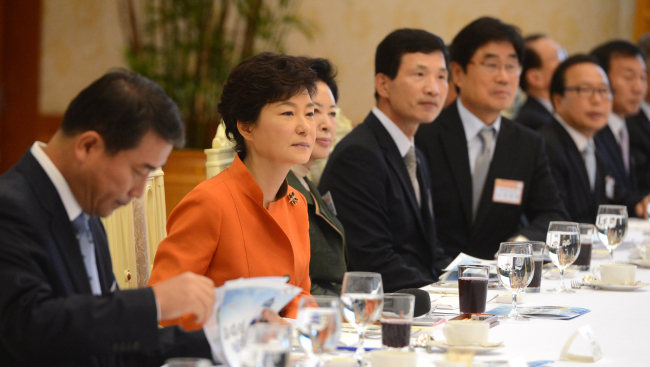
The opposition and critics soon began reproaching Park for abandoning “yet another” presidential pledge: to share more responsibility with the prime minister and ministers by allowing them greater discretion in decision making.
To political pundits, the latest mishap was not a surprise, as they said the recurring pledge during presidential campaigns to “share more power with the prime minister” or to “enable more discretion to ministers” has always been “ludicrous.”
“In the presidential system, the so-called ‘responsible prime ministerial or ministerial structure’ does not exist nor is it plausible when the president holds ultimate personnel power,” said politics professor Cho Sung-dae of Hanshin University.
Cho cited how such supervisory organizations as the Board of Audit and Inspection remained under the control of the president who appoints its chief.
In the 2002 presidential election, both Roh Moo-hyun and his rival Lee Hoi-chang pledged to share more power with the prime minister. The same pattern went for Park and her rival Moon Jae-in last year.
Division of power remains one of the better-received pledges during campaigns in a society where avoiding an administration similar to past authoritative or dictatorial governments has been a key concern since the first direct presidential election in 1987.
“Since democratization, we have always faced the task of containing an imperialist president,” Cho said.
“But dispersing the excessive power within the administration is neither meaningful nor possible. What is needed instead is to dissipate the power to the parliament for the National Assembly to be able to keep the president in check,” he suggested.
The need to disperse the president’s power has been a frequent subject of debate in the political arena. One suggestion has been to revise the Constitution to bestow more power on the prime minister. Other suggestions have included establishing a stronger anti-corruption body to deal with cases involving the president’s family, relatives and friends.
Park emphasized the prime minister would have full discretion to exercise his ostensible authority guaranteed by the Constitution to recommend Cabinet members and implement personnel moves within the ministries.
Her creation of the Ministry of Science, ICT and Future Planning to oversee her key creative economy vision and cooperation among the ministries was seen as part of such efforts.
Park’s designation of figures relatively unknown or with less political experience to join the presidential office was also interpreted as a sign of change.
But as Park began to face a series of jams and attacks in her administrative drive such as through her personnel appointment failures, she was seen moving towards relying on a stronger figure to head the secretariat by naming political veteran Kim Ki-choon, who was also an aide to her late father former President Park Chung-hee.
“So far, the president seems to be involved in every nook and cranny of the administration operation to make decisions,” former lawmaker Chough Soon-hyung of the opposition Democratic Party said in a radio interview recently.
“The president’s secretariat must not reign over the Cabinet and the center of the administration must be within the Cabinet,” Chough said, citing how every word of the president made during the weekly senior secretarial meeting is released and publicized for each ministry to copy.
There have also been several instances of Cheong Wa Dae’s plans overriding long-held positions of the ministries.
The Education Ministry, for instance, reportedly indicated a cautious approach on including Korean history on the college entrance exams citing fairness. But soon this position was overridden when Park mentioned during a luncheon with editorial writers on July 10 that “including Korean history into the college entrance exams will be a clean solution.”
In August, the Ministry of Strategy and Finance was seen hastily revising its tax reform plan overnight as Park remarked on a need for change upon outcry from middle-income taxpayers. Up until then, the ministry had defended its proposal to collect more taxes from workers with annual income of 34.5 million won or more.
Another example was when Unification Minister Ryoo Kihl-jae in April said the government was not necessarily proposing talks with the North when releasing a statement regarding the suspended Gaeseong industrial complex. The same night, Cheong Wa Dae overturned Ryoo’s comments and explained it was in fact a dialogue offer.
Observers said the problem lies in not only the lack of discretion held by each minister but also the lack of communication within the Cabinet.
“It makes you wonder how sufficient the communication within the Cabinet is, as well as the leadership to adjust different positions,” said politics professor Lee Jung-hee of Hankuk University of Foreign Studies.
“Chin’s case, for instance, exemplified the unsmooth operation. The president should have been able to adjust the position of each ministry and persuade those that needed to be persuaded beforehand,” he added.
Professor Choi Young-jin of Chung-Ang University said that under the present system, true change in the top-down structure fully lies in the hands of the president.
“These are not matters concerning the system where tenures of many executive positions are already secured by law. Without the intention of the president, (dispersing of power) is not viable.”
By Lee Joo-hee ()
koreaherald@heraldcorp.com











