The National Assembly appears headed for gridlock after the Democratic Party vowed to up the pressure on the ruling Saenuri Party and the government.
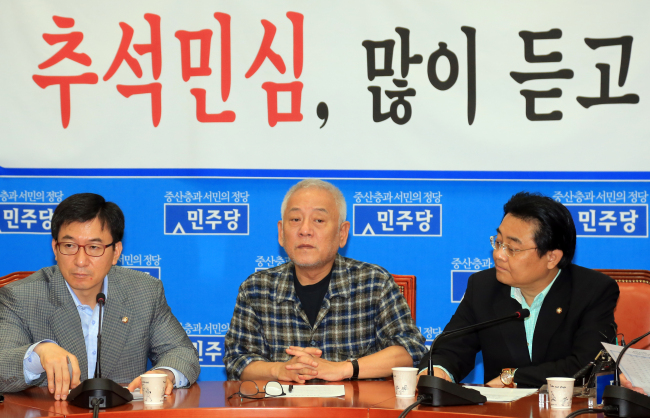
With the DP showing determination to shore up its position in the parliament and to shed more light on developments surrounding the National Intelligence Service, concerns are rising that its actions may jeopardize the parliamentary inspection of the government and the budget review.
On Sunday, as the parliament returned from a half-week Chuseok holiday break, DP chairman Rep. Kim Han-gil said that the consensus among his party’s lawmakers was to raise the pressure on the government from within and outside the National Assembly.
“The shared view was that the parallel resistance on and off the floor should be strengthened,” Kim told reporters, saying that he and DP lawmakers conferred about the direction the party should take.
Since the beginning of August, the DP has been operating from a tent set up outside Seoul City Hall in an effort to pressure President Park Geun-hye to take a hand in developments surrounding the NIS’ alleged involvement in last year’s presidential election.
With the DP calling for an apology from the president, the parliament has remained effectively idle despite the 100-day regular session of the National Assembly getting underway on Sept. 2. Hopes that the Sept. 16 meeting between the president, Kim and Saenuri Party leader Rep. Hwang Woo-yea were quickly dashed as they failed to reach a compromise.
While Kim did not elaborate on the actions his party would take, DP floor leader Rep. Jun Byung-hun indicated that motions put forward by the Saenuri Party would be strongly resisted.
Saying that the party would engage in standard parliamentary procedures, Jun said that the president had forced the DP into flexing its muscles.
“(Parliamentary processes) will not be given up. But, as the president and Saenuri Party do not recognize the DP as the main opposition, we can’t help but show them that it is difficult to conduct state affairs without the cooperation of the main opposition,” Jun said in a recent interview.
As for the timing of the parliamentary inspection, Jun left the question open, saying that it could be held sometime between October and December.
For its part, the ruling Saenuri Party is pressuring the DP to negotiate the parliamentary schedule, citing its version of public opinion, which varies dramatically from that perceived by the main opposition.
“The public opinion during Chuseok was that (the parties) should stop fighting over the NIS issue and to take care of the livelihood of the people,” Saenuri Party deputy floor leader Rep. Yoon Sang-hyeon was quoted by a local news agency.
“If the DP also heard the people’s voice, it must feel the harsh reprimand of the people. (The DP) should quickly return to the floor and process related laws.”
In contrast, the DP claimed that the view that the president’s disdain for the main opposition has gone too far held sway among the public.
koreaherald@heraldcorp.com











