Seoul allows civilian humanitarian aid to N.K.
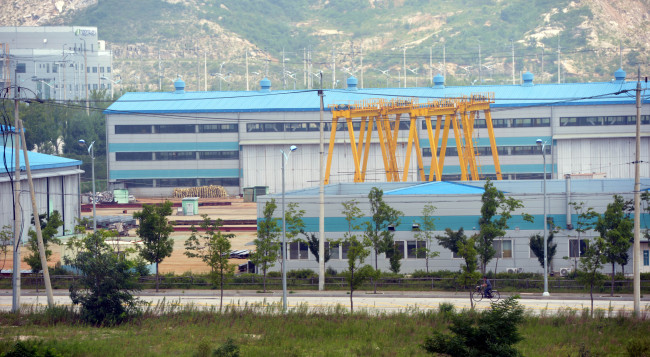
Seoul on Sunday proposed what it said would be the “last offer” for talks with Pyongyang over the normalization of the joint industrial park in Gaeseong, raising pressure on the North to offer clear assurances to prevent its unilateral closure.
Unification Minister Ryoo Kihl-jae also said the Seoul government would allow five civilian organizations to send aid to support infants and the economically vulnerable classes in the North on Monday.
Seoul would make an official proposal for the working-level meeting through a communications channel at the inter-Korean border village of Panmunjeom on Monday, the minister said.
“Our government’s consistent position is that the park should not be suspended because of political and military reasons, and that South Korean firms should freely operate there in accordance with international standards,” he told an impromptu press conference.
“Our demands are very natural for the future-oriented normalization of the park. But the North hinted (during previous talks) that the park could be suspended again under political, military logic.”
The proposal for another meeting came after six rounds of bilateral working-level talks failed to reconcile their differences over how to prevent the recurrence of a suspension and to restart the complex.
Urging the North once again to offer clear measures to prevent any abrupt suspension, Ryoo reiterated that the Seoul government would, otherwise, make a “grave decision” to prevent greater mental and financial damage to South Korean firms.
Observers construe the “grave” decision as a complete shutdown of the last remaining symbol of cross-border cooperation.
Some, however, said the shutdown could deal a blow to President Park Geun-hye’s peninsular trust-building process ― a reason why how she handles this pending issue is seen as an indicator of inter-Korean relations over the next several years.
Seoul’s approval for civilian aid to the North would come for the first time since March when it allowed the Eugene Bell Foundation to ship anti-tuberculosis drugs to the impoverished state. The government plans to approve aid by five civilian organizations along with the U.N. International Children’s Emergency Fund.
For a cash-strapped Pyongyang, a complete closure of the park could further squeeze its supply of hard currency amid deepening isolation caused by global sanctions for its missile and nuclear development. It had raked in more than $90 million a year from the park.
The factories of the 123 South Korean firms stopped operating on April 9 when some 53,000 North Korean workers did not come to work under the directive of Pyongyang, which expressed displeasure over the South Korean media criticizing it for cashing in on the complex while churning out war threats against Seoul.
The decade-old park has been the only area for bilateral exchanges and communication. It had been kept alive despite a series of political conflicts, which were prompted by the North’s provocations including nuclear and missile tests.
koreaherald@heraldcorp.com











