PHNOM PENH (AFP) ― Japan’s Mount Fuji, a series of ancient terraced rice paddies China, and the desert city of Agadez in Niger were among the cultural jewels granted World Heritage status by UNESCO at its annual meeting on Saturday.
Fujisan, the highest mountain in Japan at 3,776 meters, is one of the country’s most recognizable sights. The snow-capped peak “has inspired artists and poets and been the object of pilgrimage for centuries,” UNESCO said.
The United Nations Educational, Scientific and Cultural Organization committee, currently holding its 37th annual session in Phnom Penh, classified the site as a “cultural” heritage site, rather than a “natural” heritage site.
“The awe that Fujisan’s majestic form and intermittent volcanic activity has inspired was transformed into religious practices that linked Shintoism and Buddhism, people and nature,” documents prepared ahead of the meeting said.
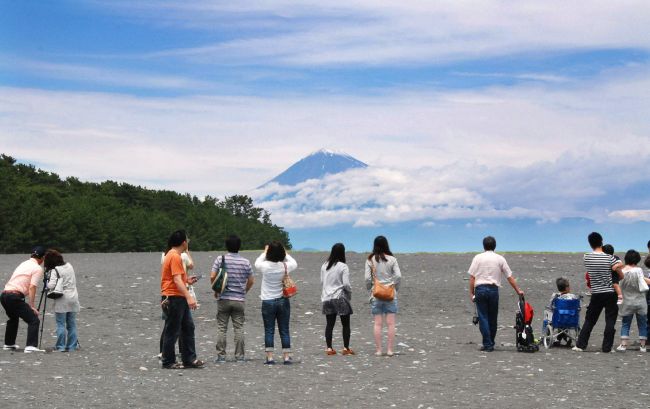
Mount Fuji “inspired artists in the early 19th century to produce images that transcended cultures, allowed the mountain to be known around the world, and had a profound influence on the development of Western art.”
Fujisan, which is located some 100 kilometers southwest of the capital Tokyo, last erupted around 300 years ago. Images of its peak adorn tourism literature published at home and abroad.
Mount Fuji is the seventeenth Japanese site to be inscribed by UNESCO.
UNESCO is currently holding a 10-day annual meeting in Phnom Penh during which it is considering adding 31 sites to the World Heritage List.
The committee also granted the historic town of Agadez in Niger, seen as “a gateway to the desert,” World Heritage status on Saturday, UNESCO said.
From the 15th century, Agadez “became an exceptional crossroads for the caravan trade. It bears witness to an early historic town, forming a major centre for trans-Saharan cultural interchanges.”
The historic city, which includes a mosque with an imposing minaret ― the tallest ever built in mudbrick ― and the Sultan’s Palace, dates back to the fifteenth and sixteenth century.
Agadez is characterized by an adobe architecture, unfired clay brick obtained by sun drying, and “bears witness to an exceptional architectural tradition, based on sophisticated use of mudbrick,” UNESCO said in documents prepared ahead of their ongoing annual meeting in Phnom Penh.
koreaherald@heraldcorp.com











