Presidential candidates Thursday voiced opposition against a military clash on the Korean Peninsula, amid escalating tension over the possibility of a US strike on North Korea.
But they remained in sharp conflict over the deployment of an advanced US missile defense system called the Terminal High Altitude Area Defense.
In their first television debate, jointly hosted by broadcaster SBS and the Journalists Association of Korea, the five presidential aspirants suggested their countermeasures if North Korea were to carry out a military provocation that could trigger a forceful response from the US.
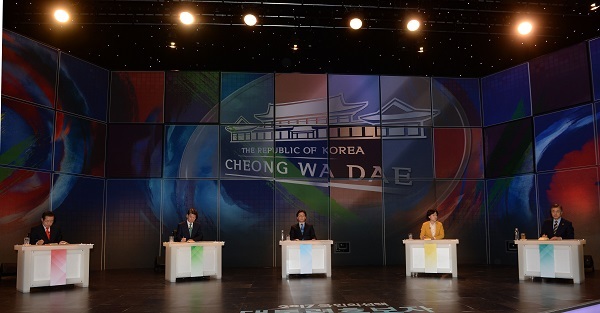
All came up with diplomatic solutions, such as reaching out to the US and China’s state chiefs, while a hard-line conservative left some room for military action.
“I would call the US president to prevent a pre-emptive strike, order a state of emergency within our government, and urge Pyongyang through various channels to stop provocations,” said Moon Jae-in of the liberal Democratic Party of Korea.
Ahn Cheol-soo of the centrist People’s Party said that he would talk with both the US and China, dissuading the former from military action and requesting the latter to exert pressure on North Korea. He also vowed to issue a statement directly addressing the North.
Hong Joon-pyo of the conservative Liberty Korea Party also said that he would work on preventing a preventive strike through talks with Washington and Beijing, but added that he would prepare for battle, if the US went ahead.
Yoo Seong-min of the splinter conservative Bareun Party underlined the importance of remaining in close partnership with the US, while minority progressive Justice Party’s Sim Sang-jeung said that she would first deliver a presidential address and then talk to US and Chinese leaders.
But as for the deployment of THAAD, which has been suggested as a countermeasure to the North’s provocations, there were differences among candidates -- especially between Moon and Yoo.
“My suggestion is to remain open to both possibilities (of deploying or withdrawing THAAD) and pass the issue on to the next government,” Moon said.
Moon had previously opposed the US anti-missile system, but recently altered his policy line to accepting it if North Korea continues nuclear provocations.
He also criticized Yoo for his pro-THAAD stance, pointing out that the deployment, requiring massive public finances, would first need to be ratified by legislature.
Yoo, on the other hand, raised doubts on Moon’s shift in stance.
“It sounds like (Moon) was against THAAD up to the North’s fifth nuclear test last year, but will accept it upon a sixth test,” he said, arguing that Moon was only seeking votes ahead of the election.
Far-leftist Sim was the uncompromising opponent of the missile defense system.
“I seem to be the only one among the five candidates to oppose THAAD,” she said. “We should not let THAAD lead to an economic crisis or create a power game on the Korean Peninsula.”
Ahn, who was accused of flip-flopping over the issue, claimed that he had to adjust to the recent diplomatic and economic situations.
“A state leader should make the best response possible for the sake of national interest according to the changing situation,” he said.
Referring to China’s economic retaliation and North Korea’s provocations, Ahn called for an active, reinforced national security system.
The five presidential hopefuls are to officially register themselves as candidates this weekend, after which a 22-day campaign period will kick off until a day before the May 9 election.
By Bae Hyun-jung ()
koreaherald@heraldcorp.com











