Tokyo officials give few details of content of discussions
An adviser to Japanese Prime Minister Shinzo Abe ended a visit to North Korea last Friday but did not give details of his talks with leaders in Pyongyang, as Seoul expressed discomfort toward the surprise trip, while Washington sidestepped questions about its stance.
Isao Iijima’s three-day visit came amid a slight easing of tension on the Korean Peninsula after weeks of threats from the North aimed at Washington, Seoul and Tokyo.
Japan has not disclosed the purpose of Iijima’s trip.
“I had serious and long hours of talks (with North Korean officials) during my visit,” Iijima told reporters after he arrived in Beijing. He would not give details about the talks.
“I will not speak to any media,” he said. “I plan to inform the prime minister about my talks.”
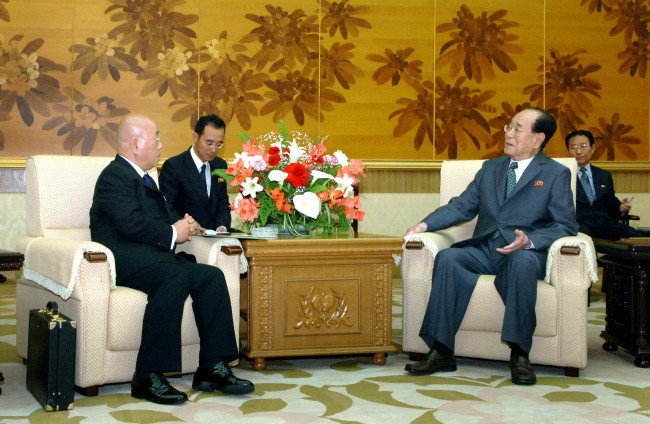
Japan is a participant in now-dormant six-nation talks aimed at ending North Korea’s nuclear weapons program, and its failure to inform its ally the U.S., or South Korea, about Iijima’s visit beforehand raised eyebrows.
Glyn Davies, the top U.S. envoy on North Korea, who visited South Korea, China and Japan this week, said earlier he had hoped to learn more about Iijima’s visit during his talks in Tokyo.
Japanese Foreign Minister Fumio Kishida on Friday said cooperation among Japan, the U.S. and South Korea is extremely important for resolving North Korean issues.
“We need to make effort in the future to ensure good communication among us,” he told reporters when asked about complaints from South Korea over Iijima’s visit.
Iijima also was a senior aide to former Japanese Prime Minister Junichiro Koizumi, who met with late North Korean leader Kim Jong-il in 2002 and 2004.
Tokyo officials hinted Iijima’s visit was related to cases of Japanese kidnapped by the North decades ago.
However, Kishida refused to comment on the outcome of Iijima’s visit. He reiterated Japan’s official line that all outstanding bilateral issues including abductions, missile launches and nuclear development must be resolved comprehensively.
Davies, meanwhile, sidestepped questions Thursday on the nature of a surprise visit to Pyongyang by an aide to Japan’s prime minister, but said all sides tackling North Korea’s nuclear ambitions should coordinate closely.
Isao Iijima’s trip to the North Korean capital, Pyongyang, and his talks with senior officials there have irritated South Korea and analysts said possibly the United States as well, although China has been more positive about it.
“This mission ... is still underway,” Glyn Davies, U.S. special representative for North Korea policy, told reporters, referring to Iijima’s visit. “I think we have some days to wait, all of us, before we know if there are any results from this mission,” Davies said. “We all have fundamental security interests in dealing with North Korea. ... It is important that we stay connected very closely.”
Davies spoke after meeting Shinsuke Sugiyama, a senior Japanese foreign ministry official. Davies said he had received no advance notice of Iijima’s trip.
South Korea bluntly expressed its irritation at the trip.
“We don’t think Isao Iijima’s visit to North Korea was helpful,” said South Korean foreign ministry spokesman Cho Tae-Young said.
China said it hoped the visit would help ease tension.
According to North Korean state media, Iijima has met the titular head of state, Kim Yong-nam, and the ruling Workers’ Party’s top official in international relations, Kim Yong-il.Abe and his top spokesman have been silent about the purpose of the visit, but experts said it was probably aimed at scoring diplomatic points ahead of an upper house election in July.
Abe’s Liberal Democratic Party is expected to win the poll but it wants a huge victory to cement its grip on power.
“(Abe) wants to achieve some movement in relations with North Korea ahead of the upper house election. I don’t think there will be any huge advance, though,” said Masao Okonogi, a North Korea expert at Keio University in Tokyo.
A confidential report by a U.N. panel of experts, seen this week by Reuters, said the tougher sanctions had significantly delayed expansion of the North’s nuclear arms program.
Analysts have also said Japan has felt left out as the United States, China and South Korea take the lead in trying to confront Pyongyang’s nuclear ambitions.
Tokyo’s often testy relations with Beijing and Seoul have been further strained by feuds over disputed isles and recent remarks by Japanese politicians that appeared to try to justify its wartime aggression in Asia.
Iijima, also an aide to former prime minister Jinichiro Koizumi when he held summits in Pyongyang, might succeed in reopening talks on the topic of Japanese citizens kidnapped by Pyongyang’s agents decades ago, Keio’s Okonogi said.
Abe told a parliamentary panel on Wednesday he was open to meeting North Korea’s young leader, Kim Jong-un, if a summit would help resolve the issues of the abductees’ fate and North Korea’s nuclear and missile programs.
Kim Jong-un’s father, the late Kim Jong-il, admitted during Koizumi’ s 2002 visit that Pyongyang’s agents had kidnapped 13Japanese citizens in the 1970s and 1980s. Five abductees were later repatriated. Pyongyang says the other eight are dead but Tokyo wants more information about them and others it believes were also kidnapped.
(From news reports)
koreaherald@heraldcorp.com











