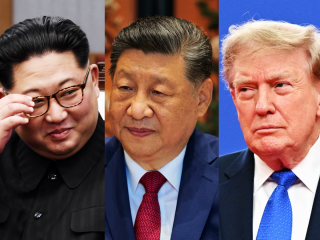
The Wall Street Journal’s report on a last-minute scramble at the White House to arrange a meeting between US President Donald Trump and North Korean leader Kim Jong-un during Trump’s recent Asia trip offers significant clues to the challenges South Korea faces in breaking the nuclear stalemate on the peninsula and rebuilding relations with the North.
Details of how Trump tried to reach Kim and was “ghosted” make for intriguing reading. More noteworthy, however, is the report’s account of what US officials, under pressure from Trump to secure a legacy-defining diplomatic achievement following his party’s bruising defeat in the midterm elections, discussed as possible incentives and objectives in laying the groundwork for another Trump-Kim summit.
The potential package, according to the Journal’s Nov. 21 report, included a declaration formally ending the Korean War, which has remained suspended under an armistice for more than seven decades; a statement neither formally recognizing North Korea as a nuclear power nor demanding the dismantlement of its nuclear program; limits on the North’s nuclear and missile testing; and the opening of liaison offices as a stepping stone toward formal diplomatic relations.
The summit ultimately failed to materialize because the North reportedly set conditions Washington could not accept. The Journal did not specify what those conditions were or identify its sources beyond describing them as people familiar with the matter. A Trump administration official disputed the account of efforts to arrange a meeting.
Given that neither leader has ruled out renewed face-to-face diplomacy and that some of the proposals closely echo Pyongyang’s long-standing demands, a similar agenda could emerge in future talks. Despite his insistence that the US drop denuclearization as a precondition for dialogue and respect his country’s nuclear status, Kim is presumably aware of the considerable obstacles to securing immediate formal recognition of that status.
A carefully worded statement on the North’s nuclear program could facilitate a phased approach, leaving room for a long-term road map toward eventual denuclearization. The question, however, is whether the Trump administration has a sufficiently detailed policy blueprint to translate a summit agreement into concrete action. This is precisely why South Korea must play an active role in ensuring that each stage of halting, rolling back and ultimately eliminating the North’s nuclear weapons program is backed by credible verification and accompanied by corresponding security and diplomatic measures to build mutual confidence.
From South Korea’s perspective, any agreement between Trump and Kim on limiting the North’s nuclear and missile tests could raise serious security concerns. Seoul must ensure that such restrictions cover short- and intermediate-range ballistic missiles as well as intercontinental ballistic missiles. An agreement focused primarily on reducing threats to the US mainland would leave South Korea and its neighbors exposed to the North’s increasingly sophisticated nuclear delivery systems.
The threat took on renewed urgency when Kim emphasized the operational role of tactical nuclear weapons during a Nov. 25 inspection of nuclear material production and weapons research facilities. The North’s official Korean Central News Agency quoted him as describing the deployment of tactical nuclear weapons across multiple domains and for various missions as “important and urgent,” citing the reality of sharing a border with what he characterized as the most dangerous hostile country — an unmistakable reference to South Korea.
Photos released by the KCNA showed Kim and senior officials walking between rows of apparent uranium-enrichment centrifuges and inspecting what appeared to be nuclear warheads.
Whatever message Kim intended to send to Washington or Seoul amid the shifting geopolitical landscape, the menacing scene stood in stark contrast to the image he projected on Jan. 1, 2019. Then, exuding confidence and optimism about detente as he entered his eighth year in power, the young leader extended New Year greetings to compatriots in the South and overseas, invoking a shared aspiration for reconciliation, unity, peace and national prosperity.
With portraits of his predecessors — his grandfather Kim Il-sung and his father Kim Jong-il — in the background, Kim advocated expanding inter-Korean cooperation and exchanges. To that end, he expressed his willingness to resume operations at the Kaesong Industrial Complex and tourism to Mount Kumgang, two prominent symbols of inter-Korean reconciliation and cooperation, “without any precondition and in return for nothing.”
It is deeply regrettable that the momentum for inter-Korean reconciliation was subsequently lost amid mistrust and miscalculations by all parties involved. Kim has since repudiated his predecessors’ long-standing commitment to national reunification, recast inter-Korean relations as those between two hostile states and accelerated his nuclear buildup.
Returning to the potential agenda for the next Trump-Kim summit, arguably one of the few remaining avenues for a diplomatic breakthrough, an end-of-war declaration and the subsequent establishment of liaison offices in Washington and Pyongyang could help create conditions conducive to renewed cross-border economic cooperation on the peninsula.
Seoul faces the daunting challenge of securing its rightful voice as a principal stakeholder — not merely a pacemaker or a bystander — in translating an end-of-war declaration into a sustainable peace regime. The future of the Korean Peninsula cannot be left to an understanding between Washington and Pyongyang alone.
Nevertheless, any diplomatic breakthrough, however fragile, should be welcomed as an opportunity to start afresh — with renewed hope and the wisdom gained from past failures.
Lee Kyong-hee
Lee Kyong-hee is a former editor-in-chief of The Korea Herald. The views expressed here are the writer's own. — Ed.
khnews@heraldcorp.com