Historic US-China-Russia summit raises concerns over Seoul's influence on North Korea policy, key defense priorities
The first-ever summit between the leaders of the United States, China and Russia has raised a pressing question for South Korea: Can Seoul protect its security interests if the world's major powers increasingly negotiate over regional security without its direct participation?
The historic meeting in Shenzhen, China, last week produced a joint peace declaration that made no explicit reference to the Korean Peninsula, even as Seoul seeks closer coordination with Washington on North Korea's nuclear program, wartime operational control and nuclear-powered submarines.
While a single summit does not necessarily signal a lasting shift toward great-power diplomacy, the meeting has intensified debate over how South Korea can maintain its influence as US President Donald Trump pursues closer engagement with Chinese President Xi Jinping and Russian President Vladimir Putin.
Kim Sung-bae, president of the state-affiliated Institute for National Security Strategy, said in a report released Monday that the trilateral summit could mark the beginning of a new diplomatic framework centered on cooperation among the three powers.
But he cautioned against viewing the development solely as a threat to South Korea.
"Great-power politics involving the United States, China and Russia is not a matter of preference but a geopolitical reality. It presents both challenges and opportunities for South Korea and North Korea alike," Kim wrote.
Kim suggested that if the trilateral summit becomes a regular event, future meetings could rotate among the three countries. A summit hosted by Russia, he argued, might create an opportunity for North Korean leader Kim Jong-un to participate, potentially as an observer, given Moscow's increasingly close ties with Pyongyang.
"If the second US-China-Russia summit is held in Russia, there is a strong possibility that it could be linked to a visit by Kim Jong-un," he wrote.
The scenario remains speculative, but it underscores a broader concern in Seoul: Major powers could increasingly shape discussions about the Korean Peninsula without South Korea at the negotiating table.
Kim, however, argued that closer cooperation among Washington, Beijing and Moscow could also ease the bloc-based confrontation between South Korea, the US and Japan on one side and North Korea, China and Russia on the other.
Such a shift, he suggested, could eventually create conditions for changes in Pyongyang's hostile two-state policy toward Seoul.
Rather than merely responding to a new diplomatic framework, Kim urged the Lee Jae Myung administration to actively pursue its own agenda, including arms control, denuclearization and peace on the Korean Peninsula.
"South Korea should not merely adapt to the emerging framework of cooperation among the United States, China and Russia, but actively leverage it to advance its interests on the Korean Peninsula," he said.
Seoul's priorities face competing pressures
The immediate challenge for Seoul is ensuring that its position is reflected in any renewed dialogue between Washington and Pyongyang.
Although Trump expressed interest in meeting Kim Jong-un during his Asia trip, no meeting materialized. The Shenzhen declaration also omitted any explicit reference to North Korea's nuclear program, although Chinese state media reported that the Korean Peninsula was discussed during the summit.
Park Won-gon, a professor of North Korean studies at Ewha Womans University, stressed that Seoul and Washington must establish a common position before any potential resumption of US-North Korea negotiations.
"Given the possibility that US-North Korea dialogue could resume, the US and South Korea need to share a common understanding and position to ensure that Seoul's views are reflected rather than sidelined," Park said.
"With Washington yet to unveil an official North Korea policy, the two allies need to coordinate their approaches and prepare for a potential US-North Korea summit."
The concerns come as Seoul pursues two major defense priorities requiring close cooperation with Washington: transferring wartime operational control of South Korean forces from the US-led command structure and developing nuclear-powered submarines.
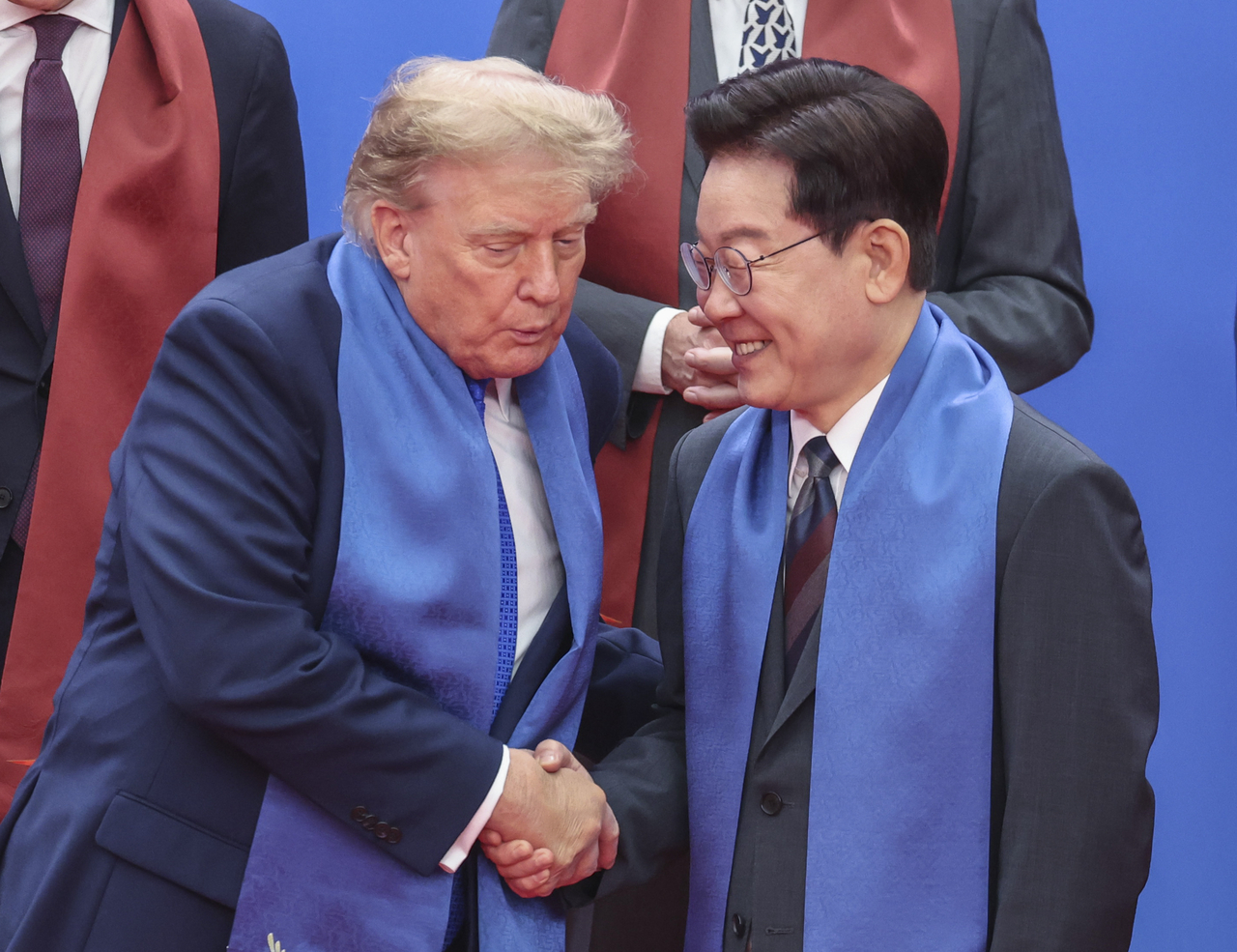
Despite expectations of talks between Lee and Trump during the Shenzhen APEC summit, the two leaders exchanged only brief greetings and did not hold a separate bilateral meeting.
That absence does not necessarily indicate a weakening alliance, but it leaves questions about when the two governments can advance discussions on their outstanding defense priorities.
China's opposition to Seoul's nuclear-powered submarine ambitions underscores the diplomatic challenges ahead.
At an International Atomic Energy Agency meeting in Vienna last week, Beijing criticized the South Korea-US submarine initiative, comparing it to the AUKUS partnership and warning of nuclear proliferation risks.
Washington and the European Union, by contrast, welcomed Seoul's cooperation with the IAEA on safeguards against the diversion of nuclear material for weapons development. Seoul plans to use uranium enriched to less than 20 percent for its conventionally armed, nuclear-powered submarines.
mkjung@heraldcorp.com