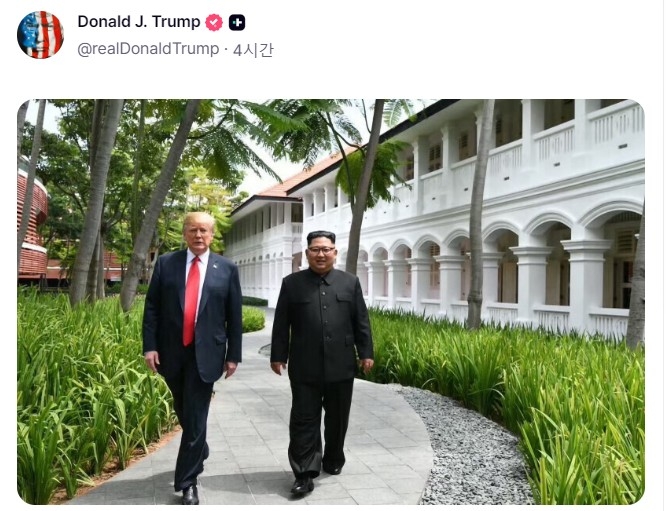
US President Donald Trump's continued interest in meeting North Korean leader Kim Jong-un has kept prospects for renewed nuclear diplomacy alive, but analysts remain divided over whether Washington can offer Pyongyang enough to bring it back to the negotiating table.
The two leaders failed to meet during the Asia-Pacific Economic Cooperation summit in China, while North Korea has shown little interest in responding to Trump's overtures, instead focusing on domestic affairs and strengthening its ties with China and Russia.
Some analysts see room for another summit, citing Pyongyang's reluctance to explicitly reject dialogue and potential diplomatic opportunities created by the US-China-Russia summit in Shenzhen.
Others argue that fundamental differences over denuclearization and North Korea's increasingly favorable strategic position make an early breakthrough unlikely.
Trump departed Shenzhen on Thursday without meeting Kim, but remained optimistic about future talks, telling NBC News that scheduling conflicts had prevented a meeting.
"The relationship is there, but we didn't meet," Trump said. "We'll have that meeting at some point."
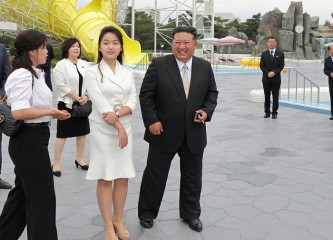
Kim, however, remained focused on domestic affairs throughout Trump's visit, inspecting tourism development projects, military education facilities and regional construction sites on Nov. 15-18, according to North Korea's state-run Korean Central News Agency.
Analysts say the most significant obstacle to another Trump-Kim summit remains the fundamental disagreement over the conditions for negotiations.
North Korea has insisted that Washington recognize its status as a nuclear-armed state and abandon what Pyongyang describes as its hostile policy, while the United States continues to uphold the objective of complete denuclearization.
In a Nov. 18 fact sheet issued following the East Asia Summit in Manila, the US State Department reaffirmed Washington's commitment to "the complete denuclearization of the DPRK and the full implementation of all DPRK-related UN Security Council resolutions." DPRK stands for the Democratic People's Republic of Korea, North Korea's official name.
Kim Jae-chun, a professor at Sogang University's Graduate School of International Studies, said the two leaders remain divided over the starting point for negotiations.
"Trump is still saying, 'Let's meet first,' while Kim Jong-un is insisting on recognition of North Korea as a nuclear-armed state," the professor said. "Recognizing North Korea as a nuclear-armed state would mean lifting US sanctions against the country."
The North's expanding partnerships with Russia and China have also reduced its incentive to seek an immediate breakthrough with Washington. Pyongyang has strengthened military and economic cooperation with Moscow following its deployment of troops to support Russia's war effort, while growing exchanges with Beijing have provided additional economic opportunities despite international sanctions.
The Sogang professor assessed the prospects for another summit as limited, saying that Trump would struggle to offer sanctions relief as a precondition for talks.
"Even Trump, despite his extraordinary negotiating style, cannot begin a US-North Korea summit by lifting sanctions or promising to lift them in advance," he said. "I would not say the possibility is zero, but if we are assessing whether another US-North Korea summit is likely or unlikely, I would say the chances are low."
Despite the obstacles, some analysts believe diplomatic engagement could resume around the end of this year or early next year.
In a Nov. 4 statement, Kim Yo-jong, the North Korean leader's sister, left the door open to dialogue with Washington but stressed that engagement would not necessarily serve Pyongyang's national interests unless the US abandoned what she described as its hostile policy.
Yang Moo-jin, a distinguished professor at the University of North Korean Studies, said both countries have reasons to pursue another summit.
"Both the United States and North Korea have their own reasons for pursuing a summit, and Trump in particular has continued to express expectations for a meeting even after the latest attempt failed," Yang said. "North Korea has also not directly expressed its refusal, meaning the possibility of a meeting remains very much alive."
The US-China-Russia summit in Shenzhen could offer another diplomatic opening, with the three leaders issuing a joint peace declaration addressing nuclear risk reduction and signaling a shift toward dialogue among the major powers.
Although the declaration made no explicit reference to North Korea or denuclearization on the Korean Peninsula, its commitment to promoting nuclear nonproliferation dialogue could create room for broader discussions on nuclear security, potentially including the North Korean nuclear issue.
Yang assessed that Pyongyang could welcome the declaration's opposition to the abuse of the International Criminal Court's jurisdiction and show interest in nuclear nonproliferation talks, while remaining firmly opposed to demands that it abandon its nuclear arsenal or return to the Nuclear Non-Proliferation Treaty framework.
"With the three major powers having opened the door to dialogue, the Korean Peninsula is also likely to see efforts to manage tensions and explore the restoration of diplomacy rather than a sharp escalation of confrontation," Yang said. "If Washington and Pyongyang succeed in reopening communication channels, a broader shift toward dialogue may not be far off."
mkjung@heraldcorp.com