Proposed exemptions from working-hour limits and employment rules spark union backlash, delaying key legislation for high-tech industrial hubs
South Korea's ambitious plan to build high-tech industrial hubs outside the capital region has hit an early roadblock: a dispute over whether companies investing in the new zones should be exempt from key labor protections.
Five months after President Lee Jae Myung unveiled the initiative, four bills intended to support the development of regional industrial clusters remain stalled in the National Assembly. At the heart of the dispute are proposals to ease the 52-hour weekly work limit and extend the maximum employment period for fixed-term workers.
Businesses and some experts argue that greater flexibility is essential to attracting investment, while labor unions warn that the exemptions could undermine workers' rights.
The deadlock is testing the government's ability to balance its industrial ambitions with labor protections.
What's at stake?
Announced in June, the initiative aims to develop large industrial clusters outside the Seoul metropolitan area to address regional economic disparities and population decline.
The plan includes an 800 trillion won ($594 billion) investment in a southwestern semiconductor cluster, with production expected to begin in 2030, alongside projects involving AI data centers and physical AI.
Legislation to establish a framework for the industrial zones has stalled over proposed labor exemptions.
First raised by Trade, Industry and Energy Minister Kim Jung-kwan in August, the proposals were incorporated into an October bill introduced by Rep. Park Sang-hyuk of the ruling Democratic Party of Korea.
Under the bill, managers and research and development employees whose income ranks among the top 3 percent nationwide could negotiate working hours beyond the current 52-hour weekly limit through individual written agreements.
The bill would also extend the maximum employment period for fixed-term workers from two to four years, requiring employers to compensate those whose contracts end without conversion to indefinite-term employment.
The ruling Democratic Party has yet to reconcile the competing bills, including proposals that exclude the controversial labor provisions.
Why the controversy?
Business groups argue that labor flexibility is necessary to compete for investment as companies increasingly consider overseas locations offering more favorable conditions.
Germany recently moved to ease certain labor regulations. Its Cabinet approved a draft bill last week that would simplify dismissal procedures for high-income workers and extend the maximum duration of certain fixed-term contracts from two to four years.
"From an economic standpoint, it may make sense for businesses to choose the US, with its tariff-free environment, or other locations offering more favorable conditions," said Park Ji-soon, a professor of labor law at Korea University.
"Unions need to face the practical challenge of job creation rather than get bogged down in rigid arguments."
Labor unions, however, warn that individual agreements could weaken collective protections and that applying different labor standards by region could violate the constitutional principle of equality.
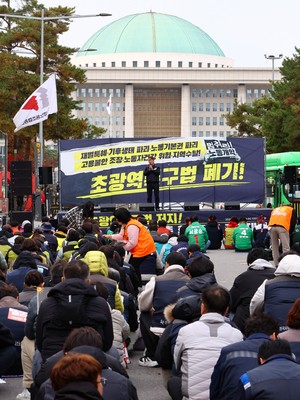
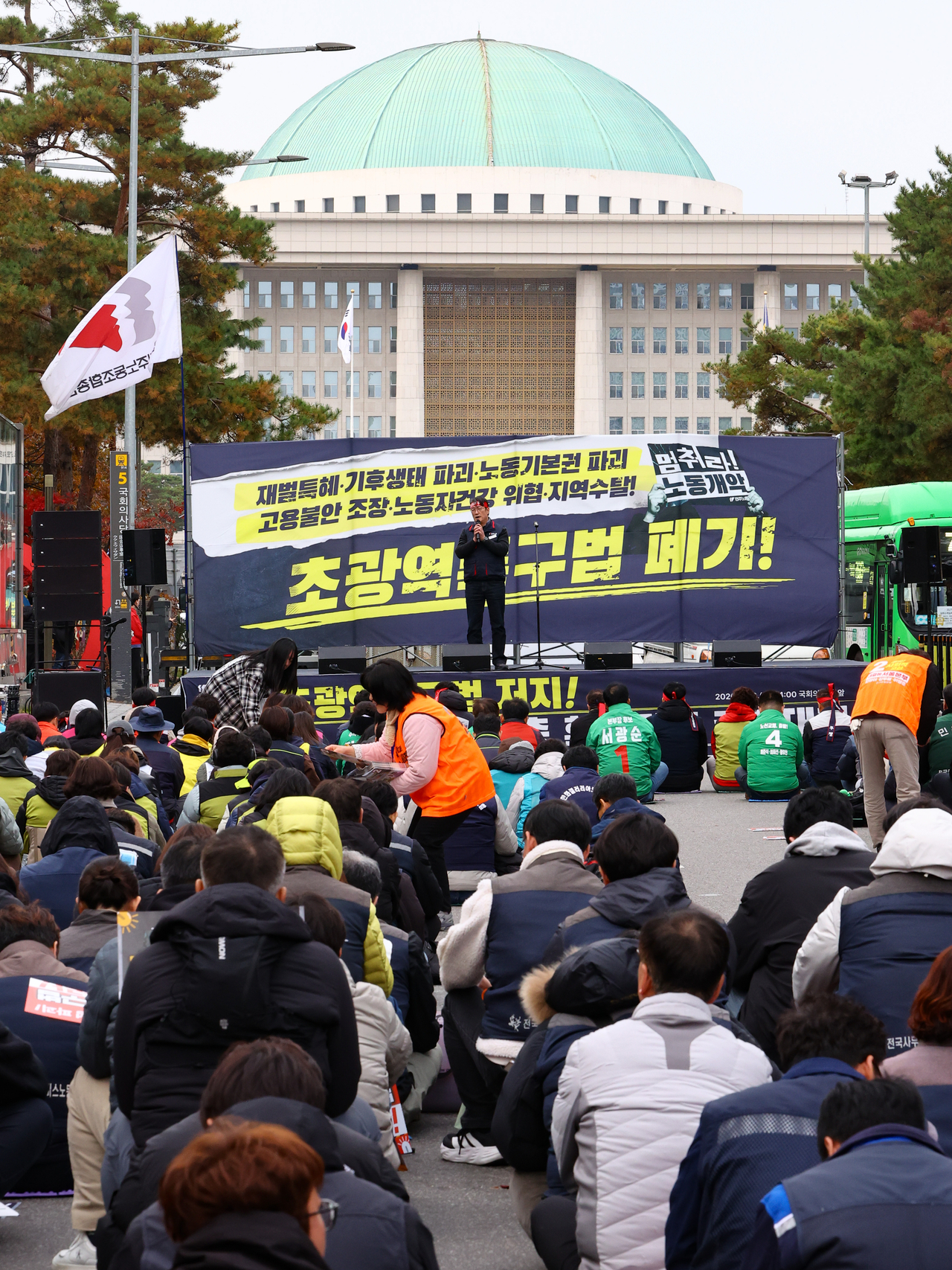
On Nov. 7, some 33,000 members of Korea's two major umbrella labor organizations rallied in Seoul to demand the removal of the labor protection exemptions in all four bills.
Federation of Korean Trade Unions President Kim Dong-myung warned last Wednesday that the opposition could extend to the Lee administration itself.
Can the government break the deadlock?
Some experts suggest passing a framework law without the labor exemptions and revisiting the disputed provisions next year. Lee has also floated moving ahead with parts of the initiative through enforcement decrees.
But Ahn Dong-hyun, a professor of financial economics at Seoul National University, warned that prolonged uncertainty could discourage investment.
"The president said this is a game of speed, but key labor issues have remained unresolved for months," Ahn said, referring to Lee's Nov. 12 remarks.
"While the government is asking businesses to make long-term investments, the situation is creating policy uncertainty."
Ahn cited the prolonged labor dispute at Gwangju Global Motors, established under an earlier regional job creation initiative, as a warning that unresolved labor issues could resurface after projects begin.
The company reached a tentative labor-management agreement in late October following two years and six months of conflict.
Labor Minister Kim Young-hoon said last week that the government would pursue discussions based on workplace evidence without predetermining the outcome.
Park of Korea University, however, called for stronger government leadership, including tax incentives, infrastructure support and a deadline for labor-management negotiations.
"Above all, the government should set a deadline and make clear that if labor and management fail to reach an agreement by then, it will proceed with its own proposal," he said.
forestjs@heraldcorp.com