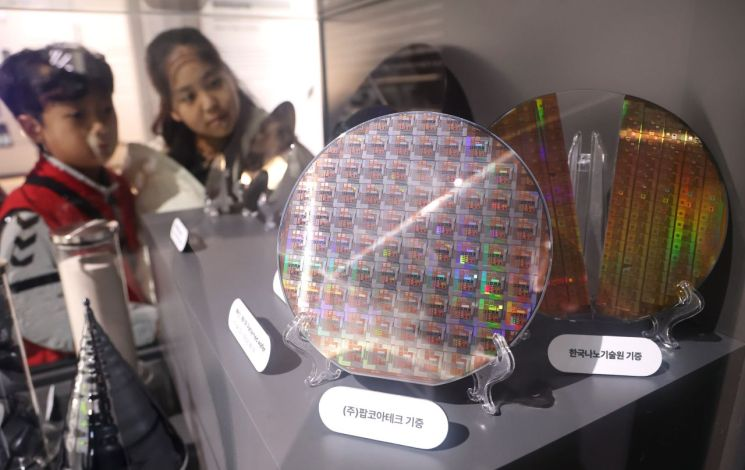
Semiconductors were the driving force behind South Korea’s first $1 trillion in annual exports, as surging demand for AI memory chips and rising prices fueled overseas sales.
The Ministry of Trade, Industry and Resources said Thursday that the preliminary figures showed cumulative exports reached the milestone at 2:09 p.m., making South Korea the fourth country to achieve the feat after the United States, Germany and China.
Chip exports exceeded $396 billion in the first 10 months of the year, accounting for about 43 percent of total exports.
As global technology companies poured money into AI data centers, demand surged for high-priced, high-bandwidth memory, or HBM, alongside server DRAM and enterprise solid-state drives.
HBM has emerged as a critical component of the AI boom, with production dominated by just three chipmakers: South Korea’s Samsung Electronics and SK hynix, and US-based Micron Technology.
Made by stacking DRAM chips vertically and connecting them through densely packed interconnections, HBM delivers large amounts of data at high speeds to the processors that train and run AI models, AI accelerators.
SK hynix held 50 percent of the global HBM market by revenue in the second quarter of 2026, followed by Samsung with 33 percent and Micron with 18 percent, according to Counterpoint Research. Samsung and SK hynix were also the world’s two largest DRAM suppliers during the period.
The AI memory boom propelled both Korean chipmakers to record quarterly operating profits. Samsung Electronics’ third-quarter operating profit surged 783.1 percent year on year to 107.44 trillion won ($80.5 billion), while SK hynix’s jumped 632.1 percent to 83.33 trillion won. Together, they generated 190.77 trillion won in operating profit.

Government officials expect the semiconductor export boom could continue into the first half of next year, supported by elevated chip prices and growing shipment volumes.
“Semiconductor prices were still rising through September, while shipment volumes were increasing even faster,” said Kang Gam-chan, director general for trade and investment at the industry ministry.
“Prices could decline slightly over the remaining three months, but they remain high, and there is room for export volumes to grow further. These factors could sustain strong semiconductor exports through year-end and into the first half of next year.”
Behind the chipmakers stands a broader network of domestic suppliers. SK hynix credited Thursday its collaboration with Korean materials, components and equipment companies as a key contributor to the export milestone. Producing advanced memory requires technologies ranging from specialty chemicals used in wafer processing to sophisticated packaging equipment and precision inspection systems, the company said.
In a joint statement, six major Korean business associations welcomed the export milestone and urged businesses and the government to translate export growth into domestic investment, jobs and stronger regional economies.
herim@heraldcorp.com