Despite the mountain's history as a backdrop for major political decisions, some analysts believe Kim's latest trip is more focused on domestic economic priorities
Kim Jong-un's latest visit to Mount Paektu, a site associated with political decisions and shifts in Pyongyang's foreign policy, has fueled speculation over whether the North Korean leader is preparing another strategic move as US President Donald Trump renews overtures for dialogue ahead of a major summit in China.
Yet despite the politically charged timing, some analysts largely view Kim's two-day trip to the mountainous border region as an effort to showcase domestic economic achievements and believe the prospects of a meeting between the two leaders remain slim.
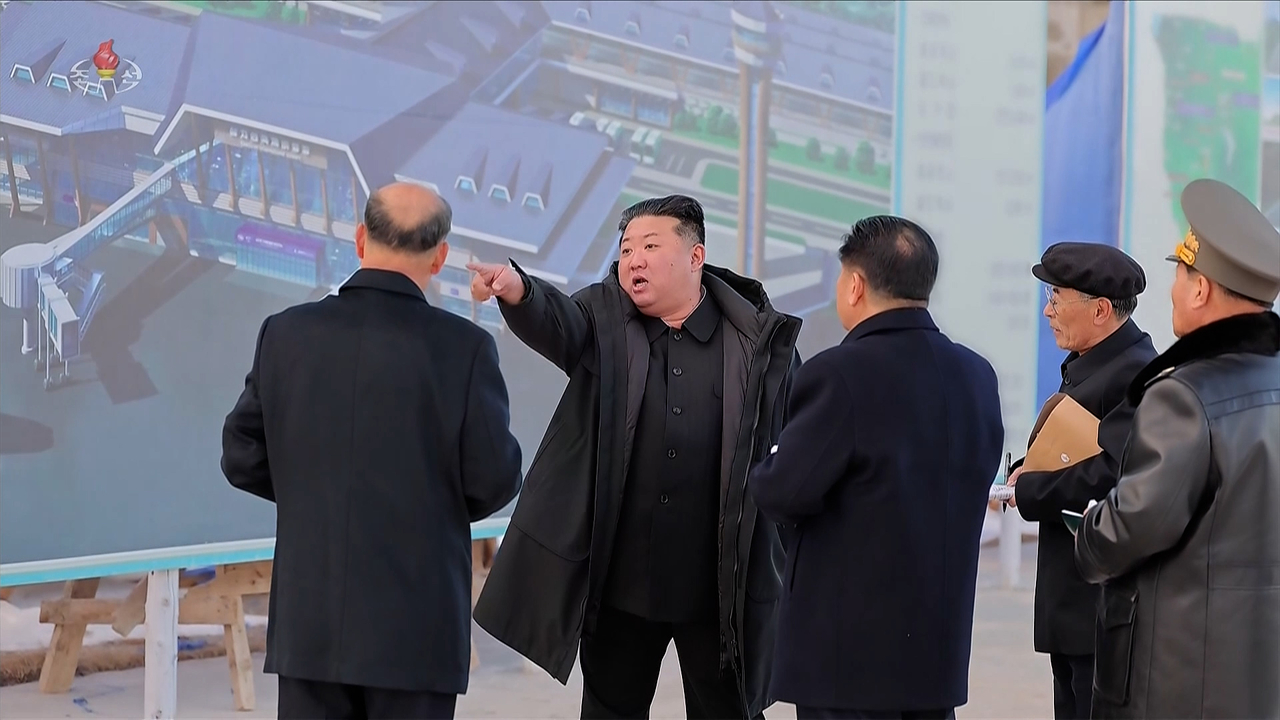
The Korean Central News Agency reported Tuesday that Kim inspected tourism development projects in Samjiyon, Ryanggang province, on Sunday and Monday, including a ski resort near Mount Paektu, airport renovation work and other infrastructure intended to transform the area into a tourism destination.
The visit took place just days before the Asia-Pacific Economic Cooperation summit scheduled for Wednesday and Thursday in Shenzhen, China, where Trump is expected to meet Chinese President Xi Jinping and Russian President Vladimir Putin.
Before departing for Asia on Monday, Trump suggested that he might also meet Kim in China, renewing speculation over a possible diplomatic opening following the Republican Party's crushing defeat in the US midterm elections.
Mount Paektu occupies a unique place in North Korea's political history and has previously served as a symbolic backdrop for major decisions involving both domestic power consolidation and relations with Washington.
Tourism development?
The circumstances surrounding the latest visit, however, differ markedly from those of previous politically significant trips: North Korean state media focused heavily on tourism infrastructure, regional development and Kim's satisfaction with ongoing construction projects, rather than emphasizing military resolve or revolutionary determination.
On Sunday, Kim inspected the renovation of Samjiyon Airport and the construction of a ski resort in the northern Mount Phothae area, directing officials to expand the airport's runway in accordance with International Civil Aviation Organization standards.
The following day, he visited construction sites around Mount Mudubong and Mount Paektu, including areas surrounding Lake Chon, and outlined priorities for next year's development projects.
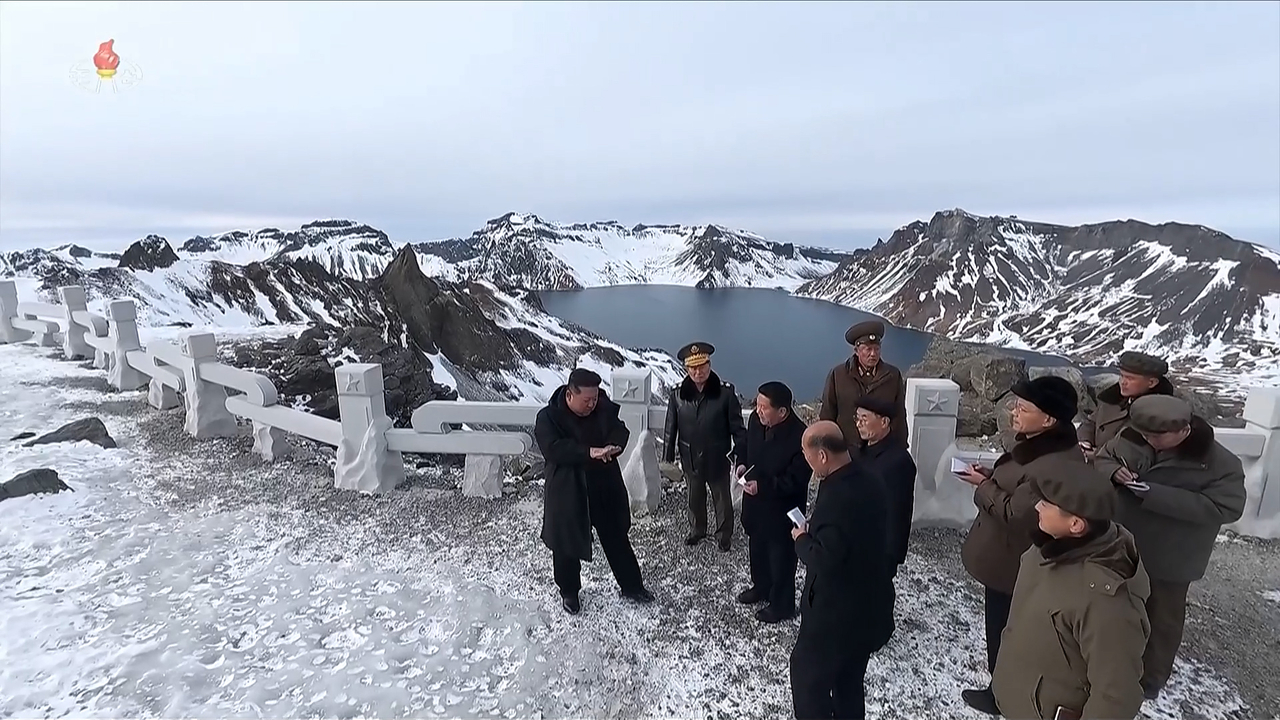
Kim emphasized that expanding tourism resources and promoting independent regional development were important components of the ruling Workers' Party's economic policies. Photographs accompanying the report also stood in stark contrast with imagery from his earlier visits.
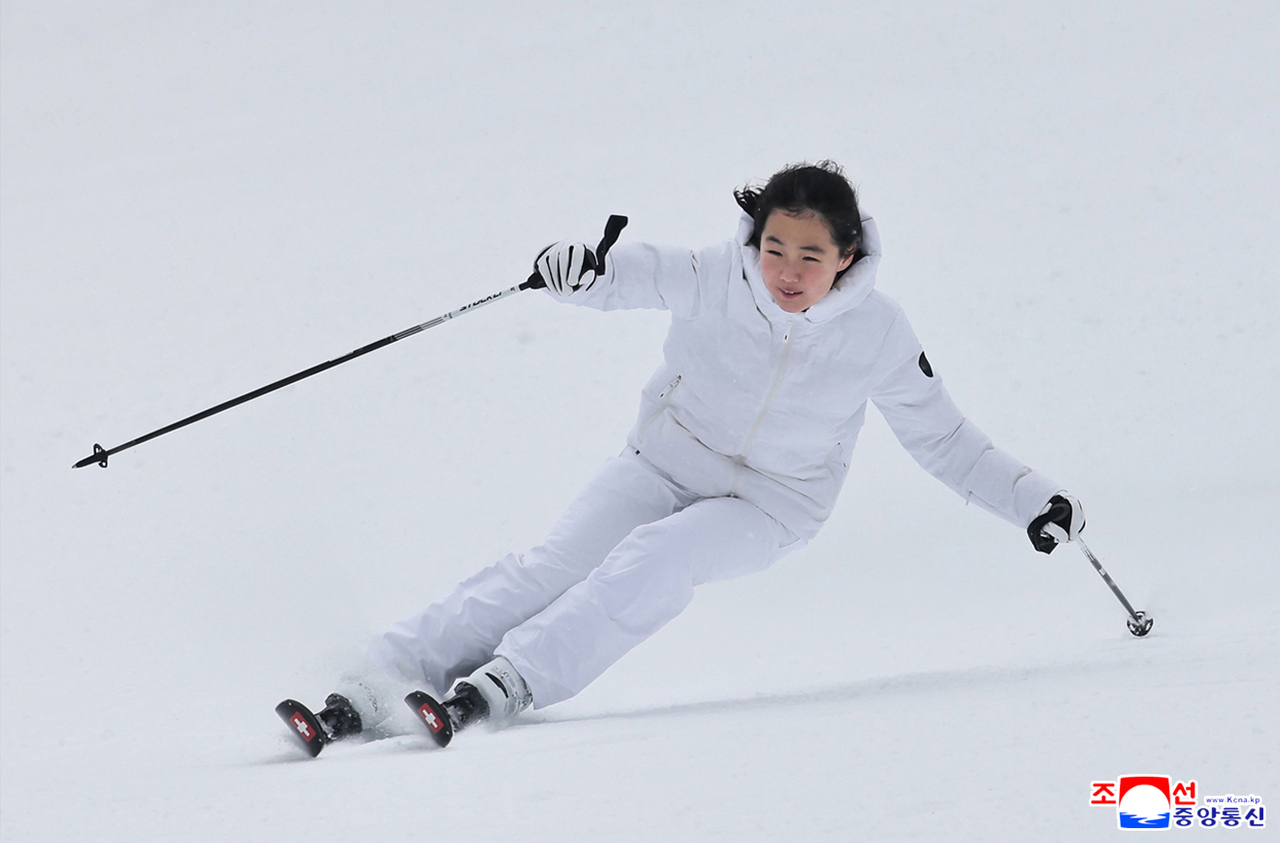
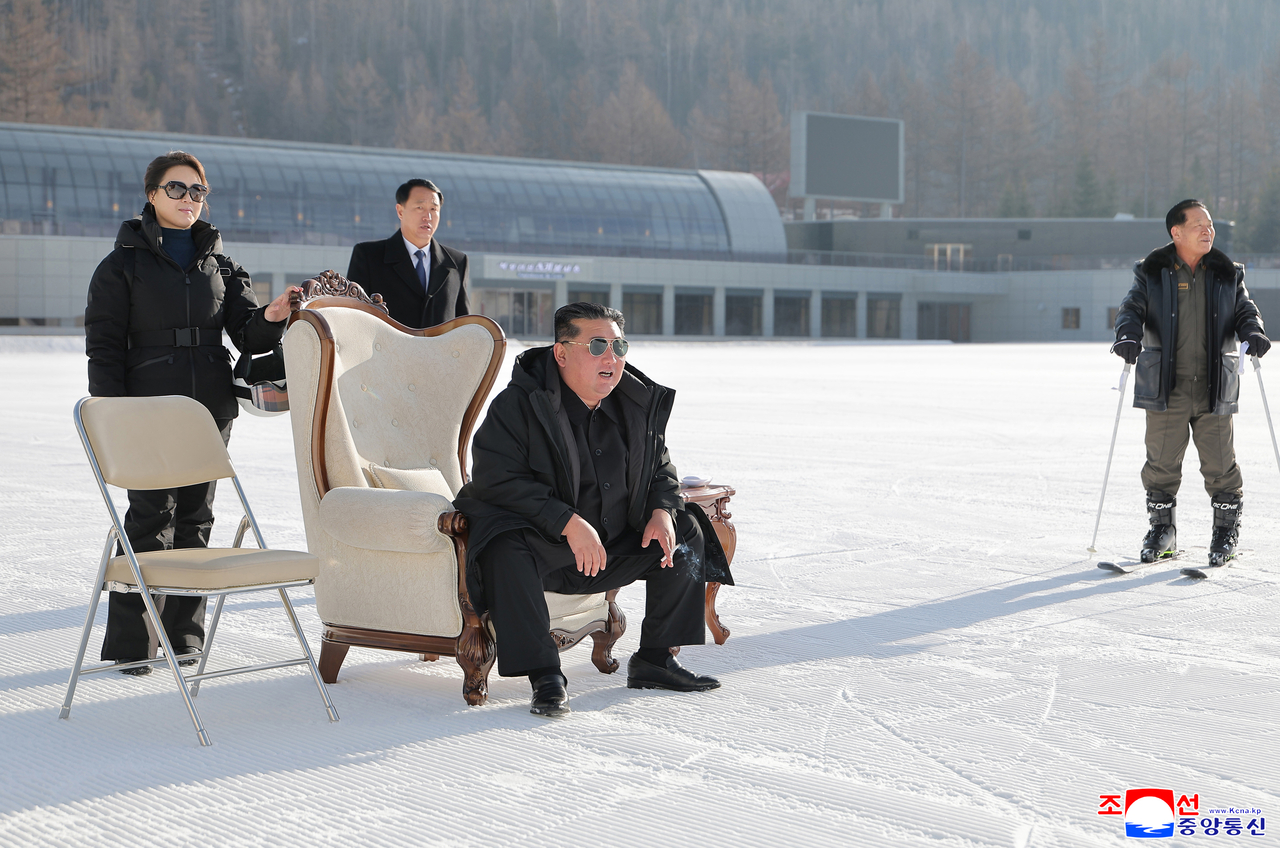
Instead of riding horseback alongside military commanders through snow-covered landscapes, Kim was shown wearing sunglasses and sitting in a chair at a ski resort while watching his daughter Ju-ae ski.
His wife Ri Sol-ju, sister Kim Yo-jong and senior party officials, including Pak Jong-chon, vice chairman of the party's Central Military Commission, also accompanied him.
The relatively relaxed atmosphere reinforced assessments that the visit was primarily intended to demonstrate progress in tourism development rather than signal an impending political decision.
Kim has also visited Samjiyon for economic purposes on several previous occasions, including in July 2024 and December 2025, when he reviewed plans to develop tourism facilities and attract foreign visitors.
An official at South Korea's Unification Ministry, requesting anonymity, told reporters Tuesday that the primary purpose of the latest inspection appeared to be reviewing construction projects Kim had personally ordered and commending the progress achieved.
"The primary purpose appears to have been to review the progress of tourism development projects he himself had ordered and recognize the achievements made so far," the official said.
"However, we will need to wait and see why he chose to visit the border region at this particular time."
Hong Min, a senior research fellow at the Korea Institute for National Unification, similarly cautioned against directly linking the trip to preparations for dialogue with Washington.
"With the year-end plenary meeting of the Workers' Party approaching, the visit appears partly intended to assess construction progress in Samjiyon and showcase achievements," Hong said.
The emphasis on economic development also comes as North Korea seeks to strengthen cooperation with China and Russia, potentially creating opportunities to expand tourism and related infrastructure.
A calculated diplomatic signal?
While the trip's immediate purpose appears largely domestic, other analysts caution that its timing leaves room for competing political interpretations.
Lim Eul-chul, a professor at Kyungnam University's Institute for Far Eastern Studies, said Kim's presence near the Chinese border could theoretically serve as a stopover ahead of a surprise visit to China.
Conversely, it could also represent an indirect signal that Kim intends to stay away from the summit, choosing instead to demonstrate his focus on domestic economic priorities while major powers engage in diplomacy.
"Kim Jong-un's stay in Samjiyon could serve as a stopover ahead of a visit to China, but it could also be an indirect signal that he has no intention of attending APEC, as he is demonstrating his focus on domestic livelihood projects in a border region during the summit period," Lim said.
Despite those possibilities, Lim assessed that a surprise meeting between Kim and Trump during APEC was less likely than Pyongyang maintaining a strategy of calculated restraint.
For North Korea, he argued, waiting for the outcome of the anticipated meetings among the leaders of the US, China and Russia would be more advantageous than entering high-stakes negotiations without sufficient preparations.
"From North Korea's perspective, it would be far more advantageous to assess the outcome of the US-China-Russia summit and the tone of Washington's messages toward Pyongyang before arranging a separate bilateral negotiating framework, rather than entering a multilateral diplomatic setting without sufficient advance coordination and risking a summit that produces no results," Lim said.
The fundamental obstacle remains the considerable gap between Washington's nuclear policy objectives and Pyongyang's demands.
Since the collapse of the Hanoi summit in 2019, substantive working-level negotiations between the two countries have remained largely suspended, leaving little opportunity to reconcile North Korea's insistence on recognition as a nuclear-armed state and sanctions relief with Washington's longstanding denuclearization objectives.
Kim Jae-chun, a professor at Sogang University's Graduate School of International Studies, also expressed skepticism about the prospects of an imminent summit.
"Although Trump has referred to North Korea as a 'nuclear power,' Pyongyang is demanding something much more substantive — genuine recognition of its nuclear status accompanied by sanctions relief," Kim said.
"Given how difficult it would be for North Korea to secure those conditions, I don't think it will come to the negotiating table for now."
China's calculations could further complicate any last-minute diplomatic initiative.
Trump suggested before departing for Asia that a possible meeting with Kim would depend on Xi, raising questions about Beijing's willingness to facilitate renewed US-North Korea engagement.
Lim noted that China might be reluctant to see a surprise Kim-Trump summit overshadow APEC, a major diplomatic gathering hosted by Beijing. Renewed direct engagement between Washington and Pyongyang could also weaken China's diplomatic leverage over North Korea, potentially reducing Xi's incentive to act as an intermediary.
North Korea, meanwhile, has offered little indication that it is prepared to soften its position toward Washington.
Meanwhile, Jo Yong-won, a senior Workers' Party official and close aide to Kim Jong-un, criticized Washington's longstanding hostility toward Pyongyang during an international forum in Moscow on Monday, according to a separate KCNA report released Tuesday.
Kim's history with Mount Paektu
Pyongyang portrays the mountain as a sacred revolutionary site associated with founding leader Kim Il-sung's anti-Japanese struggle and the purported birthplace of his son Kim Jong-il. It also serves as the symbolic foundation of the "Paektu bloodline," through which the regime legitimizes the hereditary succession of power.
Kim has visited the mountain at several pivotal moments during his rule.
In November 2013, he traveled to the Samjiyon area with close aides, shortly before the purge and execution of his uncle Jang Song-thaek, then one of the country's most powerful officials, in December that year.
In December 2017, Kim climbed Mount Paektu after declaring the completion of North Korea's state nuclear force. Weeks later, his New Year's address opened the door to North Korea's participation in the PyeongChang Winter Olympics, setting the stage for inter-Korean and US-North Korea summits in 2018.
Another politically significant visit came in October 2019, following the collapse of the Hanoi summit with Trump and the subsequent breakdown of working-level negotiations in Stockholm.
North Korean state media prominently featured Kim riding a white horse through the snow-covered mountain, projecting an image of determination amid mounting diplomatic uncertainty.
He returned to the mountain that December with senior military commanders before announcing a new strategy of a "frontal breakthrough" centered on self-reliance at a year-end Workers' Party meeting, effectively moving away from the previous diplomatic approach toward Washington.
mkjung@heraldcorp.com