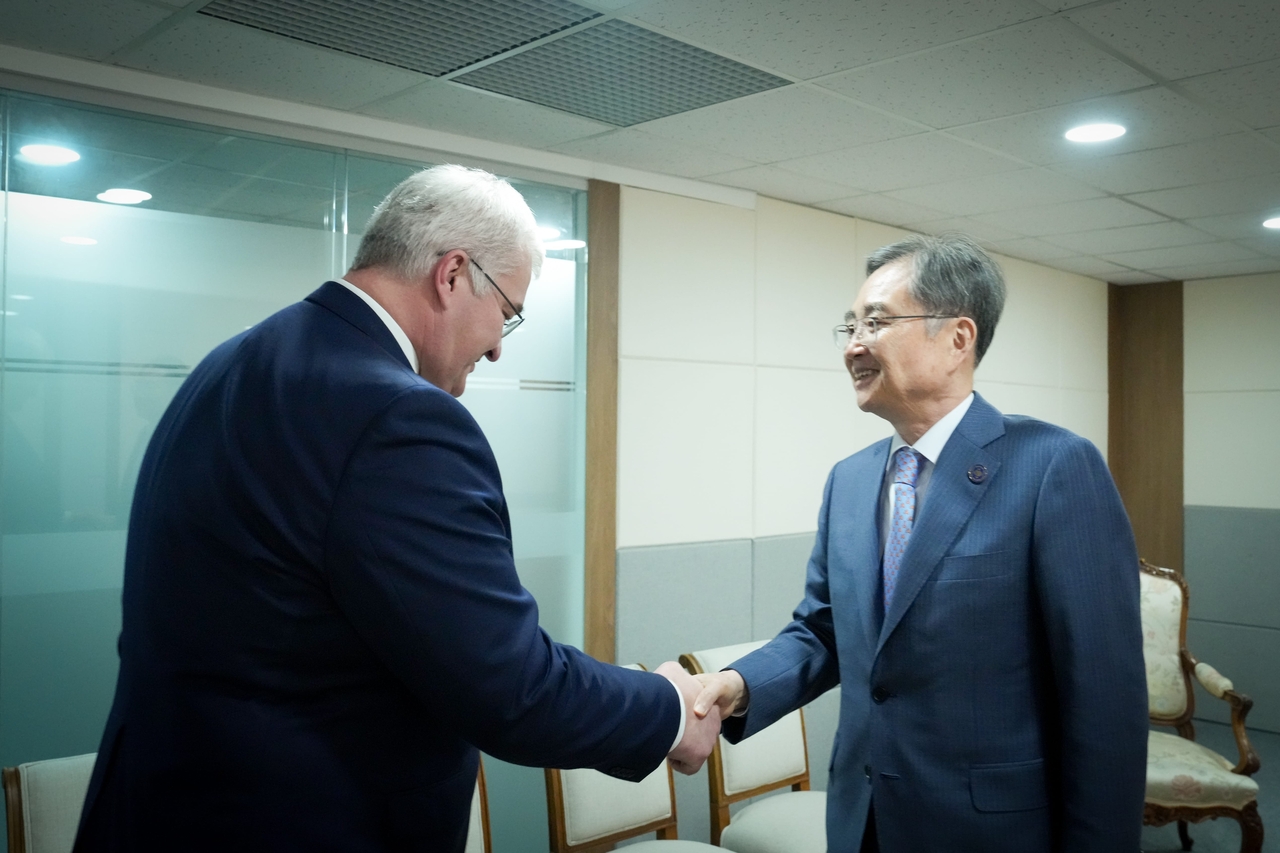
1st ministerial talks since North Korean POW dispute yield no publicly announced breakthrough, though Kyiv signals hope for full normalization of relations
South Korean Foreign Minister Cho Hyun stressed the importance of honoring agreements during talks with his Ukrainian counterpart in Paris this week, the Foreign Ministry said Wednesday.
The two countries sought common ground to resolve a diplomatic dispute over Kyiv's disclosure of the transfer of two North Korean prisoners of war to South Korea.
The meeting with Ukrainian Foreign Minister Andrii Sybiha, held on the sidelines of the Group of Seven foreign ministers' meeting on Tuesday, marked their first face-to-face encounter since the dispute prompted Seoul to recall its ambassador to Ukraine and withdraw some embassy personnel last month.
According to South Korea's Foreign Ministry, Cho emphasized that mutual respect, trust and the "faithful implementation of agreements" were fundamental prerequisites for advancing bilateral relations, expressing hope that outstanding issues between the two countries would be resolved amicably.
His remarks appeared to underscore Seoul's longstanding demand for an apology and assurances against a recurrence over what it considers Ukraine's violation of a confidentiality agreement concerning the transfer of North Korean POWs.
Sybiha, in response, called for continued diplomatic efforts to manage bilateral relations in a stable manner and further develop cooperation, according to the ministry.
Despite the resumption of high-level diplomatic engagement, the ministry's readout made no mention of an apology from Kyiv or any concrete measures to address Seoul's grievances. It also did not mention whether the talks had produced substantive progress toward resolving the dispute.
A Foreign Ministry official, requesting anonymity, described the meeting as an opportunity for both sides to reaffirm their respective positions and continue diplomatic efforts to find common ground.
The point of conflict first erupted in September after Ukrainian President Volodymyr Zelenskyy publicly disclosed during his address to the United Nations General Assembly that two North Korean soldiers captured while fighting alongside Russian forces had been transferred to South Korea.
Seoul maintains that the two governments had agreed to keep the transfer confidential, citing concerns over the safety of the former prisoners and their families. Kyiv, however, has disputed the existence of such an agreement.
The disagreement subsequently escalated into an unusual diplomatic confrontation between the two countries, which have maintained close cooperation in response to Russia's invasion of Ukraine and North Korea's military support for Moscow.
On Oct. 8, Seoul recalled its ambassador to Ukraine, Park Ki-chang, from the country in protest over Kyiv's handling of the matter. The government subsequently withdrew half of its embassy personnel on Oct. 20, citing Ukraine's failure to take what Seoul considered adequate corrective measures, as well as persistent security threats from Russian airstrikes.
South Korea has demanded a clear explanation, an apology and assurances that similar disclosures will not recur.
Tuesday's meeting was the first between the two foreign ministers since those diplomatic measures were taken, although they had previously held bilateral talks on the sidelines of the UN General Assembly in New York on Sept. 23.
Despite the absence of any publicly announced breakthrough, Sybiha struck a conciliatory tone following the meeting, expressing confidence that the two countries would take further steps toward restoring their relationship.
"I am convinced that further steps lie ahead towards the full normalisation of our bilateral relations, and this is the outcome we are working to achieve," Sybiha wrote on X after the talks.
He also reaffirmed Ukraine's willingness to develop what he described as a "dynamic and pragmatic partnership" with South Korea, citing shared interests and security threats arising from North Korea's involvement in Russia's war against Ukraine.
The Ukrainian minister said he had briefed Cho on Kyiv's peace initiatives and proposals for de-escalation, adding that the two had discussed possible ways to bring the war to an end.
He also expressed appreciation for Cho's perspectives, which he said drew on South Korea's own historical experience.
Sybiha reiterated his invitation for Cho to visit Ukraine, signaling Kyiv's willingness to maintain high-level diplomatic engagement despite the unresolved disagreement.
Meanwhile, Cho reaffirmed that South Korea's principled position on supporting Ukraine remained unchanged, emphasizing Seoul's responsibilities as a member of the international community.
He said the government would continue exploring ways to provide humanitarian assistance to the Ukrainian people and contribute to the country's reconstruction.
Sybiha expressed gratitude for South Korea's continued support for Ukraine's sovereignty and territorial integrity, while welcoming greater participation by South Korean businesses in Ukraine's recovery efforts.
The two ministers also exchanged views on regional security developments, including the situation on the Korean Peninsula and the ongoing war in Ukraine.
mkjung@heraldcorp.com