Inside Posco's Gwangyang complex, expanded LNG infrastructure, battery material production and recycling facilities bolster supply security
GWANGYANG, Jeonnam-Gwangju — Just a few kilometers from Posco's sprawling steelworks, Gwangyang Bay and the neighboring Yulchon Industrial Complex are emerging as key hubs in South Korea's efforts to strengthen energy security and reduce its dependence on overseas suppliers of critical battery materials.
From massive liquefied natural gas storage tanks to highly automated battery material plants, Posco Group is building an industrial ecosystem that connects energy infrastructure, advanced manufacturing and strategic resources.
Expanding Korea's LNG infrastructure
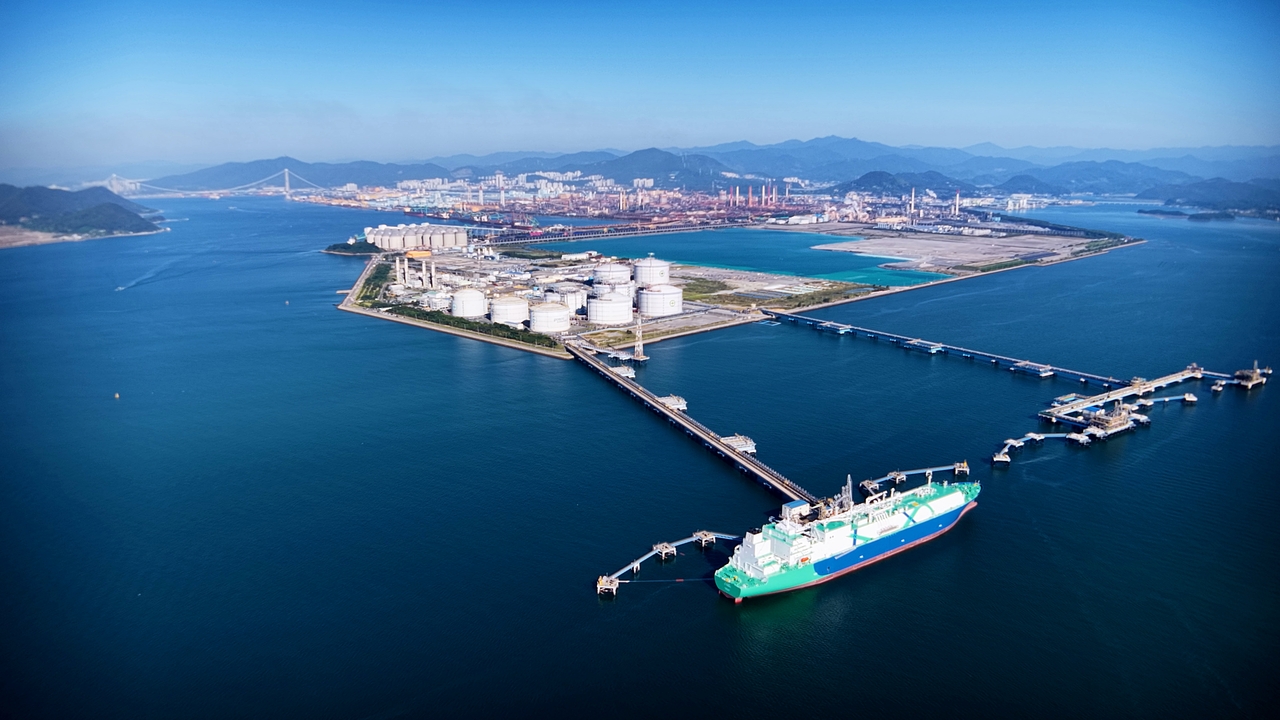
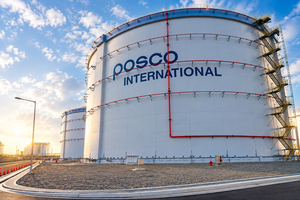
At the center of the group's energy business is Posco International's Gwangyang LNG Terminal, Korea's first privately operated LNG import terminal, where a major expansion has added storage capacity and opened opportunities for new businesses.
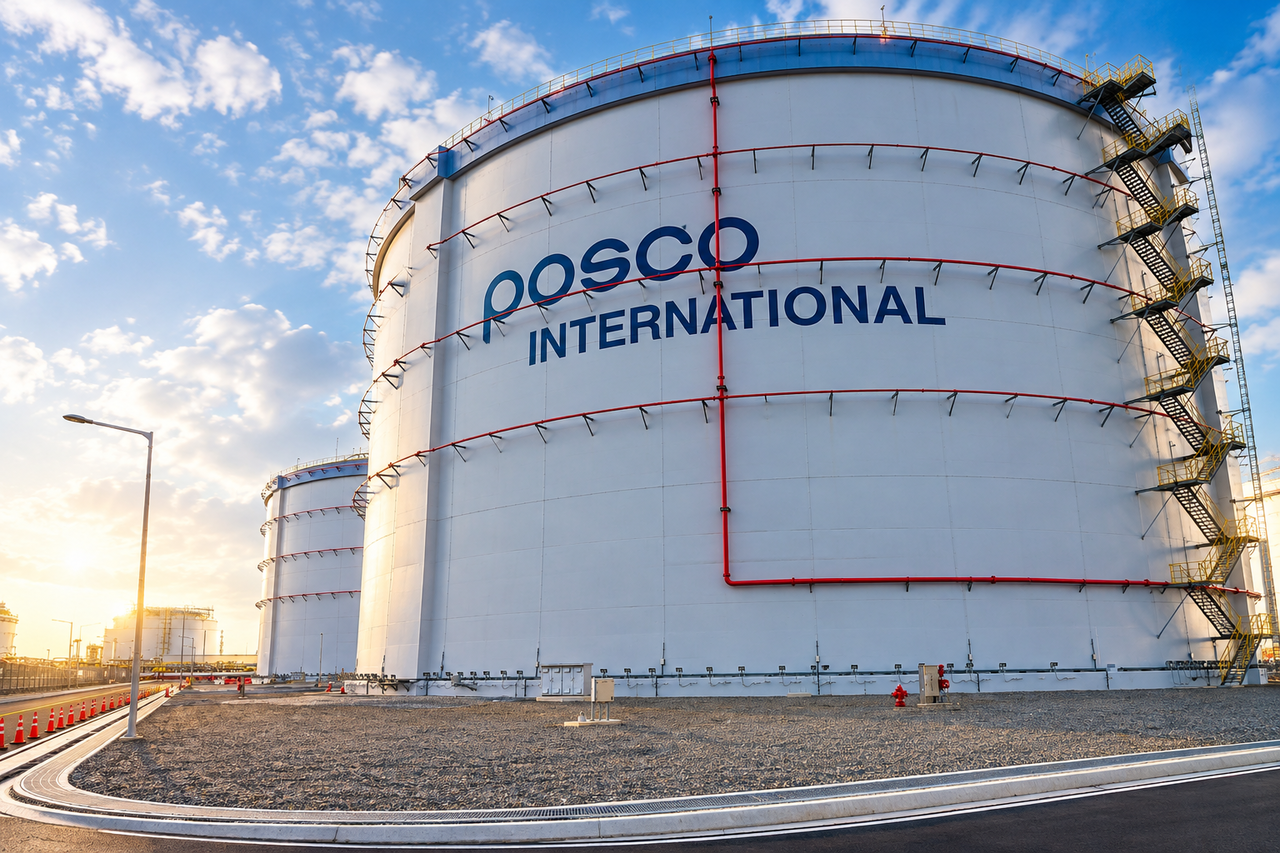
During a press tour on Nov. 3, the company showcased its newly completed Terminal 2 expansion, featuring two LNG storage tanks, each standing 50 meters tall and measuring 100 meters in diameter.
The 949.2 billion won ($709 million) project added two 200,000-kiloliter tanks, bringing the terminal's total storage capacity across eight tanks to 1.44 million kiloliters — equivalent to roughly 40 days of Korea's residential heating demand, according to the company.
Inside the tanks, LNG is stored at minus 162 degrees Celsius, reducing natural gas to about one-600th of its original volume. Each tank can hold the equivalent of 400 million 500-milliliter water bottles.
The tanks also showcase Posco's proprietary high-manganese steel, first used in the terminal's fifth and sixth tanks. Designed to withstand extremely low temperatures, the material offers performance comparable to conventional 9 percent nickel steel while reducing material costs by approximately 25 percent, according to Posco.
The structures feature 75-centimeter-thick outer walls and are engineered to withstand earthquakes and other external shocks.
A newly added second pier, connected by a 740-meter offshore corridor, can accommodate LNG carriers with capacities of up to 270,000 cubic meters, among the largest in operation.
Beyond supplying gas to Posco's steelworks and domestic power plants through the national gas network, the expanded terminal is expected to support additional businesses, including LNG carrier commissioning, ship bunkering and cold-energy recovery.
Posco International has also reserved space for four additional tanks, which could eventually increase the terminal's storage capacity to 2.27 million kiloliters.
Automation drives battery material production
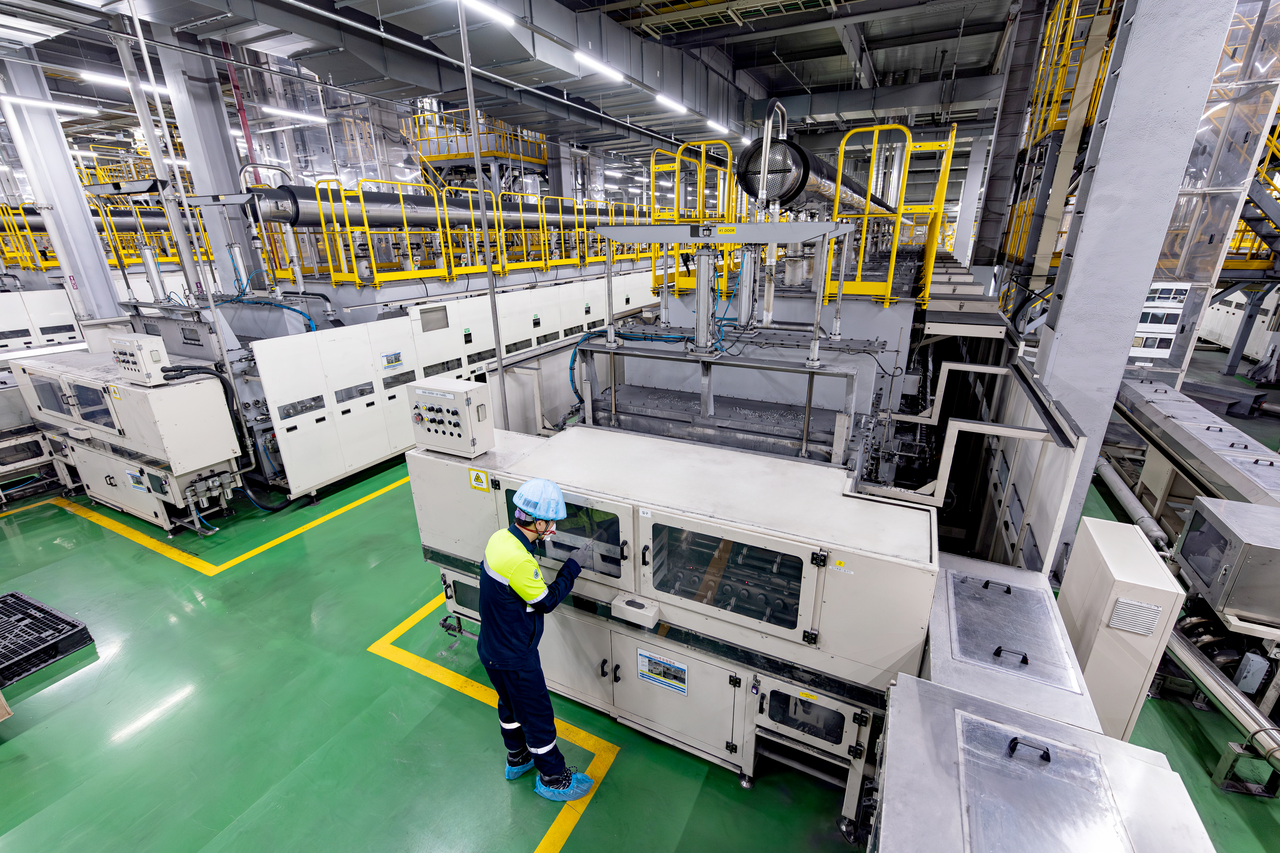
At the nearby Yulchon Industrial Complex, Posco Future M operates a cathode material plant with an annual production capacity of 90,000 tons, which the company describes as the world's largest single-site facility of its kind.
That output is sufficient to supply batteries for approximately 850,000 Hyundai Ioniq 5 electric vehicles.
Inside the plant, workers oversee a largely automated process in which precursor materials are mixed with lithium compounds and heated in industrial furnaces before cooling and further processing.
The facility produces high-performance cathode materials, including nickel-cobalt-manganese, nickel-cobalt-aluminum and nickel-cobalt-manganese-aluminum compositions.
Its single-crystal cathode technology is designed to improve battery durability and thermal stability. Unlike conventional polycrystalline materials, which consist of multiple smaller crystals, single-crystal particles are more resistant to cracking during repeated charging and discharging.
Automation extends beyond the production line.
After the heating process, robotic arms package samples into capsules that travel through overhead pneumatic tubes to a second-floor laboratory in about 20 seconds. Automated guided vehicles transport materials between production areas and warehouses.
Inside the testing laboratory, robotic systems prepare samples for chemical analysis, crystal structure inspections and battery performance tests conducted under tightly controlled conditions.
Materials that fail to meet quality standards can be transferred to nearby Posco HY Clean Metal for the recovery of valuable metals.
The Gwangyang facility serves as a model for Posco Future M's efforts to expand automated battery material production overseas.
Building domestic critical materials supply chain
Beyond cathode production, Posco Group is expanding its presence across the battery materials supply chain, from lithium processing to recycling.
Posco-Pilbara Lithium Solution operates Korea's first commercial lithium hydroxide plant using lithium ore imported from Australia under a 20-year supply arrangement.
With an annual production capacity of 43,000 tons, the facility combines electrodialysis and conventional chemical processing to produce lithium hydroxide, a key ingredient in high-performance EV batteries.
The project is part of Posco's efforts to diversify supply chains and reduce Korea's reliance on China for processed battery materials.
Nearby, Posco HY Clean Metal processes up to 12,000 tons of black mass annually. Black mass is the material recovered from crushed spent batteries and manufacturing scrap that contains valuable metals.
The facility extracts lithium carbonate, nickel sulfate and cobalt sulfate, with reported recovery rates exceeding 90 percent. The recovered materials can be reused in Posco Future M's battery material production.
Posco is also expanding into industrial gases essential for advanced manufacturing.
Posco Air Solution produces high-purity specialty gases, including xenon, krypton, neon and helium, with a stated annual production capacity of 130,000 normal cubic meters.
The gases have applications in semiconductor manufacturing, aerospace and defense, industries where reliable supplies have become increasingly important amid geopolitical tensions and supply chain disruptions.
Together, the facilities illustrate Posco's strategy to extend its industrial capabilities beyond steelmaking, linking LNG infrastructure, battery materials, recycling and specialty gases in a bid to strengthen its position in critical supply chains.
hyejin2@heraldcorp.com