German ambassador advocates closer trade, technology and security ties among middle powers amid uncertainty
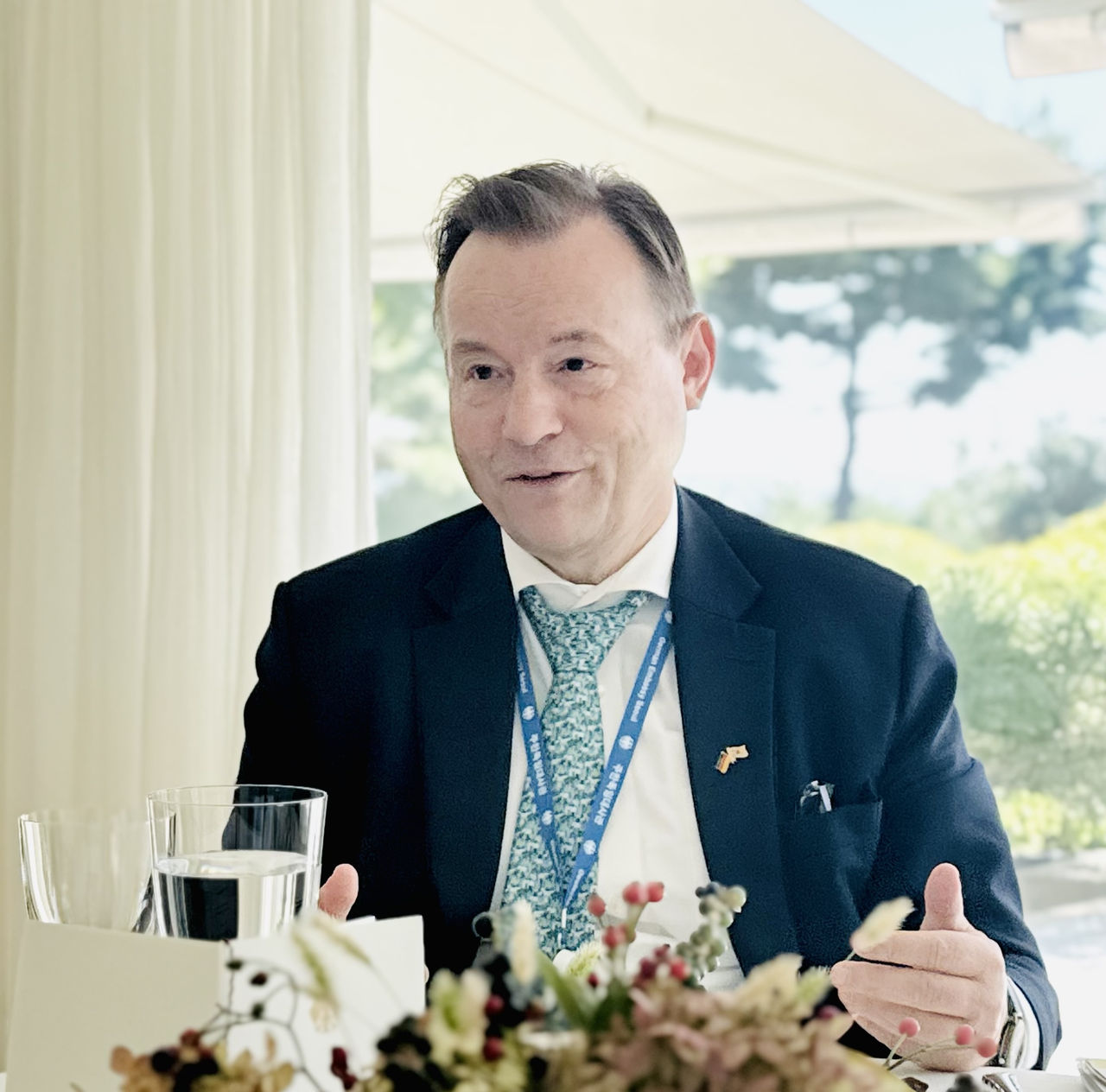
Germany and South Korea can bolster economic and security stability through closer cooperation as middle powers amid conflicts in Europe and the Middle East, German Ambassador Georg Schmidt said, while cautioning that neither can replace the United States or China.
Speaking with The Korea Herald on Wednesday ahead of German Chancellor Friedrich Merz’s summit with President Lee Jae Myung in Seoul, Schmidt pointed to industrial partnerships, technological cooperation and political coordination as ways to reduce shared risks. Merz’s visit is part of a tour covering Singapore, Japan and South Korea, and he is set to attend the Asia-Pacific Conference of German Business, known as APK, while in Seoul.
Schmidt stressed the need for cooperation among middle powers and the opportunity greater Korea-Germany cooperation presents to build stability and technological expertise.
“We might not be superpowers, but we do not need to hide," he said.
“We are facing a lot of global disorder, but we need global rules and benefit from them,” the ambassador added.
Trade and value chains
On US trade pressure, he pointed to the EU’s and South Korea’s free trade agreements as a basis for more reliable trade but did not outline specific joint action.
He highlighted supply chains and AI as areas for cooperation, advocating a wider range of markets and suppliers rather than cutting economic ties.
“We do not advocate decoupling, for instance, but we strongly advocate derisking,” he explained.
Schmidt emphasized German companies’ willingness to enter long-term agreements with Korean partners and link their value chains. Korean components already feature in familiar German products.
“If I look at many German products, such as a Mercedes-Benz, there is a lot in them that is made in Korea,” he noted.
Such partnerships offered stability amid geopolitical uncertainty, according to Schmidt.
“They feel that this long-term stability is there.”
He cited Merck’s 300 million euro ($334 million) investment in a bioprocessing production center in Daejeon and Sartorius’ biopharmaceutical campus in Songdo, Incheon, as examples of German companies integrating into Korea’s industrial ecosystem.
“They (Merck) are doing that because they have long-term commitments with their Korean partners,” he said.
Schmidt identified artificial intelligence, semiconductors and biotechnology as areas for cooperation, while noting that large US and Chinese investments in AI were creating new dependencies.
“So what do we do as medium-sized powers? Where can we work together? How can we work together? We very much see Korea as a like-minded partner.”
Dialogue and deterrence
The envoy linked North Korea’s involvement in Russia’s war against Ukraine to the increasingly connected security challenges facing Europe and the Korean Peninsula.
He acknowledged that some South Koreans might see Ukraine as a distant conflict, just as some Germans might view North Korea as remote from their concerns.
“But if you take a closer look, it is very obvious that these things are linked,” he noted.
“Germany is a UNC member committed to peace and security here in the region,” Schmidt said, referring to the United Nations Command, which oversees the armistice.
According to Schmidt, security cooperation should extend to cybersecurity, drones, AI and uncrewed systems, with governments comparing threat assessments and ensuring their military equipment can operate together.
“Of course, we face similar threats, but from different perspectives, and it is good to listen to each other.”
On keeping talks open with Pyongyang, Schmidt pointed to Germany’s experience of division. Germany had offered dialogue while standing firm, he said: “Don’t push us around.”
“We are happy to share our experiences, but every country has to find its own balance,” he explained, acknowledging the difficulty South Korea faces with a nuclear-armed neighbor.
Responding to concerns that US President Donald Trump might ease North Korea sanctions or soften denuclearization demands, Schmidt reaffirmed Germany’s commitment to UN sanctions and maintaining the armistice.
He also stressed the importance of keeping dialogue open, despite Pyongyang’s lack of response to Seoul’s overtures.
sanjaykumar@heraldcorp.com