Lee defends investigative chiefs’ attendance at Cabinet meeting as ‘restoring normalcy’
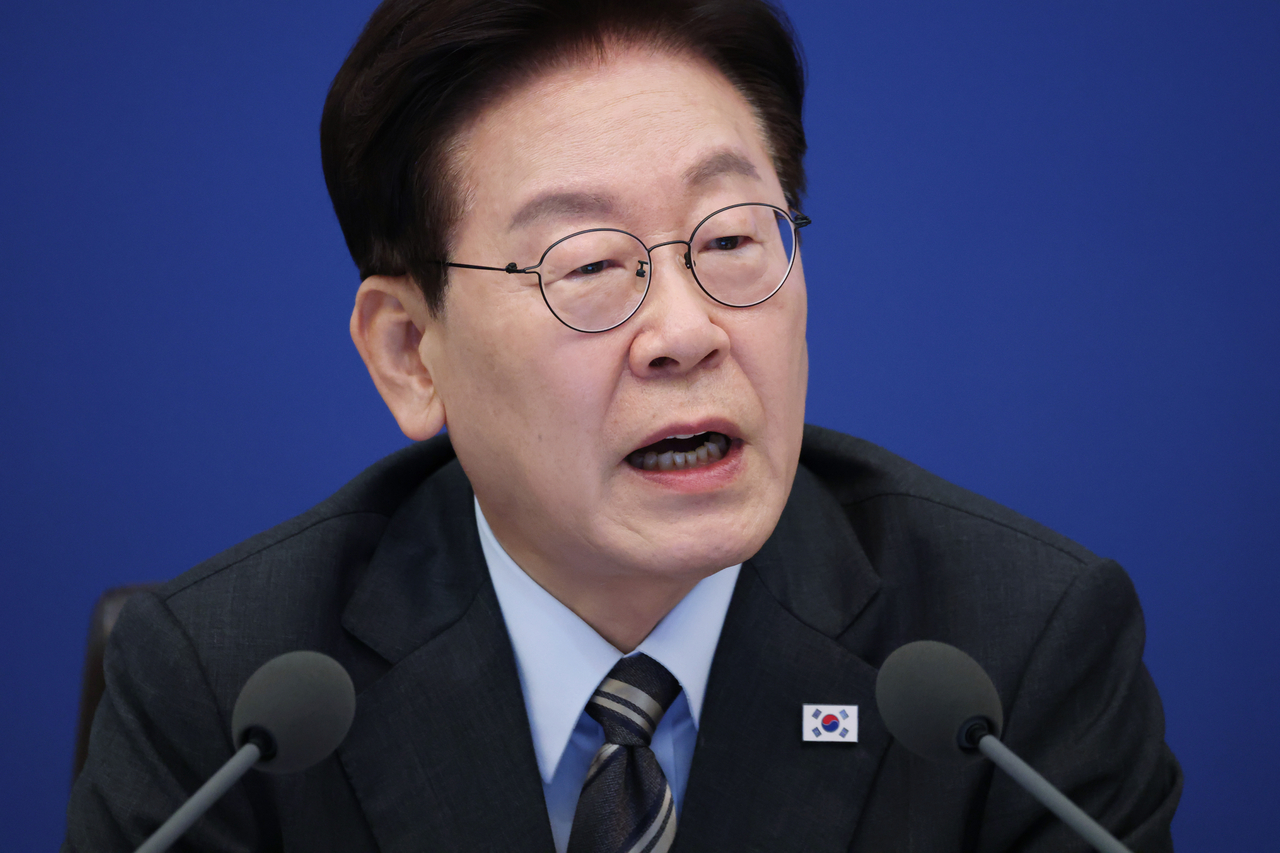
President Lee Jae Myung said Tuesday that low economic growth was the root cause of social unrest across Europe, and that South Korea must learn from the turmoil.
His remarks came as Europe grappled with a wave of protests stretching from Albania to Belgium, Italy, Portugal and Spain, alongside mass demonstrations in France, where thousands of people have been arrested in recent weeks.
The grievances vary across the continent, ranging from rising living costs and strained public services in France and Belgium to housing shortages in Spain and Portugal and corruption in Albania. Young people have led many of the demonstrations.
Speaking at a Cabinet meeting, Lee said many experts had pointed to rising living costs, including fuel prices, sluggish economies and entrenched inequality as common factors behind Europe's troubles. But Lee identified low economic growth as the underlying cause of the unrest.
“While various factors have contributed to the situation, the biggest and most fundamental cause is ultimately low economic growth,” Lee said. “It seems prolonged, low growth has worsened youth unemployment and economic polarization while weakening public finances, threatening the very foundations of social stability.”
Lee stressed that “we must heed the lessons of Europe’s current turmoil.”
Turning to South Korea, Lee said the economy had delivered impressive results by key measures, but the recovery had yet to be widely felt by ordinary households, with disparities in income, wealth and employment opportunities persisting.
“Above all, our young people face significant difficulties because there simply aren't enough opportunities,” Lee said. “Sustainable growth is ultimately essential to addressing these problems.”
His remarks coincided with fresh data showing South Korea’s economy grew 1.0 percent in the third quarter from the previous quarter. The stronger-than-expected increase was driven by robust semiconductor exports and increased investment in manufacturing equipment, according to the Bank of Korea on Tuesday.
Lee called for greater investment in advanced industries, measures to boost domestic demand and policies that would allow households to feel the benefits of an economic recovery.
Stronger growth, Lee explained, would also help stabilize the debt-to-GDP ratio and strengthen public finances, laying the groundwork for sustainable expansion.
Lee reiterated the importance of studying other countries’ experiences and drawing lessons from them, while cautioning against selective interpretations.
“However, we must also be careful not to overemphasize any single aspect and draw forced conclusions,” he said.
Pledge to prevent repeat Itaewon tragedy
On public safety, Lee called for stronger government action to prevent tragedies such as the 2022 Itaewon tragedy, which killed 159 people, two days before its fourth anniversary, which falls on Oct. 29.
“I pray for the souls of those who lost their precious lives and extend my deepest condolences to the bereaved families enduring unimaginable grief and suffering,” Lee said.
Lee said protecting citizens’ lives and safety was the state’s “foremost duty and reason for existence,” citing the Itaewon disaster and the 2014 Sewol ferry sinking as reminders of the country’s shortcomings in public safety.
“We still have a long way to go before everyone can live their daily lives in safety,” Lee said.
“The government must take the lead in protecting people’s lives and building a country where everyone can go about their daily lives safely, so that such horrific tragedies, in which innocent lives are lost because of the state’s failure to act, never happen again.”
Lee urged the government to ensure that all necessary follow-up measures are in place for the smooth implementation of the Basic Act on Life and Safety, set to take effect Dec. 3, calling it “a major milestone toward building a society where life and safety are fundamental priorities.”
Dimissal of concerns over investigative chiefs’ neutrality
Separately, Lee dismissed an ongoing controversy over whether the attendance of investigative agency chiefs at Cabinet meetings could compromise their political neutrality, defending the practice as a way to promote transparency.
“What does attending an open meeting like this have to do with political neutrality?” Lee asked. “Would Cabinet ministers make personal requests or issue improper orders to investigative agency chiefs in such a setting? The likelihood of unlawful conduct is actually lower.”
Lee's remarks came as Kim Ji-yong, head of the newly launched Serious Crimes Investigation Agency, attended his second Cabinet meeting since taking office, alongside acting chiefs of the prosecution and police agencies.
Lee reiterated that investigative agencies remain subject to presidential supervision under the law, arguing that public Cabinet meetings provide a more transparent forum for sharing government priorities than private instructions.
“It is better to share the government’s policy direction in an open meeting. It would be stranger to do so privately,” Lee said.
“This is part of an effort to restore normalcy to what has long been abnormal,” he added.
dagyumji@heraldcorp.com