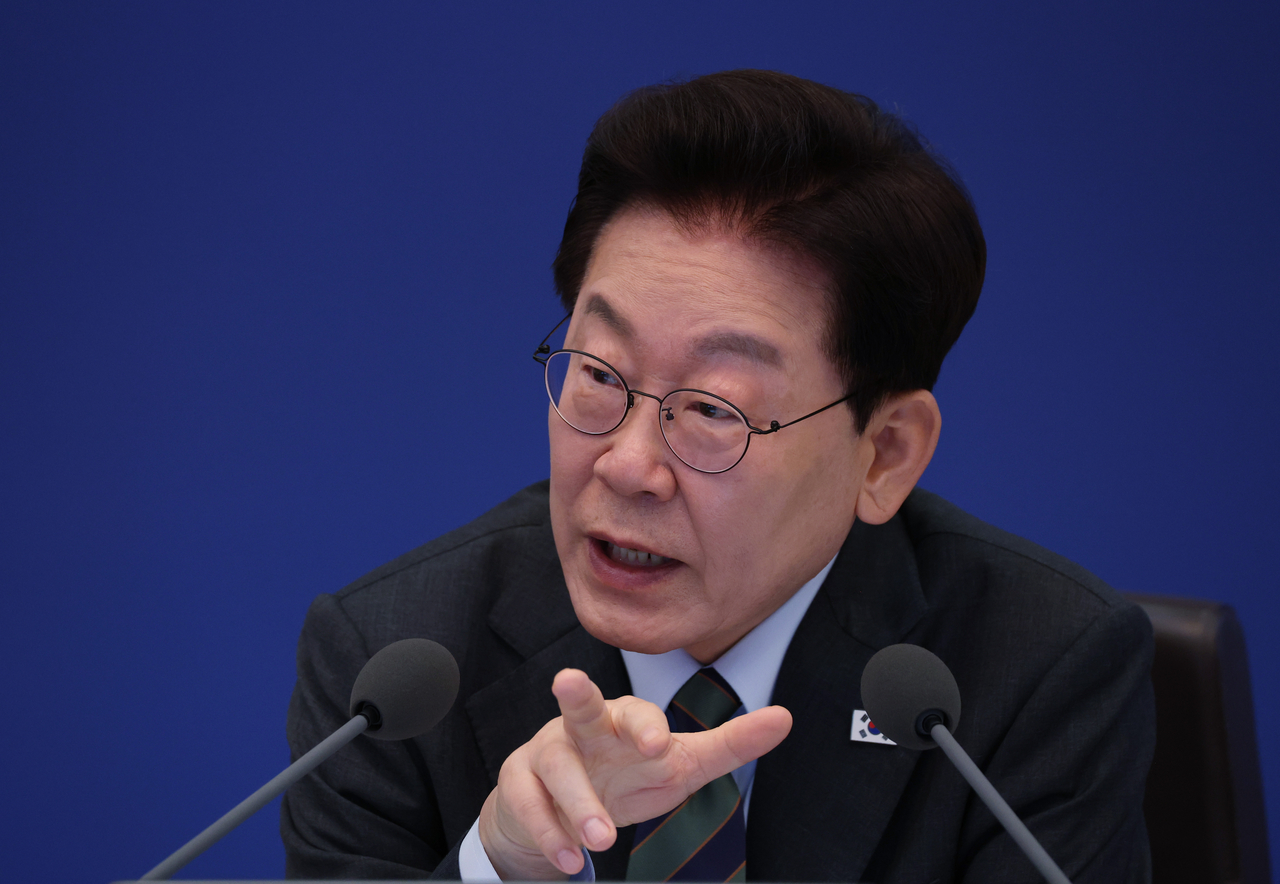
South Korean President Lee Jae Myung on Tuesday called for a “significant expansion” of investment in rocket and satellite launches, stressing their importance to national security.
Lee said space launch vehicles and satellites were “closely linked to national defense,” pointing to tensions between Washington and Kyiv over Ukraine’s access to US satellite-based communications and intelligence services amid its war with Russia.
Lee’s remarks came as Ukrainian officials reported restrictions on the country’s access to SpaceX’s Starshield, a military-grade satellite network used for battlefield communications and drone operations.
“There has been controversy between the US and Ukraine over whether to provide Ukraine with surveillance, intelligence and communications capabilities,” Lee said during a live-broadcast Cabinet meeting. “These are likely to become critical military assets in the future.”
Lee also predicted that satellite communications would become increasingly important beyond military applications, with growing demand for reliable connections as more electronic systems depend on space-based networks.
“Demand is likely to increase enormously as satellite communications become more important. Isn’t our launch vehicle development program moving too slowly?”
Lee questioned whether South Korea’s plan to use its domestically developed Nuri rocket to launch government satellites — both civilian and military — roughly once a year through 2032 could meet growing demand.
“At this rate, how long will it take?” Lee asked. “We need hundreds of satellites ourselves, but we have only three or four rocket launches scheduled through 2030,” he added.
Speaking at the meeting, Bae Kyung-hoon, deputy prime minister for science and technology, said the country operates about 67 satellites in orbit, most of them used for observation, and was pursuing plans to deploy between 128 and 512 communications satellites by 2035.
Defense Minister Kang Shin-chul said the military was working with the space agency on plans to launch eight additional satellites around 2030 and four more in 2031.
The planned launches appear to include eight synthetic aperture radar or SAR satellites, capable of monitoring targets at night and in poor weather, and four electro-optical or EO satellites, which would complement them with high-resolution optical imagery.
Kang also said the military was developing solid-fuel launch vehicles that could allow more frequent satellite launches, underscoring the need for greater investment in the country’s space launch capabilities.
Lee underlined that “space launch vehicles and satellites, which are closely related to national security, are areas where it would be desirable to increase investment."
He noted that space technology was also "closely related to missile technology" and that South Korea’s technological capabilities had advanced faster than expected.
“We should gather opinions from government ministries, lawmakers and industry representatives and review our plans with a view to significantly expanding the sector," Lee said.
Lee reiterated his call for greater attention to investment in space launch capabilities, saying, “I raised this issue because I believe it deserves particular attention.”
Minister of Planning and Budget Park Hong-keun said the government had allocated about 2.3 trillion won ($1.73 billion) for launch-vehicle development, along with roughly 2 trillion won for existing projects covering Nuri, launch infrastructure and lunar exploration.
“If additional funding is needed to shorten launch intervals and increase the number of launches, we will consider raising the total project budget,” Park said.
Oh also said more frequent launches would give South Korean companies in industries such as semiconductors, advanced materials and solar cells greater opportunities to test their products in space, helping them secure customers and generate revenue.
Lee urged officials to reassess South Korea’s broader space strategy and identify areas where the country could become a global leader rather than remain a technological follower.
“We should not simply be catching up,” he said. “We need to identify areas where we can compete on equal terms or even take the lead.”
dagyumji@heraldcorp.com