Exclusive FSS data show sharp growth in foreign workers' retirement savings participation, potentially broadening Korea's long-term investment base

The number of foreign nationals enrolled in South Korea's defined contribution retirement pension plan has surged 67.5 percent in 3 1/2 years, highlighting their growing participation in the country's retirement savings market and the potential to broaden the long-term investment base.
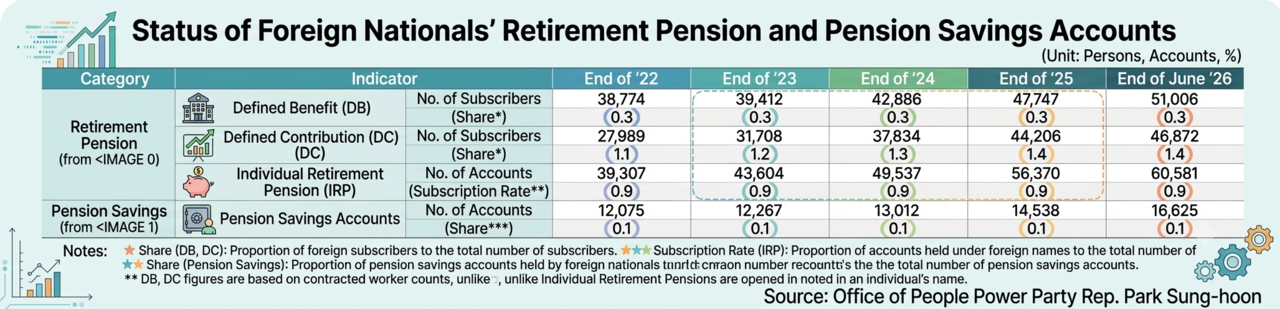
Foreign DC plan subscribers reached 46,872 at the end of June this year, up from 27,989 at the end of 2022, according to Financial Supervisory Service data obtained by People Power Party Rep. Park Sung-hoon and shared with The Korea Herald.
The increase was the fastest among four major pension account categories, reflecting broader growth in retirement savings participation among foreign nationals.
The number of foreign DC subscribers has risen steadily, reaching 31,708 at the end of 2023, 37,834 in 2024 and 44,206 in 2025, before climbing further in the first half of this year.
Other pension categories also recorded significant growth. Foreign nationals enrolled in defined benefit plans increased 31.5 percent to 51,006 over the same period, while individual retirement pension accounts rose 54.1 percent to 60,581. Personal pension savings accounts increased 37.7 percent to 16,625.
DC plans were the only category in which foreign nationals gained a larger share of total subscribers or accounts. Their share rose to 1.4 percent at the end of June from 1.1 percent at the end of 2022, while the proportions remained unchanged at 0.3 percent for DB plans, 0.9 percent for IRPs and 0.1 percent for personal pension savings accounts.
Unlike DB plans, under which employers manage retirement assets and guarantee benefits based on salary and years of service, DC plans allow employees to decide how their retirement contributions are invested.
The growing participation of foreign workers in DC plans could therefore expand the pool of retirement savings available for long-term investment, although the impact on capital markets depends on how those funds are managed.
"Foreign workers' participation in retirement pensions is a positive sign for the expansion of South Korea's capital market," Park said.
However, he cautioned that without adequate financial education, many foreign workers could leave their retirement savings in low-risk deposit products rather than actively managing their investments.
Growing participation, persistent barriers
Industry experts attribute the rise partly to the growing number of foreign workers employed by small and midsized enterprises, where DC plans are more common than DB arrangements.
"Foreign workers are concentrated at SMEs, which rarely offer DB plans and mostly operate DC plans," said Son Jae-Seong, a business administration professor at Soongsil University.
Son said the growing reliance on foreign labor among SMEs was helping drive pension enrollment. A shift from departure-related insurance arrangements toward workplace retirement pensions could also signal improved retirement benefits, although companies offering such plans may have greater resources to support employees.
Despite the growth, regulatory and structural barriers continue to limit access.
The FSS said foreign nationals holding certain short-term or temporary residence statuses are not eligible to open retirement pension accounts.
Some foreign workers covered by departure guarantee insurance under the Employment Permit System also face different arrangements for retirement benefits, depending on their employment circumstances.
Banks are seeking to attract eligible foreign workers by helping employers establish retirement pension plans and expanding multilingual financial services.
An official at a commercial bank attributed the increase in foreign DC subscribers partly to improved accessibility, including multilingual support and efforts to provide pension information through corporate clients.
However, the official said many foreign workers hold short-term jobs or work for smaller companies, making it difficult to join pension plans and maintain them over time.
Bigger pension market, new investment challenges
The rise in foreign participation comes as DC and IRP accounts gain ground in Korea's broader retirement pension market.
At the end of 2025, DC plans accounted for 28.2 percent of total retirement pension assets, while IRPs represented 26.1 percent, according to a joint report by the FSS and the Ministry of Employment and Labor.
Together, the two categories held 54.3 percent of pension assets, surpassing the 45.7 percent share of DB plans.
Total retirement pension assets reached 553.9 trillion won ($410 billion) in the second quarter of 2026, up about 45 trillion won from the previous quarter, according to FSS data.
DC assets increased by 20.1 trillion won and IRP assets by 22.6 trillion won, while DB assets grew by some 2.4 trillion won.
The figures underscore the expanding role of retirement accounts in Korea's financial market, where individual investment decisions are becoming increasingly important.
Yet rising enrollment does not necessarily translate into more active investment.
Son said foreign workers may struggle to select appropriate financial products because of language barriers and limited investment knowledge, leaving much of their retirement savings in fixed-term deposits.
He called for more tailored financial guidance to help foreign workers manage their pension assets effectively.
Park likewise urged authorities and financial institutions to remove unnecessary barriers and introduce education and support programs designed for foreign workers.
The challenge, experts say, is to ensure that growing pension participation translates not only into broader retirement coverage, but also into better asset management and long-term financial security for foreign workers.
ch0221@heraldcorp.com