Five-year plan unveiled at inaugural meeting of presidential Population Strategy Committee
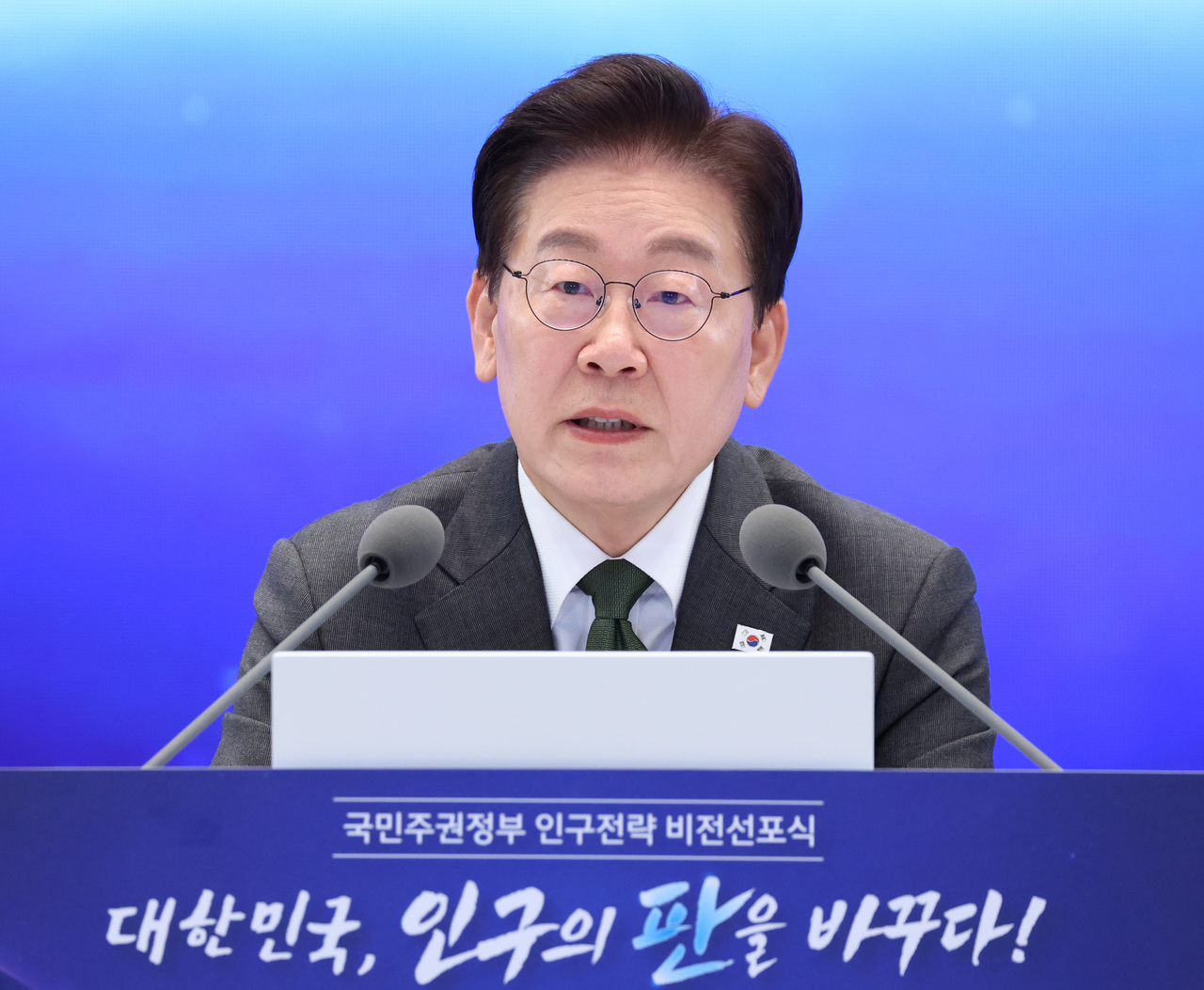
President Lee Jae Myung on Wednesday called for a "fundamental shift” in population policy, saying that the country should redesign its economic and social systems to cope with persisting issues.
The Lee administration unveiled a sweeping five-year strategy to tackle the country's deepening demographic crisis, the first such plan since the presidential Population Strategy Committee was established in September.
Over the past two decades, successive governments have spent heavily and expanded policy frameworks to address low birth rates and population aging, yet South Korea's demographic challenges remained unresolved, Lee noted.
"The population problem is becoming increasingly complex and deeply rooted in structural issues," Lee said at the committee's inaugural meeting, calling for a shift beyond quantitative measures such as birth rates and population size.
"Ultimately, this means fundamentally redesigning the Republic of Korea's entire socioeconomic system to adapt to demographic changes," Lee said, referring to South Korea by its official name.
"Population policy must also be labor policy, welfare policy, employment and housing policy, as well as education policy."
Lee also pointed to the artificial intelligence revolution as an opportunity to fundamentally rethink South Korea's population policy.
"Looking further ahead, the historic transformation brought about by the AI revolution presents an opportunity to redesign our entire social system, including industry, jobs, education and care services," Lee said.
"The population vision we are unveiling today will mark the starting point of that transformation."
The government unveiled its first five-year population strategy for 2026–2030 on Wednesday under the Population Strategy Act, which took effect on Sept. 10 following a comprehensive overhaul of the Framework Act on Low Birthrate and Aging Society.
The legislative overhaul also transformed the former presidential committee on low birth rates and aging into the Population Strategy Committee, chaired by Lee, giving it a broader mandate to coordinate demographic policies across government agencies.
According to the committee, the government sees the next five years as a critical window to address demographic challenges that could undermine essential public systems, including pensions, health care, education and national defense.
The strategy rests on three approaches: mitigation, adaptation and transformation.
Mitigation aims to slow the pace of demographic change to buy time for reforms. Adaptation focuses on adjusting economic and social systems to a smaller, older population, recognizing that decades of low birth rates will continue to shape the country's demographic outlook even if births rebound.
Transformation seeks to turn the demographic crisis into an opportunity for economic growth by boosting productivity and using technological advances to modernize industries and public services.
The proposed strategy sets out 117 core policy measures across four broad areas, with five key goals for 2030 aimed at improving quality of life and sustaining economic and social development.
The strategy places particular emphasis on supporting young people through major stages of life, from finding jobs and securing housing to marriage and raising children.
It aims to raise the youth employment rate from 45 percent in 2025 to 50 percent by 2030, while halving the rate of career interruptions among women aged 30 to 44 from 20 percent to 10 percent. The plan also sets a target of increasing the use of flexible work arrangements from 16.3 percent to 25 percent over the same period.
For older South Koreans, the strategy seeks to expand opportunities to work and remain active in their communities while easing financial insecurity. It hopes to reduce the poverty rate for those aged 65 and older from 35.9 percent in 2024 to 30 percent by 2030, alongside measures to expand housing, employment and care services.
Immigration also features prominently in the strategy, which aims to increase the proportion of immigrants holding residence statuses that allow long-term settlement from 24.3 percent in 2025 to 28 percent by 2030.
The plan calls for attracting highly skilled foreign professionals through incentives covering housing, taxes, children's education and employment opportunities for family members. It also proposes exploring a birth registration system for foreign-national children born in South Korea and expanding childcare and vocational education support for children from immigrant backgrounds.
To offset a shrinking workforce, the strategy seeks to harness AI and robotics, while expanding AI education in schools, workforce retraining and lifelong learning programs to boost productivity.
dagyumji@heraldcorp.com
![[Graphic News] 6 in 10 people living alone feel lonely](https://wimg.heraldcorp.com/news/cms/2026/10/13/news-p.v1.20261013.78692699312346e2a2817fabedf14bb6_T1.gif?type=h&h=800)