The university aims to develop and commercialize technologies for use in manufacturing, healthcare, defense and everyday life
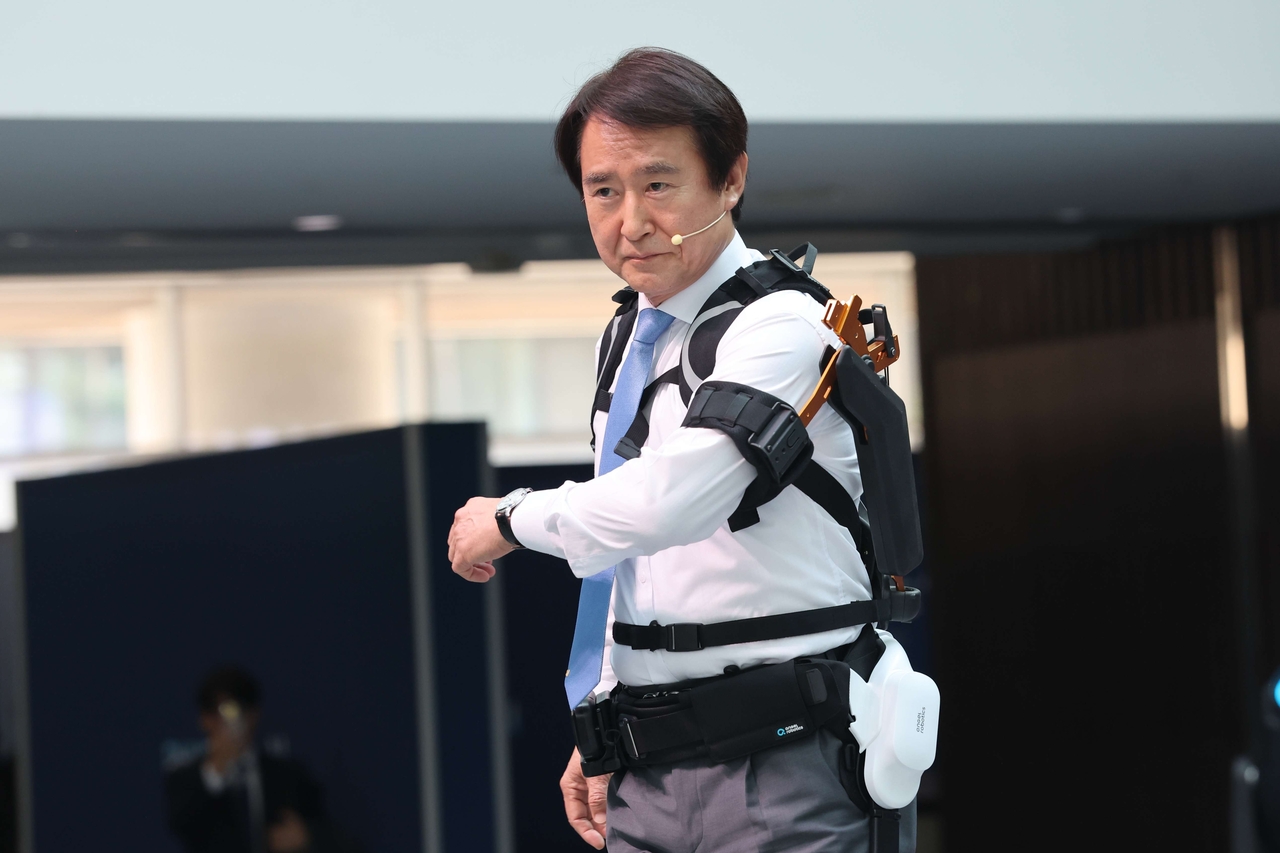
DAEJEON — KAIST will focus on technologies that can be used across different robots and industries, rather than developing humanoid robots as standalone machines, the university said Tuesday as it outlined its strategy for physical AI.
KAIST President Bae Choong-sik demonstrated the approach by wearing an artificial intelligence-powered exoskeleton at the university’s Daejeon campus. Sensors tracked his leg strength, balance and gait, allowing AI to analyze his physical condition.
Bae said KAIST would combine its research in robotics, AI, sensors and motion control to develop technologies for manufacturing, healthcare, defense, logistics and daily life.
“The competition in physical AI is not about how closely robots resemble humans, but how effectively AI that understands and moves through the physical world can be deployed across different environments,” Bae said.
“KAIST will build foundational technologies for sensing, movement and cooperation among machines so they can be applied across various robots and industries. We will also nurture the talent and companies needed to lead this transformation.”
Physical AI refers to AI systems that perceive their physical surroundings and perform tasks in response.
KAIST groups its capabilities into three areas: sensory intelligence, which enables machines to process their surroundings; motor intelligence, which allows them to act on that information; and collective intelligence, through which multiple machines share information and coordinate.
The university plans to focus on five foundational technologies: actuators for precise movement, physical data processing, data center infrastructure, motor intelligence and sensory intelligence.
KAIST said it could support applications ranging from industrial automation and autonomous logistics to medical devices and wearable robots.
Next-generation technologies
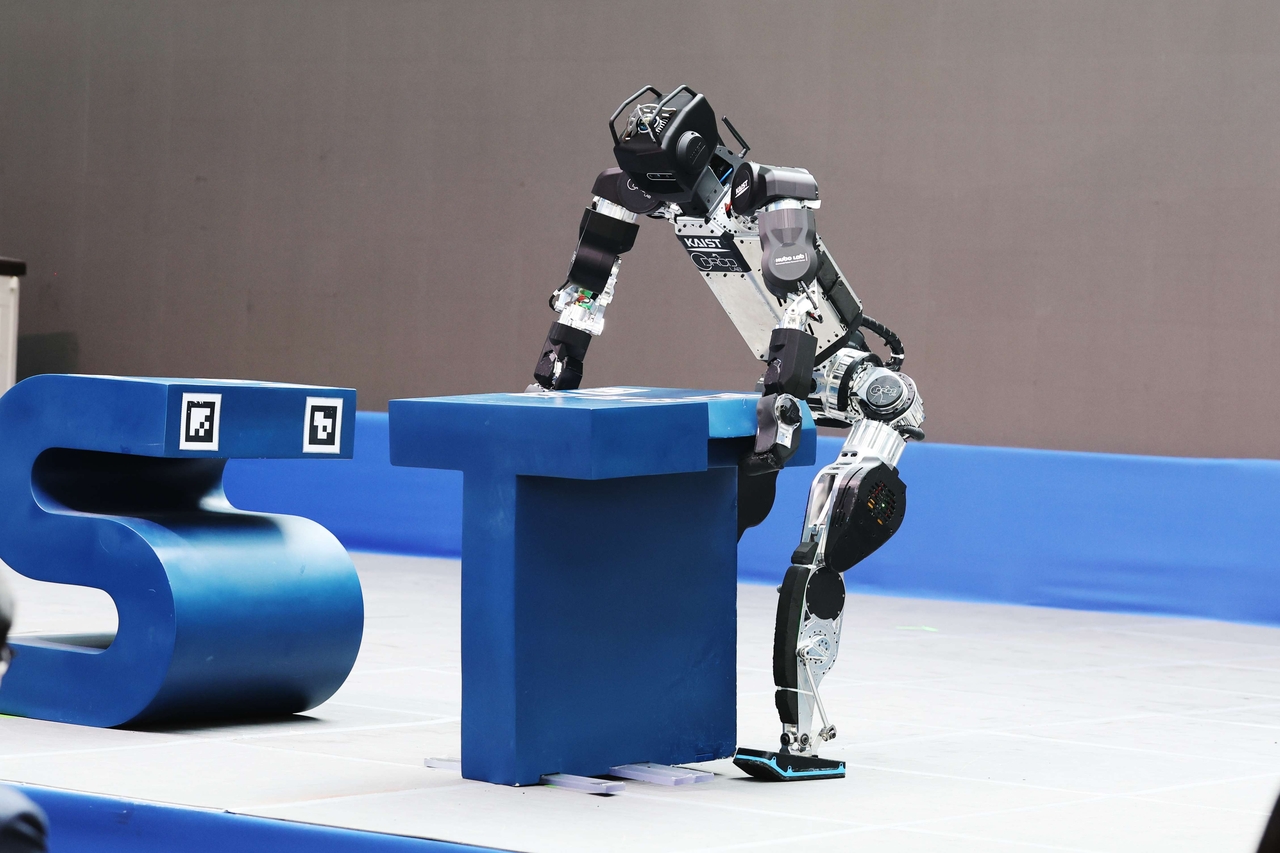
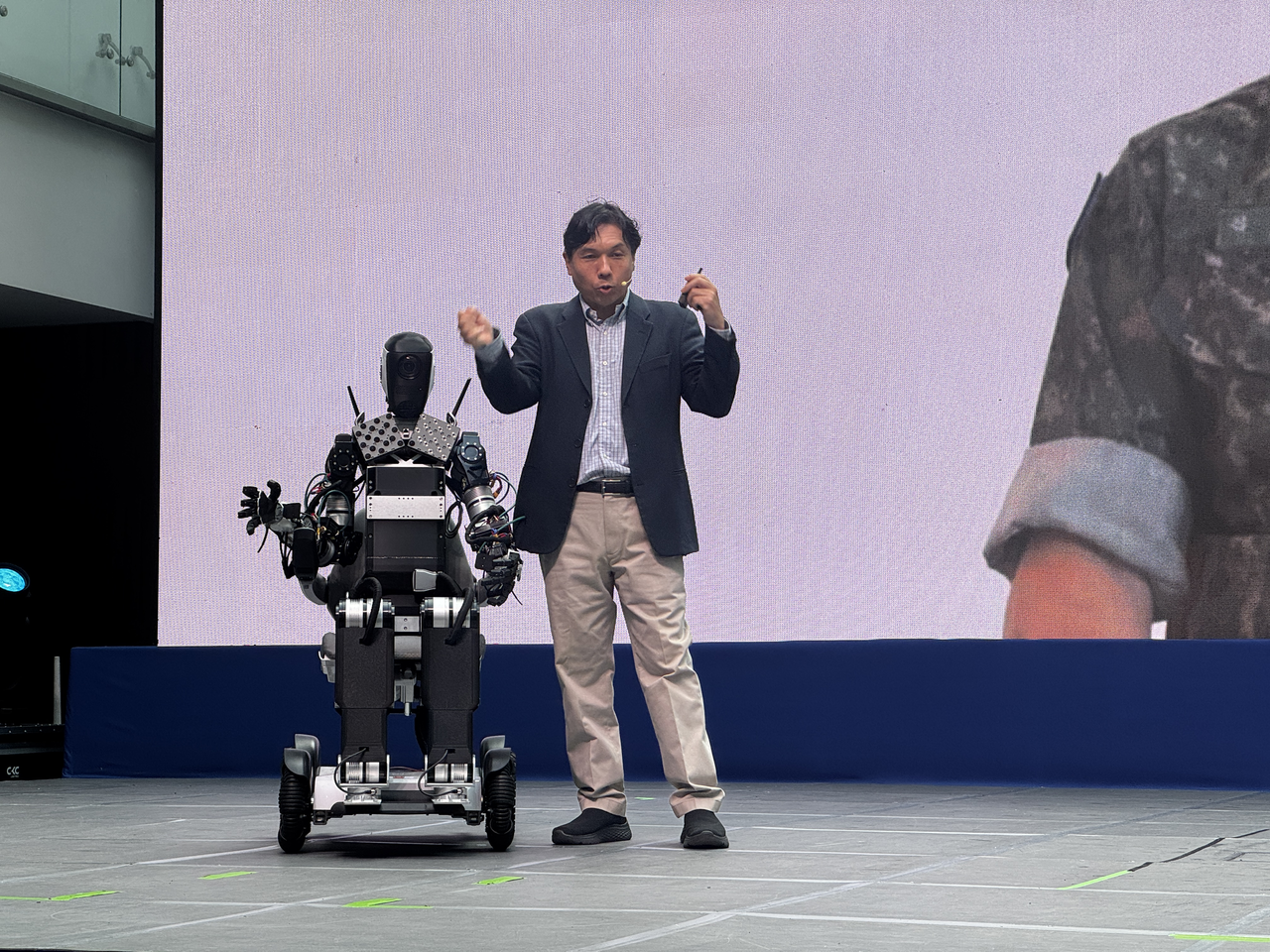
Five research teams from KAIST’s mechanical and electrical engineering departments presented technologies illustrating the strategy.
A team led by mechanical engineering professor Park Hae-won introduced a humanoid robot capable of carrying loads weighing more than 15 kilograms.
The team has developed locomotion and motion-control technologies through research on legged robots, including the quadrupedal robot HOUND.
Electrical engineering professor Shim Hyun-chul’s team demonstrated PIBOT, a humanoid pilot robot being developed to operate aircraft controls using flight information.
Other demonstrations featured autonomous navigation technology that allows robots to recognize unfamiliar environments and plan their routes, as well as an autonomous ultrasound system designed to locate target organs.
Bae’s exoskeleton was developed by a team led by mechanical engineering professor Kong Kyoung-chul, whose research focuses on assisting people with mobility impairments. KAIST said the technology could also monitor human movement and provide health-related information.
Commercialization at heart of strategy
KAIST plans to strengthen ties between its research teams and faculty-founded companies, including Angel Robotics and Raion Robotics, to bring foundational technologies into industrial use.
The university is also researching AI systems that can interpret human movement through its Human Physical Intelligence Research Center, including in cooperation with the NVIDIA AI Technology Center.
It plans to expand education, research-based entrepreneurship and retraining for industry workers to support a broader physical AI ecosystem.
“We will not stop at completing a single robot,” Bae said. “We will develop world-class platform technologies that can serve as the foundation for any robot and any industry.”
Bae also pledged to expand industry-academic collaboration and international research partnerships.
He said physical AI could help South Korea address labor shortages as its population ages and its workforce shrinks.
“Physical AI is not an option but a necessity for South Korea,” he said. “The world ushered in the era of thinking AI. South Korea will usher in the era of moving AI.”
seungku99@heraldcorp.com