SK Group Chairman Chey Tae-won called Monday for a market system that financially rewards companies for the social value they create, asserting that measuring impact will not draw enough capital to tackle mounting social challenges.
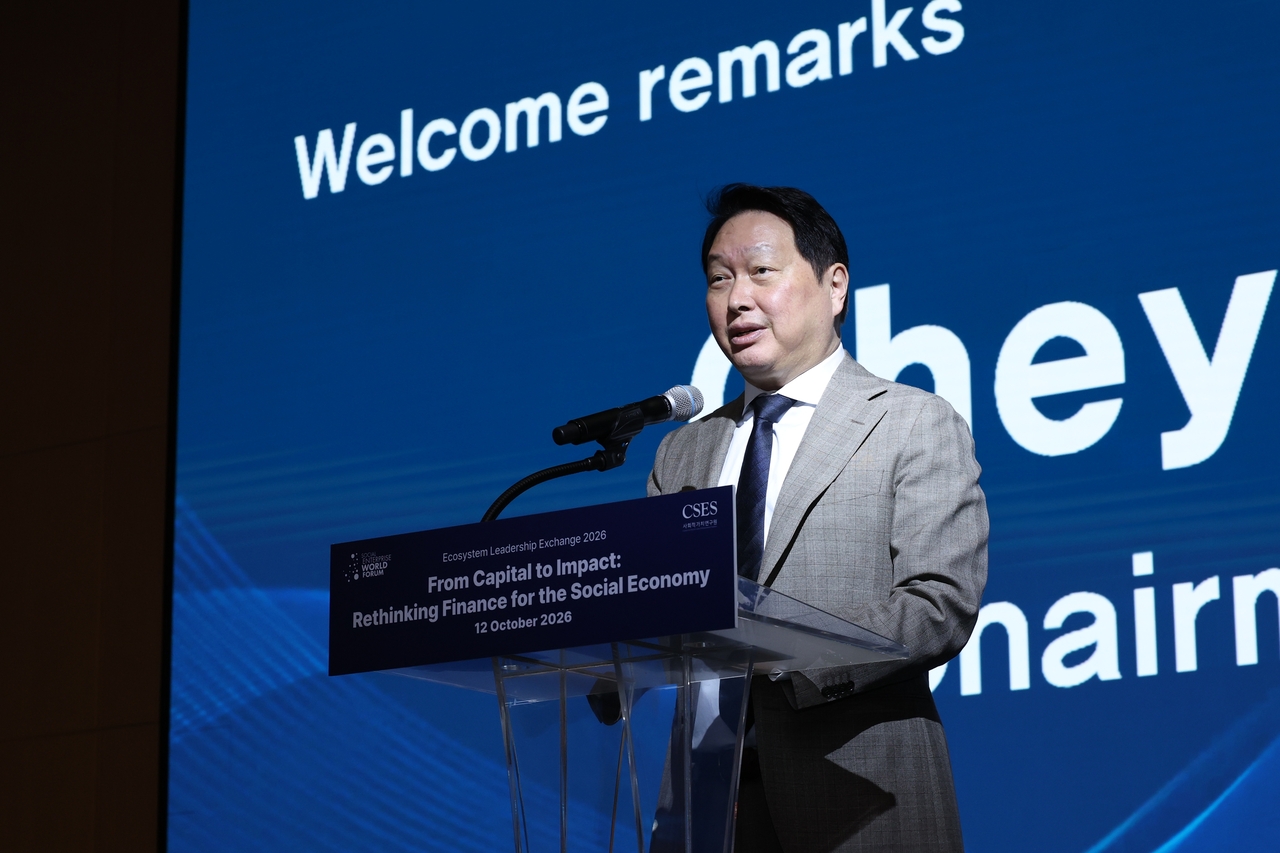
“Relying on altruism alone cannot generate the scale needed to address growing social problems,” Chey said at the opening session of the Social Enterprise World Forum’s inaugural Ecosystem Leadership Exchange in Seoul.
“A sophisticated, performance-based incentive system is essential to encourage voluntary participation,” he added.
Chey said conventional corporate social responsibility efforts have often focused more on how much companies spend and how activities are promoted than on whether they produce meaningful results.
Advances in artificial intelligence could make the results easier and cheaper to quantify, he said.
“Recent advances in AI can help overcome the high cost of accurately measuring social value,” Chey said.
But measurement alone is not enough, he said. Social outcomes must carry financial value if businesses and investors are to commit capital at scale.
Chey pointed to SK’s Social Progress Credit initiative, which puts monetary values on social benefits generated by participating enterprises and provides cash incentives based on their performance.
First proposed by Chey at the World Economic Forum in Davos in 2013, the model was introduced by SK in Korea in 2015. Since then, it has generated more than $360 million in verified social value and distributed $52 million in incentives to more than 400 social enterprises, according to SEWF.
“We need to accelerate the transition to a ‘new capitalism’ where the creation of social value is rewarded, rather than focusing solely on profit,” Chey said.
His proposal comes as international organizations seek to move social impact beyond corporate disclosure and make it a factor in mainstream investment decisions.
On Thursday, the World Economic Forum and its Schwab Foundation for Social Entrepreneurship published “The Impact Economy: Turning Disclosure into Demand,” in collaboration with the SK-backed Center for Social Value Enhancement Studies and Social Finance International.
In a joint foreword, Chey argued that quantifying social outcomes is only the starting point. Market rules must also change so that the outcomes influence where capital flows, rather than leaving companies to address social problems after market failures occur.
The report identifies what it calls an “impact paradox”: Tackling social problems can generate benefits shared broadly across society, while the costs are borne by individual companies or investors. That mismatch means growing awareness of social impact has yet to generate sufficient market demand or investment.
The Seoul exchange, organized by SEWF and CSES, brings together representatives from 19 organizations across 15 countries. Running through Thursday, the program examines Korea’s approach to social enterprise financing, legislation and public-private partnerships.
yeeun@heraldcorp.com