Powerful lights and noise are disturbing Bukang-i, an endangered dusky shark, experts warn
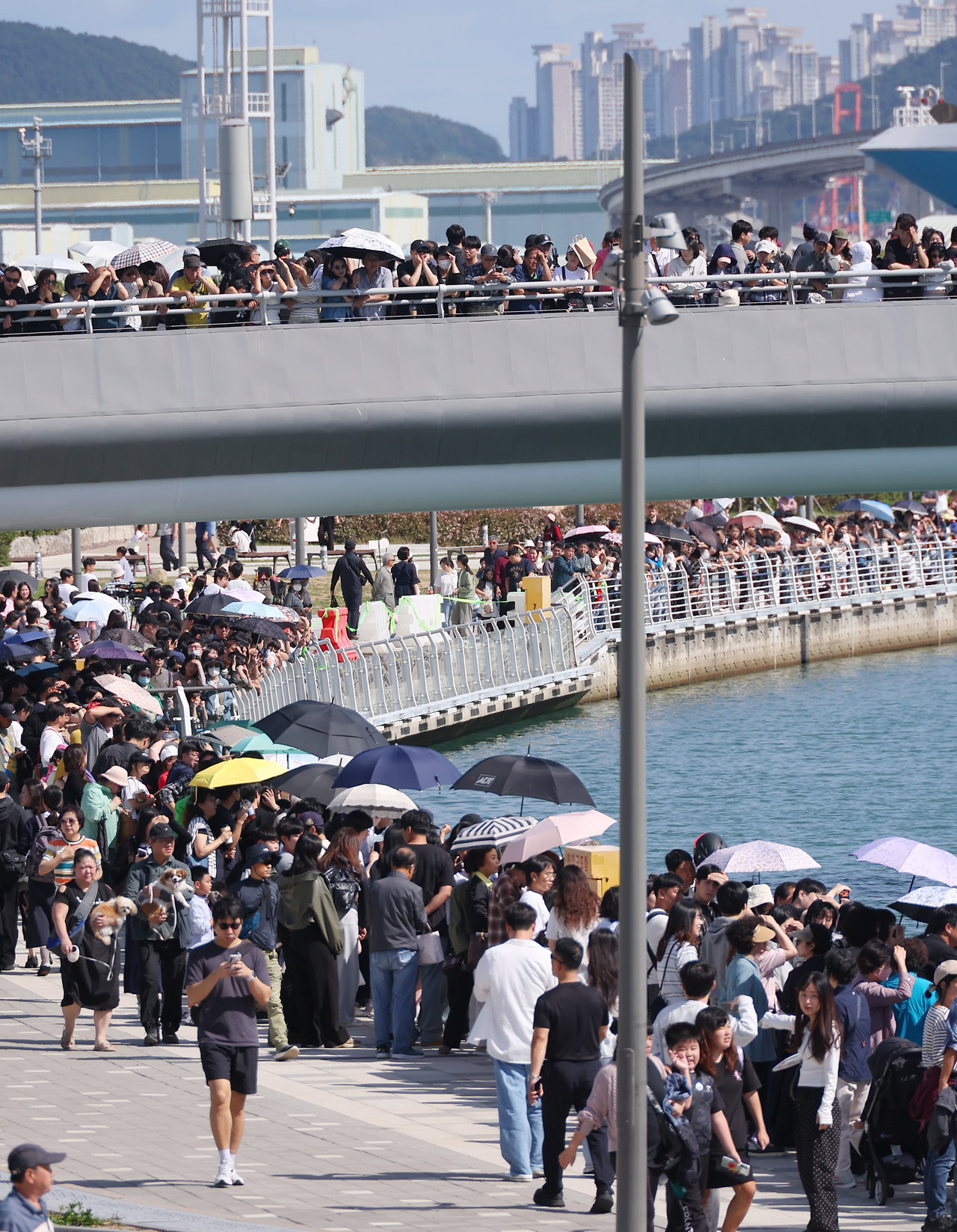
Bukang-i, the shark stranded at Busan’s North Port Waterfront Park, is facing growing disturbance from the bright lights and noise of late-night visitors, news reports said Wednesday.
Photos and videos circulating online show visitors shining high-powered lanterns, flashlights and cellphone lights onto the water to get a better glimpse of the shark in the dark. In one video posted on Threads, the shark makes sharp turns, as a powerful beam shines directly on it.
"We’re making announcements and trying to keep things under control on-site, but some people come at two or three in the morning, and we simply can’t stop everyone," a park official told a local news outlet.
Access to the park is restricted after midnight, while parts of the area where Bukang-i has been staying are temporarily closed off from 6 p.m. Still, some visitors have reportedly entered the park without permission after midnight, drawing further criticism.
"Even sharks in aquariums get to rest at night. Bukang-i is a living animal. Please, just leave him alone at night and let him rest," one user wrote on X.
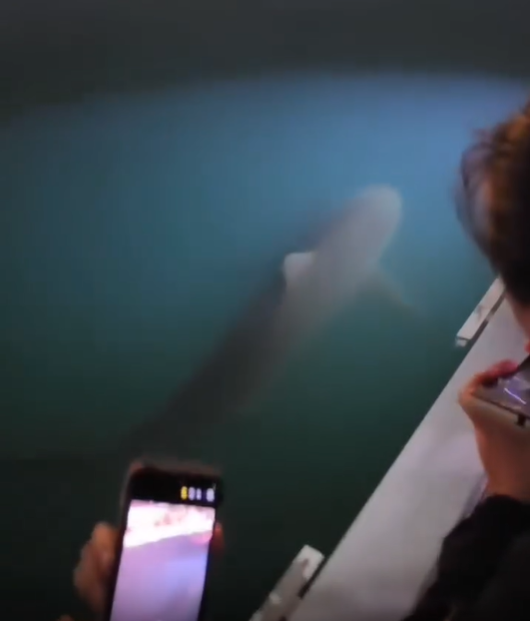
Concerns are growing over the repeated disturbance of Bukang-i, particularly after authorities identified the shark as an endangered species.
The National Institute of Fisheries Science recently confirmed Bukang-i as a dusky shark after analyzing close-up footage that showed a distinct ridge between its first and second dorsal fins, a key physical characteristic of the species.
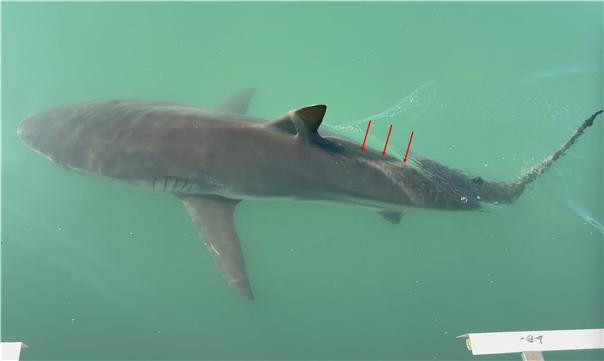
Dusky sharks can grow up to about 4.2 meters long and are found in tropical, subtropical and temperate waters. The species is classified as endangered on the International Union for Conservation of Nature’s Red List due to its slow growth and reproductive rate.
In South Korea, the dusky shark was first documented in 2019 and has since been sighted off the southern coast, near Samcheok in Gangwon Province, Sinan in South Jeolla Province, Jeju Island and Busan.
Experts say repeatedly shining powerful lights on the shark at night could interfere with its ability to hunt.
"Sharks’ eyes are built to see well in the dark. They are highly sensitive to light and have a reflective layer behind the retina that helps them make the most of even small amounts of light, similar to how cats can see well at night," a NIFS official said.
"Sudden exposure to powerful lights, particularly when beams are repeatedly directed toward the eyes, could therefore impair Bukang-i’s vision and interfere with feeding behavior. Artificial light at night could also disrupt the shark’s natural biological rhythm."
Bukang-i was first spotted in a narrow waterway at the park on Sept. 18 and soon became a local sensation.
About 89,000 people came to the park between 5 a.m. and 6 p.m. Tuesday alone, pushing the total number of visitors since Bukang-i’s arrival to roughly 1.02 million, according to the Busan Infrastructure Corp.
Despite two efforts to steer it toward the open sea, the shark has stayed in the waterway. Authorities have now put further rescue attempts on hold and plan to give the shark time to leave on its own.
cjh@heraldcorp.com



![[Graphic News] Nuri rocket set for fifth launch](https://wimg.heraldcorp.com/news/cms/2026/10/06/news-p.v1.20261005.74d188bdaff2417ebabf4560181741f4_T1.gif?type=h&h=800)