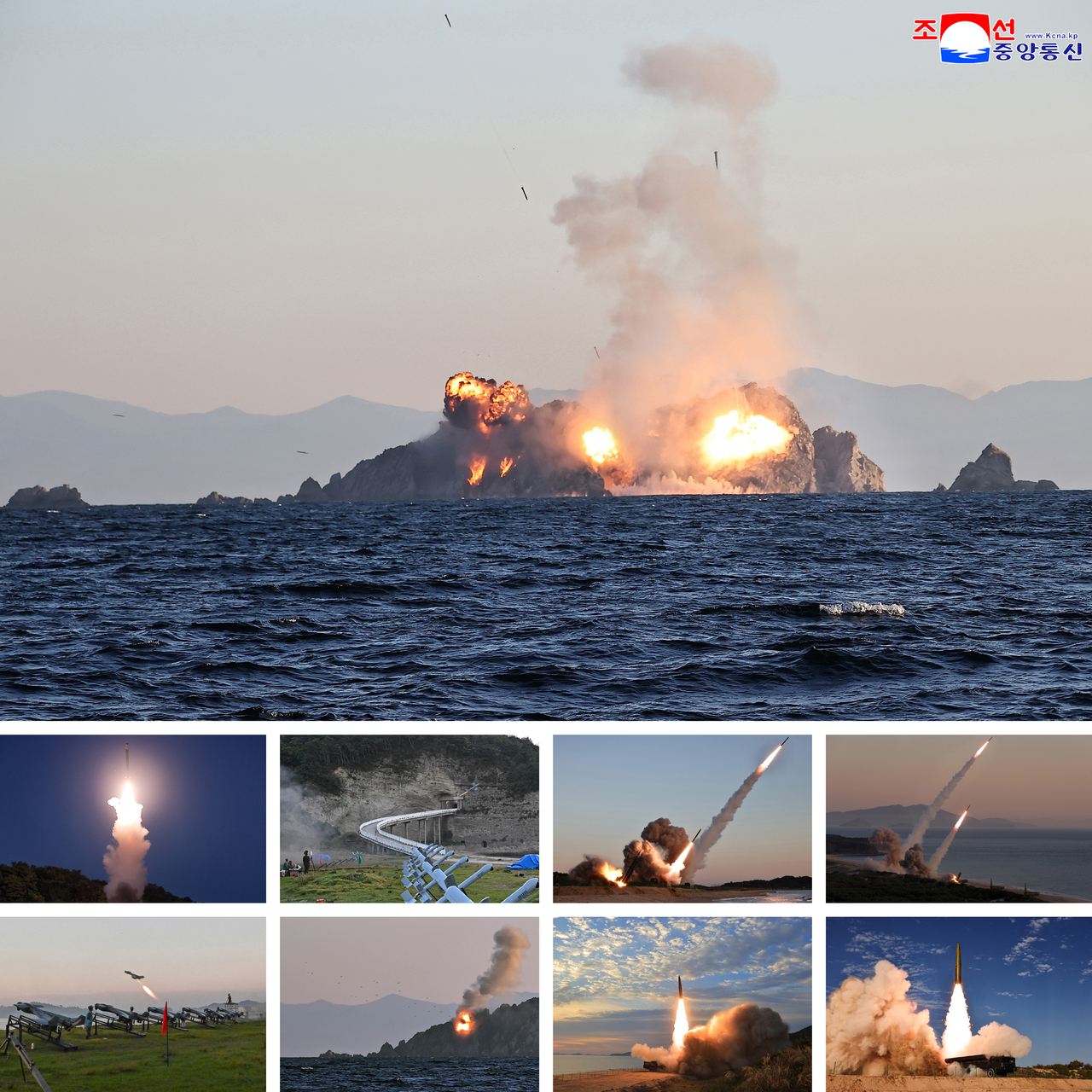
North Korea's missile launches detected Saturday appear to have been a show of its ability to carry out coordinated and simultaneous use of different strategic and tactical strike systems, just a day after the conclusion of the Freedom Edge joint exercise among South Korea, Japan and the US.
According to a report from the North's Korean Central News Agency on Monday, the launches were part of a joint firepower strike drill involving long-range artillery and missile units, with multiple types of weapons employed under an integrated firepower control system.
The exercise involved what KCNA described as new combat systems, including various types of attack drones, tactical cruise missiles, large-caliber thermobaric multiple rocket launchers and tactical ballistic missiles. In the report, North Korea claimed that all systems displayed 100 percent accuracy "ensuring the unity and simultaneity of firepower attack."
North Korean leader Kim Jong-un did not attend the exercise. Instead, Pak Jong-chon, vice chair of the Central Military Commission of the ruling Workers' Party of Korea, and Yu Chang-son, director of the Artillery Bureau of the Korean People's Army General Staff, oversaw the drill.
Pak said the exercise was intended to make "the army do what it should do," according to the KCNA.
Yu said one of the military's priority training tasks was to familiarize troops with procedures for operating an "integrated firepower control system," which the KCNA identified as a component of what it called a "strategic weapons combined management system."
The training was also aimed at improving the integrated automatic control of different combat systems and increasing the effectiveness of concentrated strikes against targets, Yu said.
He added that such exercises would strengthen the "strategic counteraction posture" of strike units and improve their ability to respond rapidly in an emergency.
The terminology drew attention from experts, as Pyongyang has previously disclosed a "nuclear weapons combined management system" dubbed the "nuclear trigger" as part of its nuclear command-and-control structure.
Hong Min, a senior research fellow at the Korea Institute for National Unification, said North Korea's reference to a "strategic weapons combined management system" appeared to be new and could suggest that its command-and-control structure is being broadened to incorporate both nuclear and nonnuclear strike capabilities.
"The latest exercise was significant not for demonstrating the capabilities of individual weapons, but for showcasing Pyongyang's ability to coordinate different strategic and tactical strike systems and employ them simultaneously," Hong said.
He said the combination of attack drones, cruise missiles, multiple rocket launchers and ballistic missiles under an integrated firepower control system could point to an evolving form of nuclear-conventional integration, in which conventional strikes and the threat of nuclear use are incorporated into a common operational framework.
Hong said the timing indicated that North Korea was responding directly to the trilateral exercise despite recent moves by Seoul and Washington to scale back some of their combined military activities amid renewed prospects for dialogue between Washington and Pyongyang.
Kim Jong-un's absence, however, could reflect an attempt to calibrate the level of the military response while preserving room for possible talks with the US, Hong said.
Saturday's launch was North Korea's 13th ballistic missile test event of 2026. The projectiles were believed to have included short-range missiles from the Hwasong-11 family as well as 600 mm superlarge multiple rocket launcher rounds, according to South Korean assessments.
Pyongyang's handling of the latest launches was also unusual, observers pointed out. While North Korea typically reports major missile launches the following day, Monday's account came two days after the exercise and was carried only by KCNA. The Rodong Sinmun, the ruling party newspaper aimed primarily at a domestic audience, did not report the drill.
Asked Monday whether it saw any significance in the delayed disclosure, South Korea's Unification Ministry declined to offer a separate assessment, saying the presidential National Security Office had already stated the government's position on the exercise.
Following the launches Saturday, South Korea's presidential National Security Office convened an emergency security meeting with military officials to assess their implications and review necessary response measures. The presidential office condemned North Korea's ballistic missile launches as a serious violation of UN Security Council resolutions and urged Pyongyang to immediately halt such actions.
mkjung@heraldcorp.com