Lee calls for all-out measures, compares real estate to ticking bomb

South Korea on Thursday unveiled plans to begin construction of 230,000 homes in the Greater Seoul area within five years and move existing construction plans ahead of schedule to address the housing affordability crisis.
The announcement comes in addition to an existing plan to build 1.35 million new homes in the region encompassing Seoul, Gyeonggi Province and Incheon by 2030. The recent announcement brings the total of planned homes to over 1.5 million.
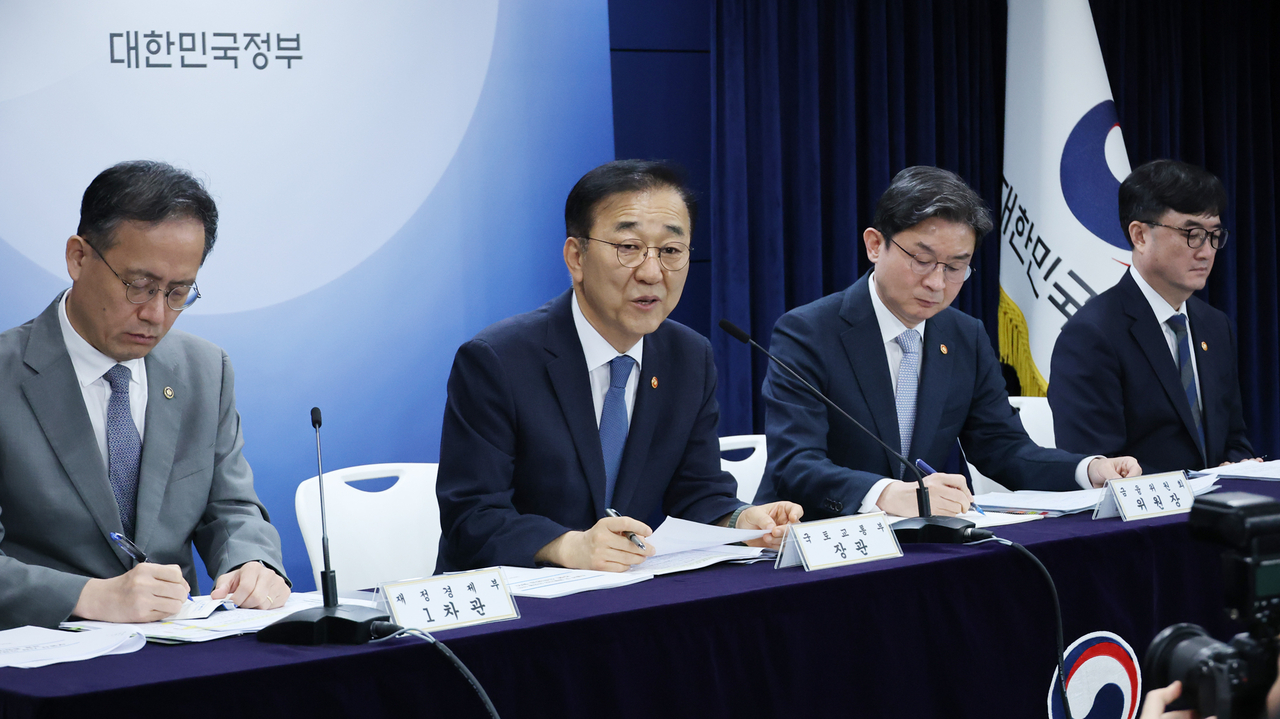
According to Thursday's plan, the construction of 27,000 homes will start "within three or four years" in newly designated public housing zones in Gangseo-gu, Seoul, and Namyangju and Gwangju in Gyeonggi Province, said Land Minister Kim Yun-duk during a government briefing in Seoul.
Kim added that 73,000 additional homes in such zones ― in which local residents or young people have priority in buying them ― will be announced later this year. Though coordination with local governments has been completed, relevant administrative procedures are still underway, he said, meaning it was still too early to announce the sites.
Under the new plan, a public housing zone will break ground within about three years after the announcement.
"The burden of housing costs for young people and low-income households is growing, and rising housing prices deter aspiring homebuyers looking for a house to live in from buying their own home," Kim said.
Kim added that swiftly beginning the construction process following the policy announcement would "address housing price fluctuation due to imbalance between supply and demand."
Other plans involve transitioning 15,000 commercial spaces into houses and fast-tracking ongoing public housing projects to put the construction of 41,000 houses ahead of schedule.
The measures will affect Geomdan-gu, Incheon, as well as Siheung and Uiwang of Gyeonggi Province. A new supply of 3,700 houses in Goyang, Gyeonggi Province, will also be possible due to the lifting of altitude restrictions.
Plans to build houses on a golf course in Nowon-gu, Seoul and on sites such as a racecourse in Gwacheon, Gyeonggi Province will break ground in 2029, a year ahead of schedule.
The policy support concerning public housing and redevelopment, as well as eased construction regulations, will enable the country to supply at least 70,000 houses in Greater Seoul, according to the government.
President Lee Jae Myung later on Thursday said South Korea's housing prices were "extremely high compared to the rest of the world." During Lee's tenure from June 2025, five batches of housing policies have been announced, including Thursday's.
"We must concentrate all available means and capabilities on resolving the real estate problem, which is like a time bomb threatening the lives of the people and the future of the nation," he told his aides in a meeting held in Cheong Wa Dae.
Lee also emphasized the importance of swift execution.
"Given the amount of time it takes to supply houses, we must engage in an all-out, comprehensive supply effort with bold determination, by shortening various licensing procedures and securing sites for housing construction as much as possible, even if it means changing laws and systems if necessary, instead of being bound by existing regulations," Lee said.
Greater Seoul's housing and rent prices — both monthly rent and the local "jeonse," or lump deposit, system — have risen steeply in recent months.
The housing affordability crisis has been cited as a reason for President Lee Jae Myung's falling approval rating. His administration has been criticized for its regulations to combat housing market overheating in the metropolitan area, including curbs on mortgages and higher taxes on homebuyers.
The ruling bloc, however, has accused right-wing Seoul mayor Oh Se-hoon of slow progress in housing supply. Land Minister Kim also said the volume of new housing units "has decreased due to the sluggish construction of houses since 2022."
Soon after the announcement, Oh said on his Facebook Thursday that Seoul was ostracized in the decision-making process, although the municipal government he leads has authority over permits for housing projects.
Oh said more of his proposals for deregulation, such as eased rules on floor area ratio regulations for private urban renewal projects and for the ratio of public housing in a redevelopment project, should also have been reflected in the announcement.
Floor area ratios measure the total indoor space built on a given area of land, with limits effectively putting a cap on the number of floors — and therefore homes — that can be built.
Rep. Choi Soo-jin of the right-wing People Power Party said in a statement Thursday's annnouncement "follows the footstep of (former liberal President) Moon Jae-in's failure" in managing Seoul's housing affordability crisis.
Meanwhile, loan curbs are likely to ease after Thursday's announcement.
According to the government, the annual household debt growth target for this year will rise from 1.5 percent to 3 percent. This indicates that loan curbs on lenders could be eased for a select group of people, such as those waiting to enter a new house or the young generation.
Lee Eog-weon, chief of the top financial regulator Financial Services Commission, said in the briefing Thursday that he would "reasonably adjust the total household debt targets to ensure that apartment sales and move-ins proceed smoothly."
consnow@heraldcorp.com