Lee convenes inaugural future defense strategy meeting at Navy Submarine Force Command
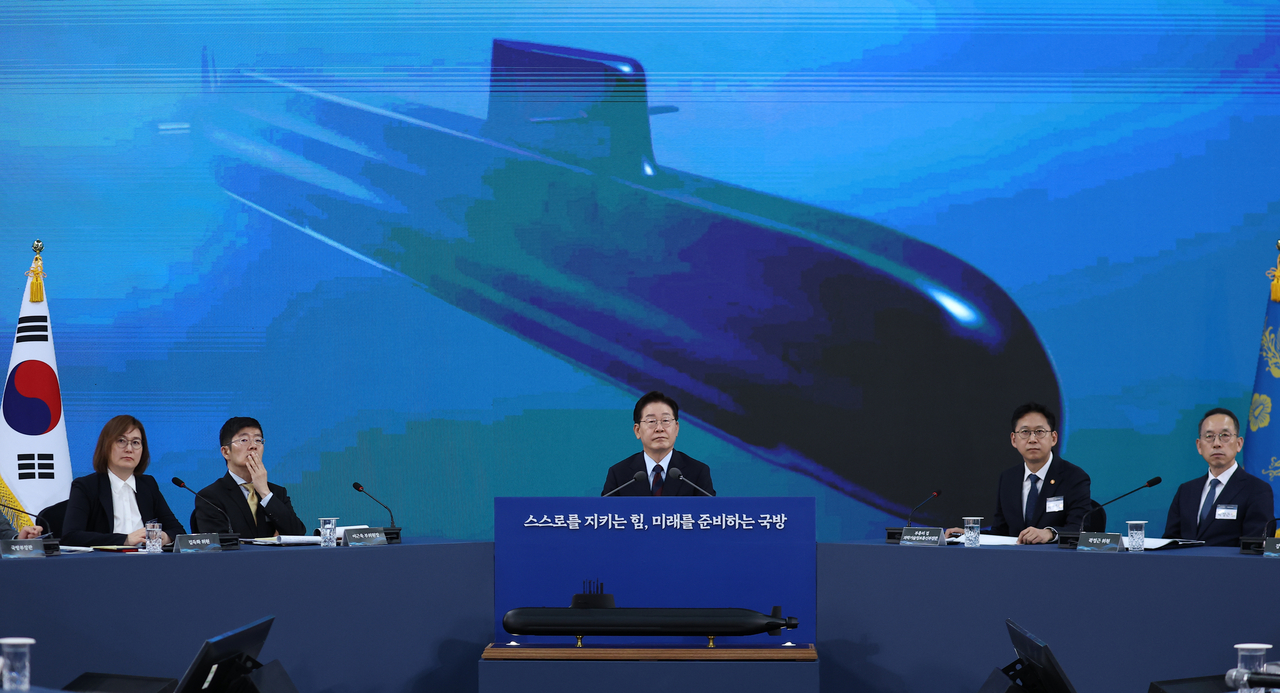
South Korea has unveiled a road map to launch its first domestically built nuclear-powered submarine in the mid-2030s, while pledging to fulfill its nuclear nonproliferation obligations.
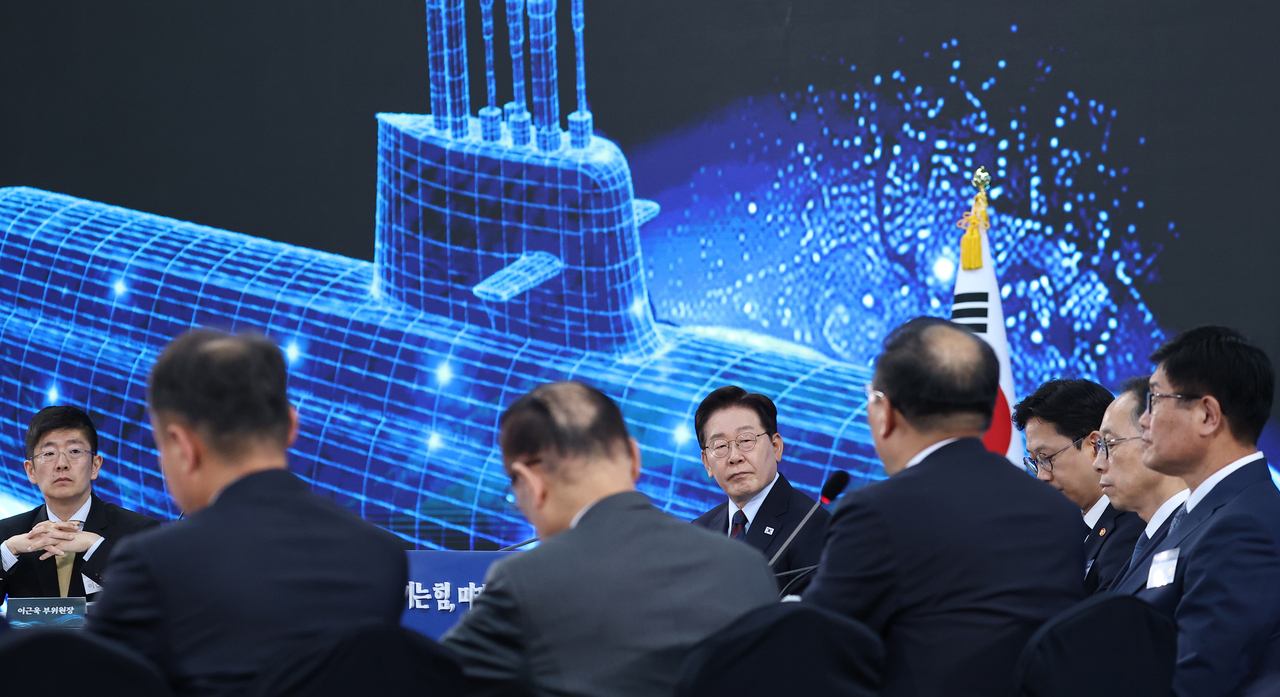
The plan was announced as the first agenda item at the inaugural meeting of the Committee on Future Defense Strategy, convened by President Lee Jae Myung at the Navy Submarine Force Command at Jinhae Naval Base in Changwon, South Gyeongsang Province, on Tuesday.
The committee, chaired by President Lee, will discuss policy tasks necessary to build robust, self-reliant defense capabilities that can safeguard South Korea from multidimensional threats, according to Cheong Wa Dae.
“The nuclear-powered submarine to be built based on the steadfast Korea-US alliance is a symbol of the will to take responsibility for the peace and security of the Korean Peninsula by ourselves,” Lee said in his opening remarks. “Furthermore, it will also greatly contribute to strengthening the Republic of Korea’s defense industry capabilities,” he added, referring to South Korea by its official name.
Defense Minister Ahn Gyu-back briefed the committee on the Master Plan for the Development of Nuclear-Powered Submarines. The document outlines, for the first time, South Korea’s road map for nuclear-powered submarine development to domestic and international audiences alike.
During the live-broadcast meeting, Ahn announced five key principles for the systematic and phased development of nuclear-powered submarines, which Seoul sees as vital to achieving self-reliant defense capabilities.
The first principle is to use low-enriched uranium to fuel the submarine’s reactor, while developing it to allow for extended operational cycles and minimize the need for refueling.
Nuclear submarines powered by LEU use reactor fuel enriched with less than 20 percent uranium-235, which significantly lowers proliferation risks compared to more highly enriched uranium.
Ahn also disclosed South Korea’s plan to push ahead with development under a timeline that envisions launching the first nuclear-powered submarine in the mid-2030s and deploying it into active service in the late 2030s or later.
Another key principle is to develop and construct nuclear-powered submarines domestically in South Korea. The Defense Ministry said in a separate statement this would help “secure self-reliance and stability in force acquisition, sustainability and maintenance.”
Seoul aims to independently build the submarines by using its reactor and shipbuilding technologies, while pledging to safely manage the entire process from construction to decommissioning, according to Ahn.
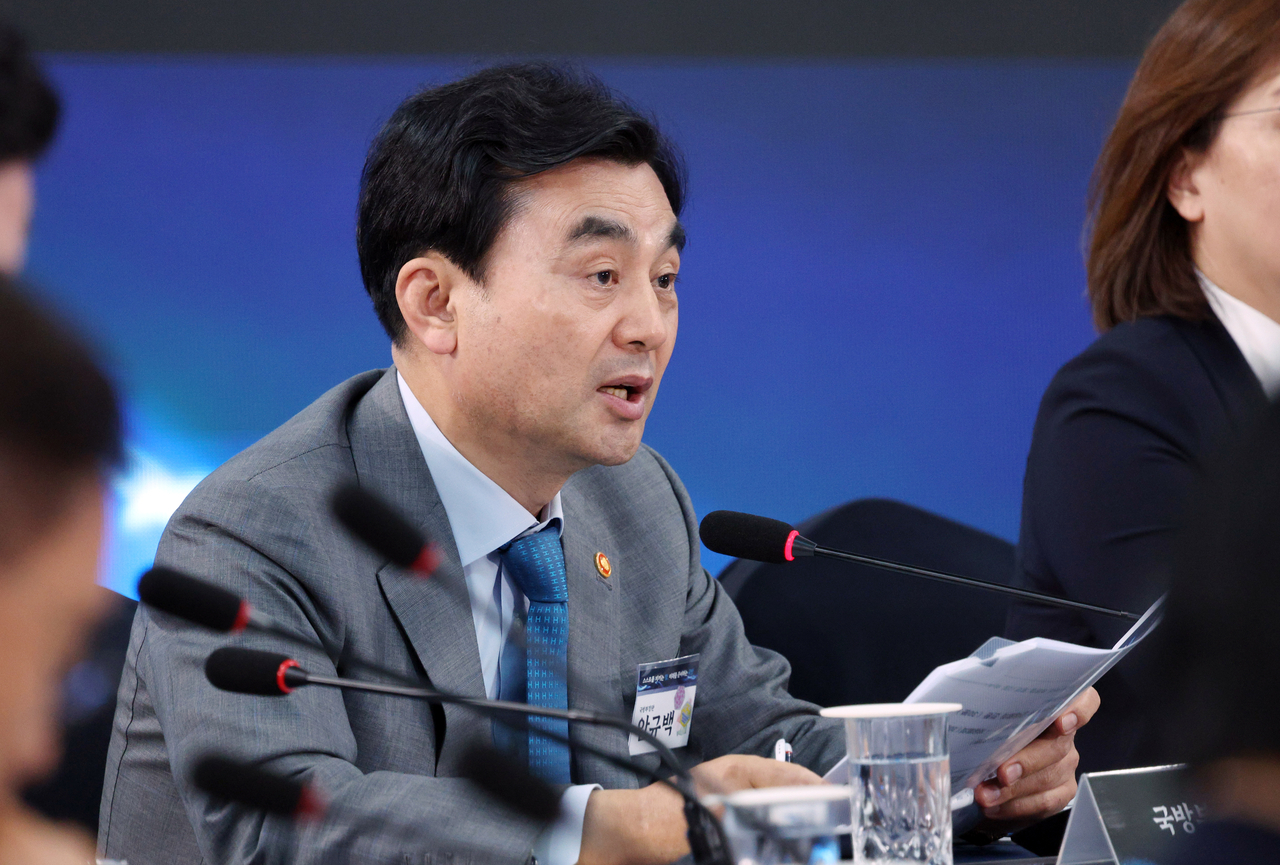
During the meeting, Ahn made three commitments “to ensure the highest level of reliability and transparency with regard to nuclear nonproliferation.” The commitments came amid concerns among some critics in the US over the project’s implications for nonproliferation.
“First, the Republic of Korea will uphold its firm principle of not possessing or developing nuclear weapons,” Ahn said. “Second, the Republic of Korea will faithfully fulfill its nuclear nonproliferation obligations throughout the entire process of securing low-enriched uranium nuclear fuel, in close coordination with the United States.”
Ahn also pledged that South Korea would “establish a safeguards system to transparently manage and monitor nuclear materials for nuclear-powered submarines in cooperation with the International Atomic Energy Agency, and will thoroughly implement it.”
The unveiling of the master plan, drawn up by the Defense Ministry in coordination with related ministries, came seven months after Lee sought approval from US President Donald Trump to build nuclear-powered submarines during their Oct. 29 summit on the sidelines of the APEC summit held in Gyeongju, North Gyeongsang Province.
The US later stated its approval for South Korea to build nuclear-powered submarines in a Nov. 13 Joint Fact Sheet, pledging to work closely to advance requirements for the shipbuilding project, “including avenues to source fuel.”
During Tuesday's meeting, Ahn also highlighted the pivotal role of nuclear-powered submarines in guarding against North Korea’s missile and nuclear threats through their long-endurance submerged operational capability and high mobility.
The committee meeting was held hours after the South Korean military said North Korea had fired several close-range ballistic missiles from an area near Chongju in North Pyongan Province toward the West Sea at around 1 p.m.
Ahn further underscored the role of nuclear submarines in strengthening an “underwater kill chain” by enabling stealthier and faster tracking of North Korean submarines than diesel-powered vessels, while serving as a core asset of “punitive deterrence” through their precision strike capabilities.
The meeting’s second agenda item focused on the “early restoration of wartime operational control” from the US and the “transition to an AI- and unmanned combat system-based military.”
Ahn underscored that the Defense Ministry will finalize a road map this year to accelerate the wartime OPCON transfer process.
Ahn said Seoul and Washington aim to complete verification of full operational capability, the second phase of the three-stage transition framework, at the 58th Security Consultative Meeting, the annual defense ministerial talks scheduled for this fall.
The Defense Ministry would make the transition more concrete by recommending a transfer timeline to Lee, after the full operational capability verification, he added.
“The recovery of wartime operational control, as a core element of self-reliant defense, will serve as an opportunity to make clearer the Republic of Korea’s role as the principal actor in defending the Korean Peninsula,” Lee said during the meeting.
Closing the meeting, Lee noted that “a great deal of dependent thinking still remains in the field of national defense,” calling self-reliant defense “the foundation of a nation.”
“How can a country that cannot defend itself continue to exist?” Lee said.
dagyumji@heraldcorp.com