This summer’s festival leans on a Strauss opera and fresh recruits
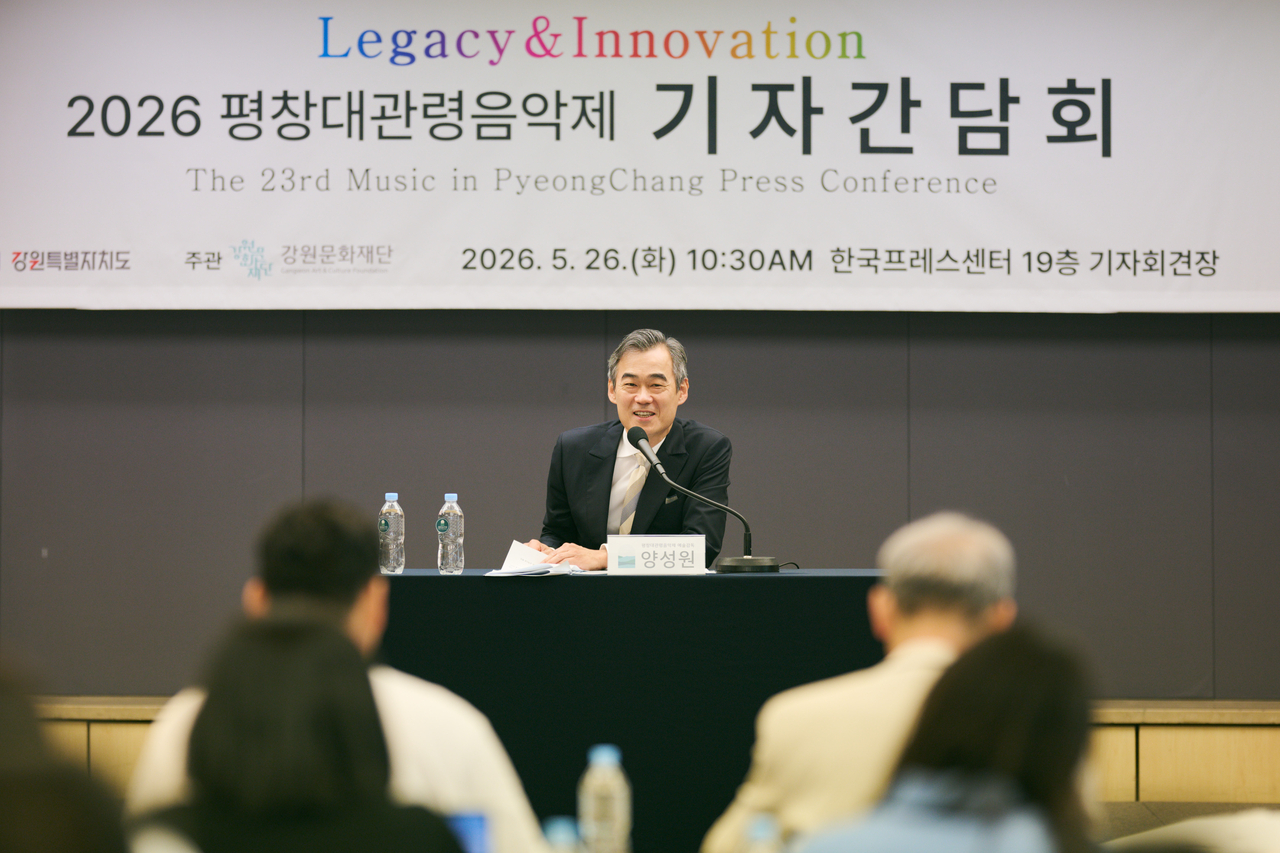
Three conservatory presidents on a single stage, a rare performance of a Strauss opera, and a debut soprano will anchor this summer's flagship classical music festival, its artistic director and cellist Yang Sung-won said Tuesday at a Seoul press conference.
Music in PyeongChang's 23rd edition opens July 23 and runs through Aug. 2 at the Alpensia Resort in Gangwon Province, with 19 main-stage concerts, 10 community outreach concerts, five family outreach concerts, a chamber music mentorship program and master classes.
Yang, who took over as artistic director in 2023, has built the program around the theme "Legacy and Innovation," threading a single arc from a Bach sonata for viola da gamba and harpsichord through Stravinsky's "The Firebird," a concert version of Strauss's "Ariadne auf Naxos," and a closing-night pairing of Debussy's "Prelude to the Afternoon of a Faun" with Mahler's Symphony No. 4, sung by a Korean soprano in her festival debut.
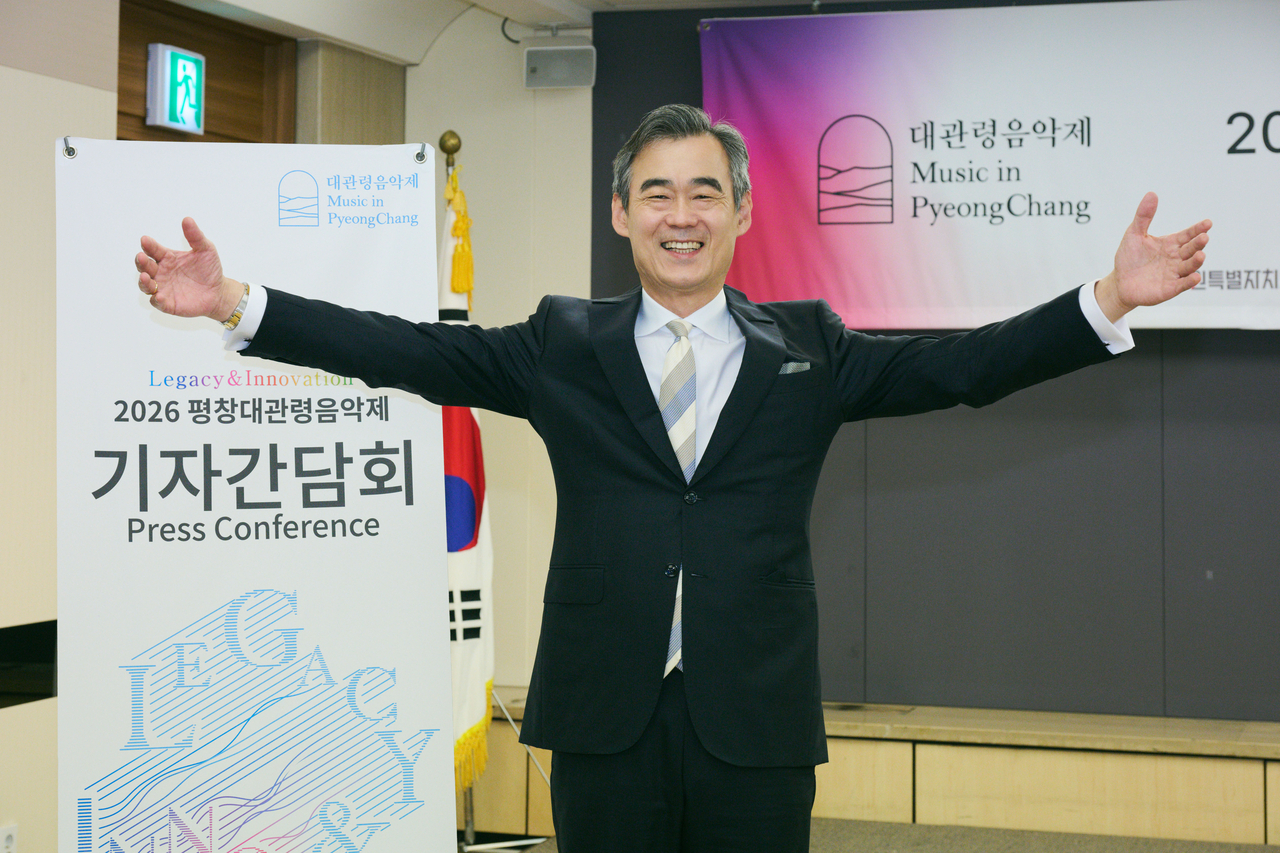
Yang framed the role of artistic director in opposition to the logic now driving Korea's biggest concerts: producing the next one that sells out. Doing that, he said, "is not my role." His job is to use his network and three decades of performing experience to make space for artists just below the tier of household names — to invite musicians audiences will remember by their timbre, not their name.
"Usually one or two artists get all the press coverage and the rest are invisible," he said. "I want the opposite."
No 'La Traviata'
The clearest test of that calculus is "Ariadne auf Naxos." Yang said the Strauss opera currently has the festival's softest ticket sales — Korean audiences don't know it, so they are not buying — and he treats this as a director's obligation rather than a problem.
He noted last summer's production of Benjamin Britten's "The Turn of the Screw" as the parallel: at a meeting in Osaka last week, he said, a representative of the Britten Foundation sought him out to thank him for it. "As long as I know there are pieces this good," Yang said, "I am not going to do a 'La Traviata.'"
The same logic extends from repertoire to people in a program on July 25 that Yang calls the "President's Concert." It puts on a single stage three musicians who have also led the conservatories Yang credits with shaping Asia's classical pipeline: Sawa Kazuki, the violinist and former president of Tokyo University of the Arts; Tsuyoshi Tsutsumi, the head of Tokyo's Toho Gakuen School of Music, which Yang said plays the role for Japan that Korea National University of Arts (K-Arts) plays for Korea; and K-Arts' former president, the pianist Kim Dae-jin.
"Wherever you go in the world, the top performers are Korean or Japanese," Yang said. "Those musicians exist because those schools existed." He framed the program as a debt repaid.
New faces
While more than 50 established artists will join Music in PyeongChang for the first time — among them conductor Hans Graf, Baroque cellist Christophe Coin, cellist Tsutsumi Tsuyoshi, pianists Sunwoo Yekwon and Kim Do-hyun, and German soprano Daniela Koehler — the same first-time logic reaches the other end of the career arc: in a first, the Festival Orchestra filled its second-chair seats through open audition, drawing 22 emerging musicians.
The orchestra, the resident ensemble that anchors the program's larger works, is led by Park Ji-yoon of the Orchestre Philharmonique de Radio France and Lee Ji-yoon of the Staatskapelle Berlin. Section principals are mid-career professionals. The value of the placement, Yang said, lies in the proximity: the audition winners sit in the second chairs alongside the principals, rehearsing, talking afterward and performing on the same stage. "That is more than any lesson can give," he said. Once a second-chair player lands a paid orchestral job, he added, they cycle out so the next cohort can take the seat.
His horizon is Korea's music scene 10 years out, not next year's auditions; that is also why, after closing night, the orchestra will travel for three concerts in three Korean cities — the festival's first national tour.
The closing-night Mahler is the most personal expression of the same bet. Mahler wrote the symphony's soprano part for an inexperienced voice — he believed the text demanded innocence rather than star power — and Yang said he set out to honor that by casting "the purest timbre I could find."
He chose Cho Yun-ji, a Yonsei University graduate unheard of in Korea's concert market, and Oscar Jockel, a 30-year-old conductor who assisted Kirill Petrenko at the Berlin Philharmonic.
Yang closed with an instruction for listeners rather than programmers. Music, he said, works like a long novel: every reader brings a different past to the page, and that variety is the point. "When someone tells you, 'I heard something else there' — that, to me, is a very positive sign," he said. "Come in with your own past. Listen to the unfamiliar voices and the unfamiliar pieces with confidence."
The festival, organized by the Gangwon Art and Culture Foundation, was launched by Kang Hyo, a violin professor at The Juilliard School. Music in PyeongChang has long engaged celebrated musicians as artistic directors, including cellist Chung Myung-wha and violinist Chung Kyung-wha. Pianist Son Yeol-eum led the festival from 2018 to 2021.
gypark@heraldcorp.com