Japan says Lee, Takaichi agreed to launch policy dialogue on energy, critical minerals
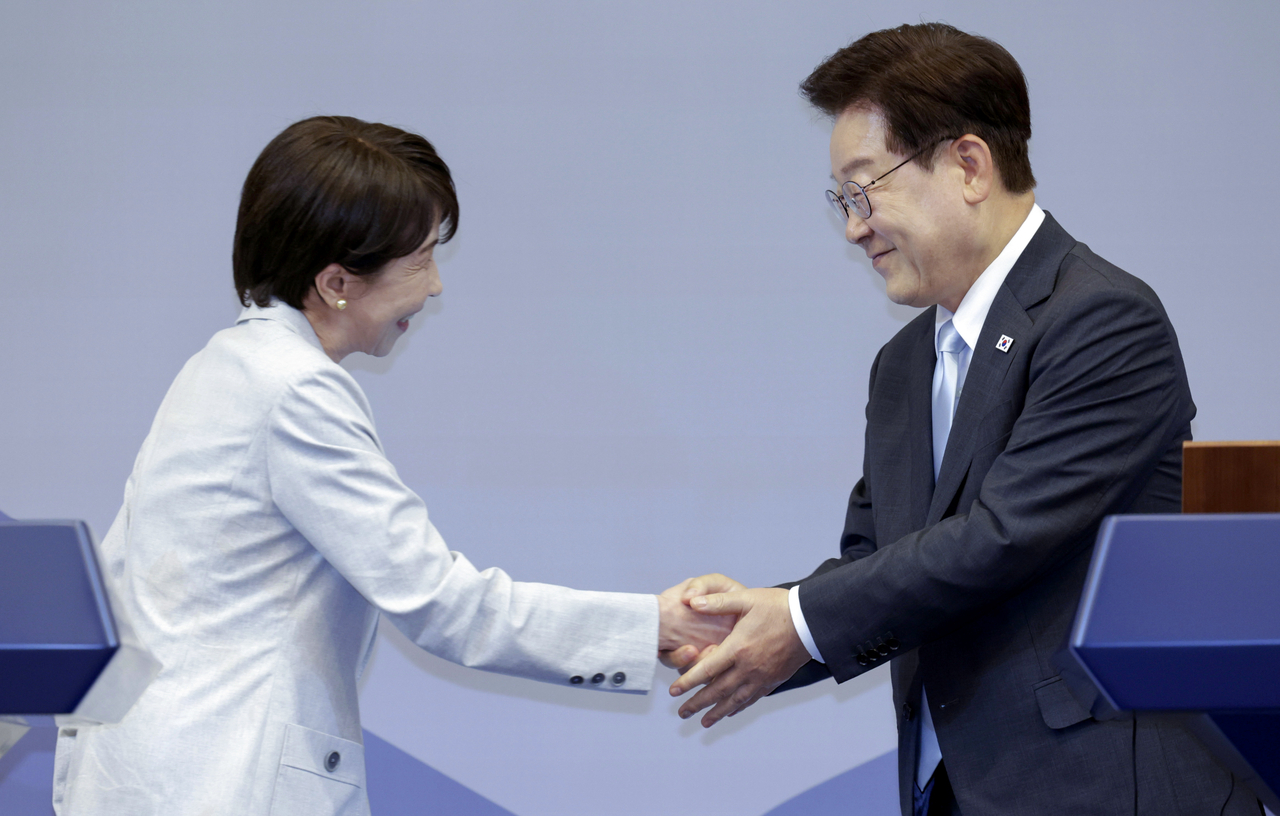
South Korean President Lee Jae Myung and Japanese Prime Minister Sanae Takaichi agreed Tuesday to pursue cooperation on swaps and mutual supplies of crude oil and petroleum products, Cheong Wa Dae said.
The agreement, reached during their summit in Lee’s hometown of Andong, North Gyeongsang Province, expands the two countries’ energy security agenda beyond their existing cooperation on liquefied natural gas swaps.
Lee and Takaichi discussed global issues, including the conflict in the Middle East, supply chains and energy security, during a closed-door small-group meeting attended by key aides, according to senior presidential spokesperson Kang Yu-jung.
“The two leaders agreed to expand cooperation between the two countries to ensure stable supplies of key energy sources, including crude oil and LNG,” Kang said.
“Detailed implementation measures to strengthen LNG supply cooperation and supply chain resilience — including swaps and mutual supply of crude oil and petroleum products, as well as cooperation in crude oil procurement and transportation — will be discussed and announced by the two countries’ industrial authorities,” Kang added.
Energy security and supply chain resilience topped the summit agenda. The effective closure of the Strait of Hormuz — a critical oil shipping route for both South Korea and Japan — continues to weigh on the two energy-import-dependent economies following the joint US-Israel strikes on Iran on Feb. 28.
Kang explained that South Korea’s Ministry of Trade, Industry and Energy and Japan’s Ministry of Economy, Trade and Industry agreed to encourage public-private dialogue on crude oil and petroleum product swaps and mutual supply arrangements following the summit.
Kang added that the two ministries also agreed to advance LNG cooperation built on a memorandum of understanding on the optimization of LNG operations between Korea Gas Corp. and Japan’s JERA, signed in March. The MOU includes LNG swaps and aims to enable joint responses to supply crises while avoiding actions that could disrupt each other’s supply chains.
South Korea and Japan share a similar energy profile. Both operate major petrochemical and refining industries, depend heavily on Middle Eastern crude oil and rank among the world’s largest LNG importers.
That shared vulnerability is reinforced by mutual dependence. Japan was South Korea’s third-largest destination for petroleum product exports last year, accounting for 11.3 percent, according to the Korea Petroleum Association.
During the closed-door meeting, Lee and Takaichi also “exchanged views on how the two countries should respond to and advance cooperation regarding navigation through the Strait of Hormuz,” Kang said.
The two leaders also “shared their assessments of last week’s US-China summit and recent communications with the United States, and agreed to further strengthen strategic coordination amid rapidly shifting global dynamics,” Kang said.
The remarks came after Lee spoke by phone with US President Donald Trump on Sunday. Takaichi held her own call with Trump on May 15, following Trump’s May 14-15 summit with Chinese President Xi Jinping in Beijing.
“They also agreed on the need to continue advancing Korea-Japan and Korea-US-Japan cooperation to promote peace and stability in the region,” Kang added.
In a separate press briefing, Toshihiro Kitamura, press secretary of Japan’s Foreign Ministry, said Tuesday that Lee and Takaichi agreed to promote supply chain cooperation, particularly in the fields of energy and critical minerals.
Kitamura explained the cooperation would be built on two core pillars.
The first is regional cooperation to strengthen energy supply resilience in the Indo-Pacific, including by enhancing energy stockpiles. This will be pursued under Japan’s POWERR Asia initiative — short for Partnership on Wide Energy and Resources Resilience — which Tokyo launched in April.
The initiative aims to strengthen cooperation with Southeast Asian countries in areas such as the construction and shared use of petroleum storage facilities backed by $10 billion in financial support from Japan.
The second pillar is bilateral cooperation between Seoul and Tokyo to strengthen energy security, including exchanges or swap transactions involving crude oil and petroleum-related products.
Kitamura added that the two leaders agreed to launch a policy dialogue on industry and commerce between their two governments, to further “elaborate cooperation in the fields of energy security and critical minerals supply chains.”
dagyumji@heraldcorp.com