Officials consider time-based rules as drivers criticize 30 kph limits that apply around the clock
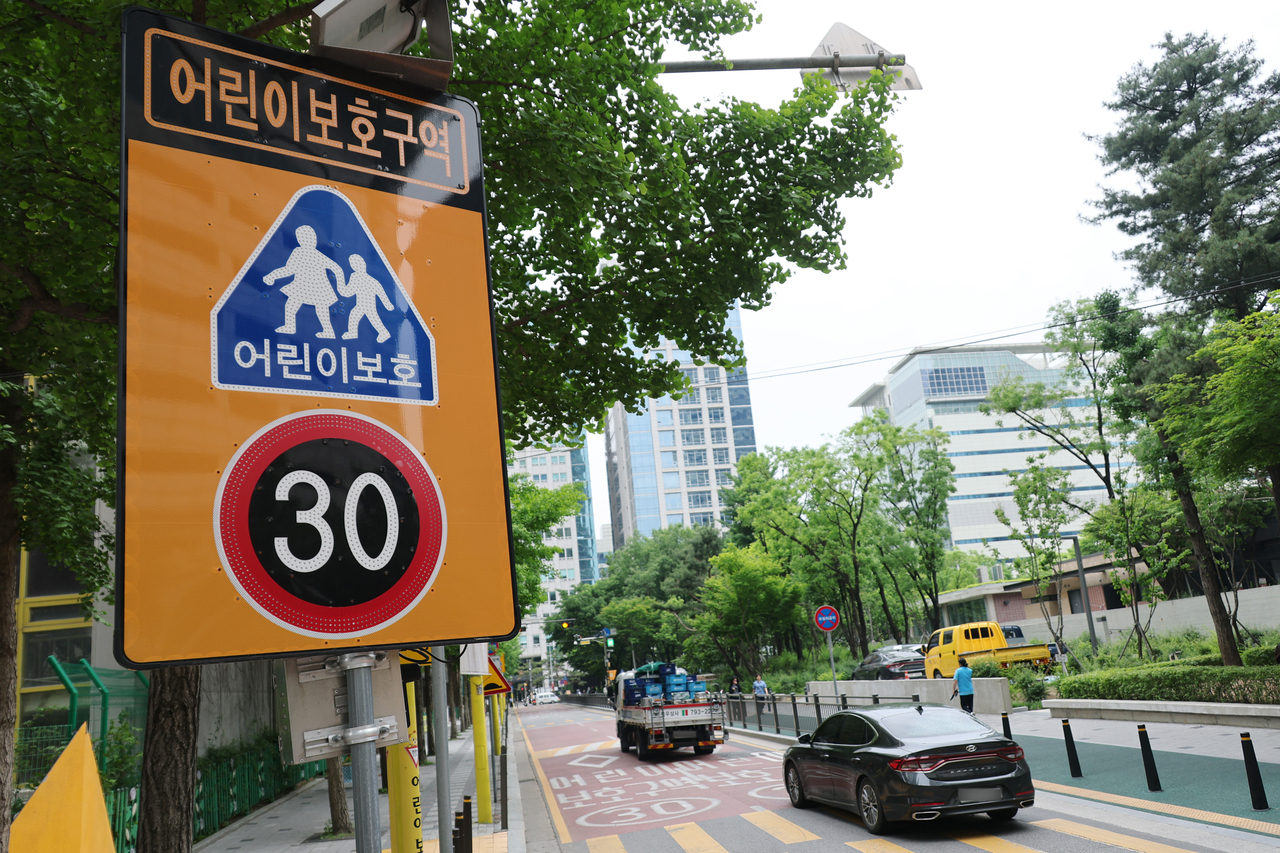
South Korean police are reviewing whether to change speed restrictions in school zones, currently set at 30 kilometers per hour around the clock, amid growing criticism that the limits are unnecessary late at night.
The National Police Agency commissioned the Korea Road Traffic Authority earlier this month to conduct a study on possible reforms to school zone speed regulations. The changes would not require revisions to the Road Traffic Act.
The move came after the government’s recently launched task force asked police to review school zone speed regulations and propose possible reforms.
The task force was launched as an interagency body assigned to review and correct what officials describe as long-standing irrational regulations, administrative practices and loopholes that have become normalized over time.
Under rules introduced in 2011, vehicles entering designated school zones must slow to 30 kph at all hours, including overnight and on public holidays. Enforcement was significantly strengthened in 2020 following the enactment of the so-called “Min-sik Law,” named after a child killed in a traffic accident in a school zone.
The law mandated the installation of speed cameras in school zones and strengthened criminal penalties for drivers involved in accidents that injure or kill children, including possible prison sentences. Fines for traffic violations in school zones are also two to three times higher than those on ordinary roads.
But public criticism has grown over the blanket application of the restrictions, particularly during late-night and early-morning hours when schools are closed and children are rarely present.
Critics, including taxi drivers and overnight delivery workers, have called the policy a one-size-fits-all regulation, saying authorities imposed rigid limits without fully considering actual conditions.
Police officials said discussions have so far focused not on abolishing the limits entirely, but on raising speed limits during night hours or on holidays.
Data from the National Police Agency showed that nearly half of child pedestrian accidents in Seoul school zones over the past three years occurred between 2 p.m. and 6 p.m., when students typically leave school.
In 2023, 41 out of 79 children injured or killed in pedestrian accidents in Seoul school zones were involved in accidents during those hours. The figure was 45 out of 91 in 2024 and 56 out of 115 in 2025.
Police have already partially introduced a time-based system at selected locations since September 2023, allowing speed limits to rise to 40 to 50 kph between 9 p.m. and 7 a.m.
However, the pilot program currently applies to only about 78 of the country’s roughly 16,000 school zones, as each case requires separate approval procedures, consultations with schools and parents, and infrastructure changes such as replacing traffic signs.
Officials said expanding the system nationwide may face opposition from parents and safety advocates because child injuries, though rare, have still occurred out of hours.
Broader changes are therefore likely to require further public consultation before they are implemented, according to authorities.
jychoi@heraldcorp.com