Joy of Strings premieres 'Metamorphosis: Yeongsanhoesang' — ambitious answer to long-standing question about Korean music on Western stages
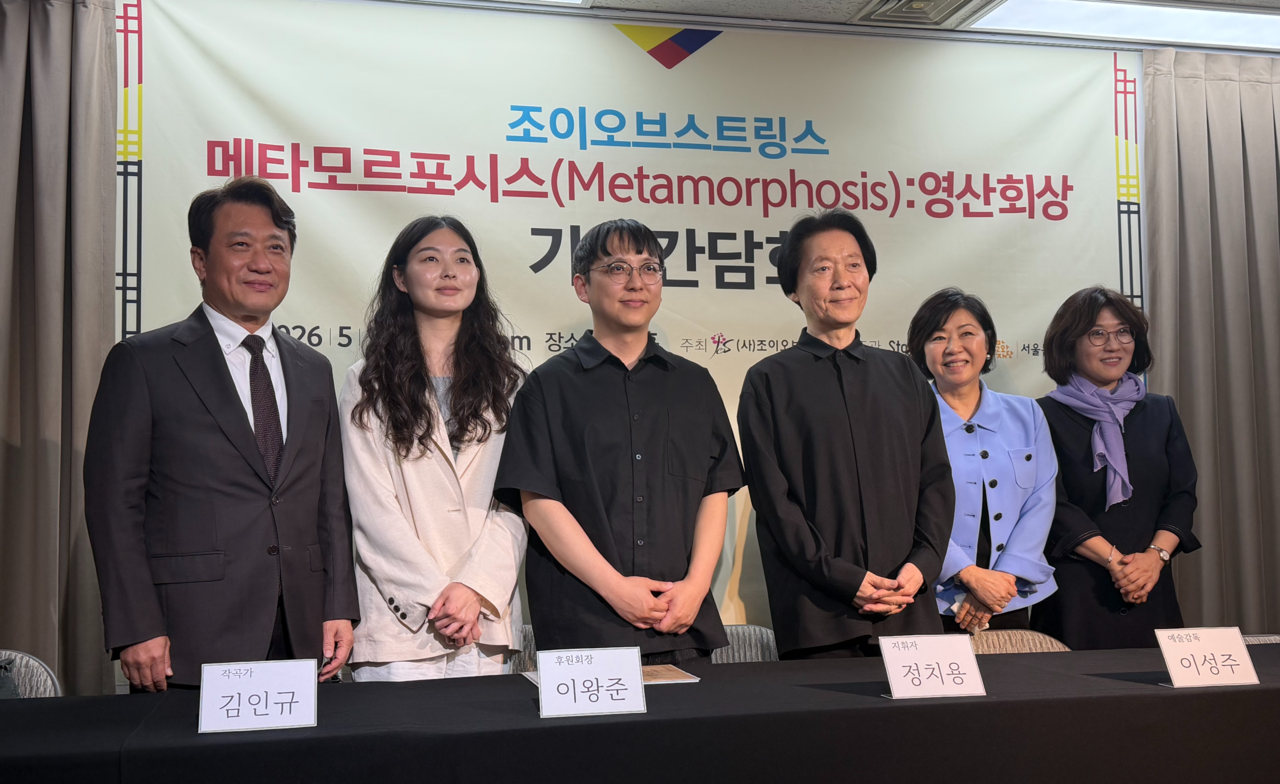
An established conductor, a string ensemble approaching its 30th anniversary led by a renowned violinist and educator and a longtime patron have come together to commission a new work built on a 600-year-old cornerstone of Korean court music.
For the conductor, it is the vindication of decades of advocacy. For the ensemble, it is a mission to define its next 30 years. And for the patron, an answer to a question he has long been asking: What, exactly, is our music?
The new work, titled "Metamorphosis: Yeongsanhoesang," premieres May 26 at the IBK Chamber Hall of the Seoul Arts Center as the centerpiece of an all-Korean program that also includes Kim's "Ganggangsullae" and Kim Jun-ho's violin concerto "Mua."
Composer Kim In-gyu has rebuilt all nine movements of "Yeongsanhoesang" — the most revered work in the Korean court repertoire — into a 40-minute, five-movement piece for a 25-piece Western chamber orchestra. Conductor Chung Chi-yong leads the Joy of Strings, founded in 1997 by violinist Lee Sung-ju. The commission is underwritten by arts patron Lee Wang-jun and supported by the Seoul Foundation for Arts and Culture.
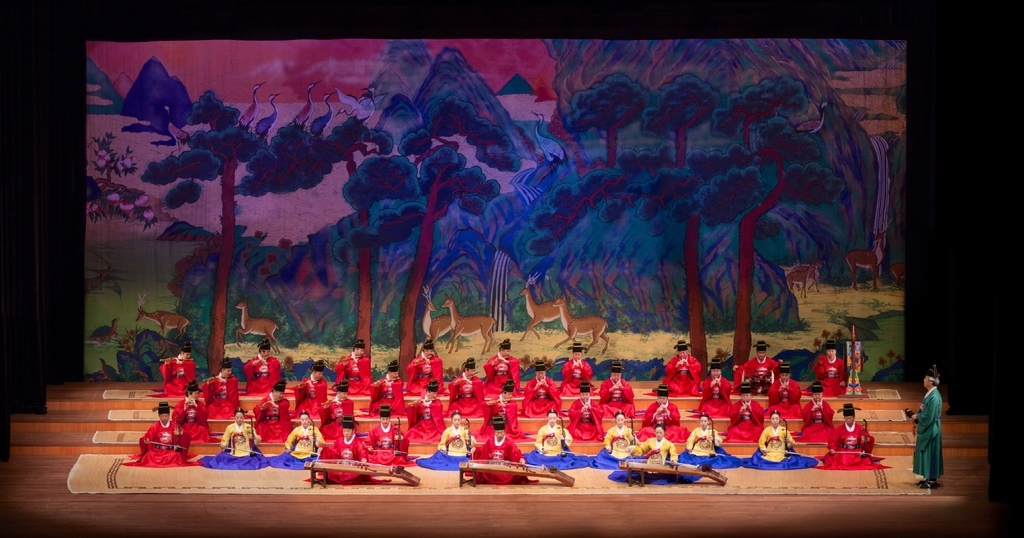
The original "Yeongsanhoesang" is not a single composer's work, but the accumulation of roughly 600 years of tradition. It began as a vocal piece used in early Joseon court rituals and, after the 17th century, transformed into a nine-movement instrumental suite running about 50 minutes, traditionally performed on piri, daegeum, haegeum, gayageum and — most importantly — the geomungo, a six-string zither whose role anchors the entire work.
"Yeongsanhoesang" has rarely been heard outside Korean halls.
When Korean works do appear on Western symphonic programs, they are typically five- or 10-minute pieces placed in the opening slot — gestures, not centerpieces. And until now, no one had produced a complete Western score of the entire suite that orchestras abroad could pick up and play.
"If it isn't written down on staff notation," said Lee Wang-jun, who underwrote the commission, during a press conference on Monday in Seoul, "no orchestra outside Korea can play it. It simply doesn't exist for them."
"Metamorphosis," echoing both Strauss' "Metamorphosen" and the Buddhist arc the work traces, is the first complete attempt at staff notation. Composer Kim In-gyu — who has worked with traditional Korean material for more than a decade but is taking on court repertoire at this scale for the first time — spent six months condensing the suite's nine movements into five, writing original counterpoint, narrative and orchestral textures around the traditional melodic lines.
The result preserves "Yeongsanhoesang" inside a new composition, framed as a Buddhist practitioner's journey. "The early movements are very meditative — a kind of music you stretch out and savor," Kim said. "As it goes on, it moves toward the human joys you find within practice."
For conductor Chung Chi-yong, having to explain this project at a press conference is "slightly disappointing." He has been arguing since the 1980s that Korea needs composers who can elevate its own forms of expression to the level of art music. Chung was one of the first conductors to cross between Korean traditional repertoire and Western symphonic work, and his former students now hold residencies at the National Gugak Center orchestra. He asks audiences to hear "Metamorphosis" as Kim In-gyu's composition rather than as "Yeongsanhoesang."
"If you keep emphasizing the source material," he said, "the composer disappears."
'First generation of genuinely bilingual'
The conditions for this kind of project, music critic Lee So-young contended, have only recently fallen into place. Earlier generations of Korean composers were typically fluent in either Western art music or a traditional Korean repertoire — those from the Western side tended to use traditional material as surface color, while those from the traditional side imposed crude Western harmony in the name of "modernization." Kim In-gyu and Kim Jun-ho, she said, belong to the first generation genuinely bilingual in both.
"This is the first generation that knows both deeply and equally," she said. "That can build a real composition from both."
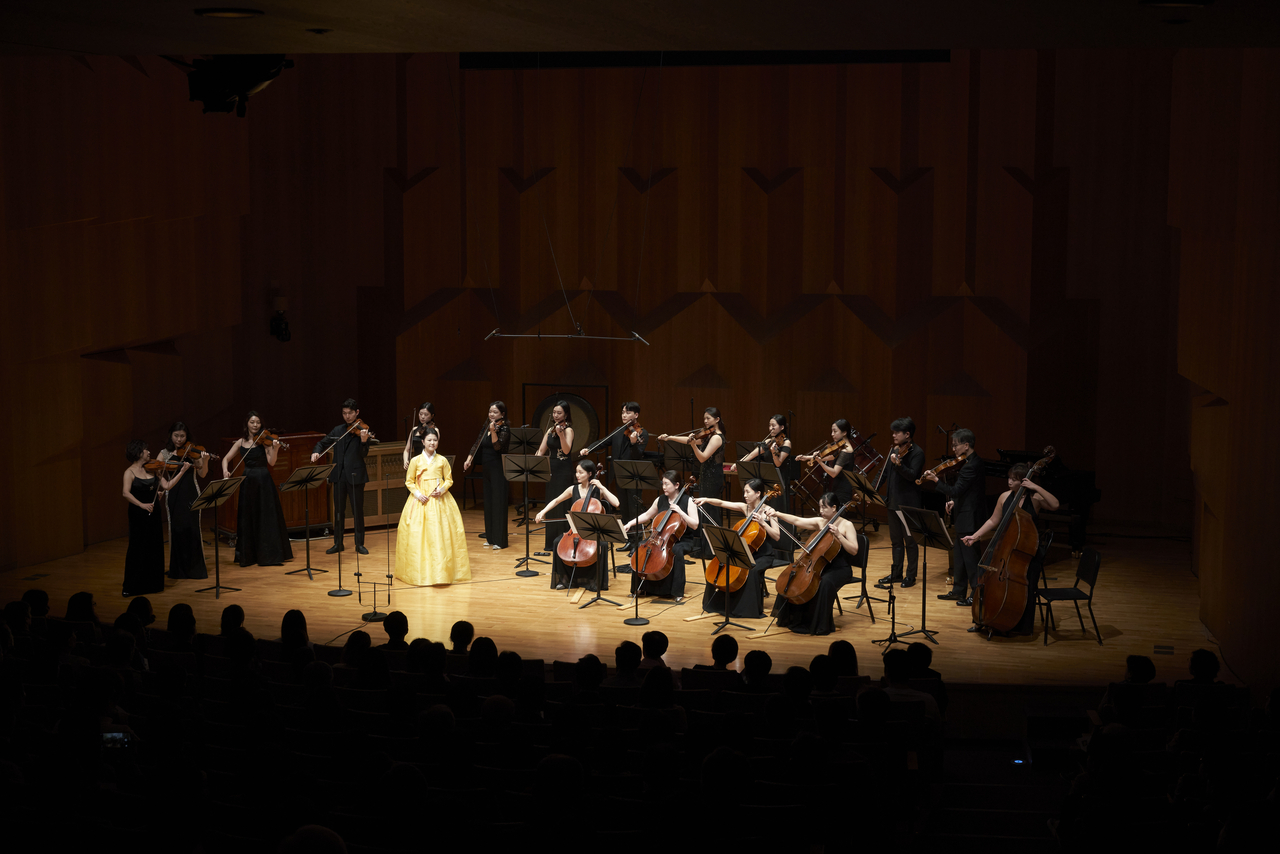
For Joy of Strings and its founder, violinist Lee Sung-ju, the project is the most pointed declaration yet of what the ensemble exists to do. Lee founded it in 1997 after returning from a teaching post abroad and has been quietly commissioning Korean composers ever since: Lee Young-jo's "Honja Nori," now a staple of international competitions, "Arirang Variations for Joy of Strings" and Kim Sung-ki's "Paldo Yuram." "Metamorphosis" is the ensemble's most ambitious commission to date, arriving as Joy of Strings nears its 30th anniversary in 2027.
For arts patron Lee Wang-jun, the question is older and bigger than the concert. Last year, as chairman of the Jeonju International Sori Festival Organizing Committee, he introduced "Simcheong," a pansori production blending Western operatic structure with traditional Korean narrative, to strong reviews.
Korean musicians have been winning international competitions for years, he emphasized, but most of what they play on those stages is not Korean — and the question of what our music actually is has not been seriously answered.
"Yeongsanhoesang," he noted, descends from a lineage of the Tang era (seventh to 10th centuries) lost in China and fossilized in Japan; only in Korea did the form survive as living tradition. To translate it into Western notation now is to make available to the world a music that had nowhere else to go.
The score will be published. The premiere will be filmed and broadcast. Other ensembles, in Korea and abroad, will be able to pick it up.
"If works like these get strong reviews and other ensembles take them up," Lee Wang-jun said, "it will trigger many more such projects."
gypark@heraldcorp.com